Department of Biological Sciences.
Department of Chemical and Biomolecular Engineering, and.
Blood Adv. 2020 Mar 10;4(5):804-814. doi: 10.1182/bloodadvances.2019000753.
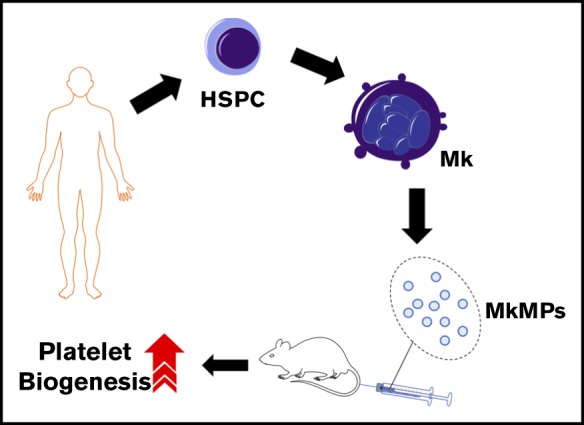
Platelet transfusions are used to treat idiopathic or drug-induced thrombocytopenia. Platelets are an expensive product in limited supply, with limited storage and distribution capabilities because they cannot be frozen. We have demonstrated that, in vitro, human megakaryocytic microparticles (huMkMPs) target human CD34+ hematopoietic stem and progenitor cells (huHSPCs) and induce their Mk differentiation and platelet biogenesis in the absence of thrombopoietin. In this study, we showed that, in vitro, huMkMPs can also target murine HSPCs (muHSPCs) to induce them to differentiate into megakaryocytes in the absence of thrombopoietin. Based on that, using wild-type BALB/c mice, we demonstrated that intravenously administering 2 × 10⁶ huMkMPs triggered de novo murine platelet biogenesis to increase platelet levels up to 49% 16 hours after administration. huMkMPs also largely rescued low platelet levels in mice with induced thrombocytopenia 16 hours after administration by increasing platelet counts by 51%, compared with platelet counts in thrombocytopenic mice. Normalized on a tissue-mass basis, biodistribution experiments show that MkMPs localized largely to the bone marrow, lungs, and liver 24 hours after huMkMP administration. Beyond the bone marrow, CD41+ (megakaryocytes and Mk-progenitor) cells were frequent in lungs, spleen, and especially, liver. In the liver, infused huMKMPs colocalized with Mk progenitors and muHSPCs, thus suggesting that huMkMPs interact with muHSPCs in vivo to induce platelet biogenesis. Our data demonstrate the potential of huMkMPs, which can be stored frozen, to treat thrombocytopenias and serve as effective carriers for in vivo, target-specific cargo delivery to HSPCs.
血小板输注用于治疗特发性或药物诱导的血小板减少症。血小板是一种昂贵的产品,供应有限,储存和分发能力有限,因为它们不能冷冻。我们已经证明,在体外,人类巨核细胞微颗粒(huMkMPs)可以靶向人类 CD34+造血干细胞和祖细胞(huHSPCs),并在没有血小板生成素的情况下诱导其 Mk 分化和血小板生成。在这项研究中,我们表明,在体外,huMkMPs 也可以靶向小鼠 HSPCs(muHSPCs),在没有血小板生成素的情况下诱导它们分化为巨核细胞。基于此,使用野生型 BALB/c 小鼠,我们证明静脉注射 2×10⁶ huMkMPs 可触发新的小鼠血小板生成,使血小板水平在给药后 16 小时增加 49%。huMkMPs 还通过使血小板计数增加 51%,在给药后 16 小时大大挽救了诱导性血小板减少症小鼠的低血小板水平,与血小板减少症小鼠的血小板计数相比。在组织质量基础上归一化,生物分布实验表明,huMkMP 给药后 24 小时,MkMPs 主要定位于骨髓、肺和肝脏。除了骨髓,CD41+(巨核细胞和 Mk 祖细胞)细胞在肺、脾中很常见,尤其是在肝脏中。在肝脏中,输注的 huMKMPs 与 Mk 祖细胞和 muHSPCs 共定位,因此表明 huMkMPs 在体内与 muHSPCs 相互作用诱导血小板生成。我们的数据证明了 huMkMPs 的潜力,它们可以冷冻储存,用于治疗血小板减少症,并作为体内有效载体,用于向 HSPCs 特异性输送货物。