Department of Maternal and Child Health, School of Public Health, Sun Yat-sen University, Guangzhou 510080, China.
School of Public Health, Li Ka Shing Faculty of Medicine, The University of Hong Kong, Hong Kong, China.
Int J Environ Res Public Health. 2020 Mar 2;17(5):1599. doi: 10.3390/ijerph17051599.
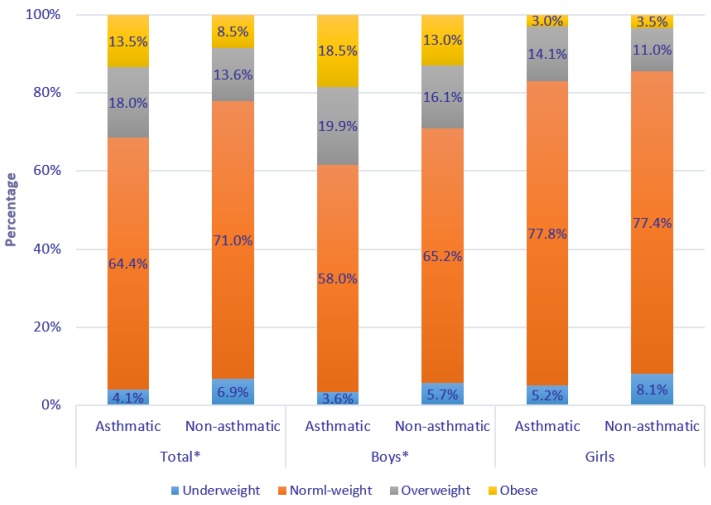
Childhood asthma and obesity have posed a parallel epidemic over the past few decades. However, whether asthma diagnosis is associated with obesity, and what the roles of lifestyle factors play in this relationship, remained unclarified. This study aimed to investigate the association between asthma and weight status in Chinese children and explore the potential mediating and/or modifying roles of lifestyle factors in the association. In this cross-sectional study, 16,837 children aged 6-12 years were recruited from Guangzhou, China. Participants' information on physician-diagnosed asthma was collected from parents, and data on physical activity, screen time, and sleeping were reported in a validated questionnaire. Height and weight were objectively measured, and weight status was classified by body mass index (BMI). Multiple logistic regression analysis and mediation analysis were used. Results showed that asthmatic children were at significantly higher risk of obesity (odds ratio () 1.51, 95% confidence interval () 1.03, 2.21) compared with non-asthmatic children. More importantly, this increased risk was even greater in children with moderate-to-vigorous physical activity <60 min/d and children with screen time >2 h/d (both < 0.05). Also, a positive relationship of asthma with overweight was found in children with screen time >2 h/d ( 3.92, 95% 1.56, 9.88), while a negative association was observed between asthma and underweight in children aged 9-12 years ( 0.23, 95% 0.06, 0.92). Mediation analysis indicated that these associations were not mediated by physical activity, screen time, or sleeping. The findings suggested that physician-diagnosed asthma was associated with higher risks of overweight and obesity, and these risks might be exacerbated by insufficient physical activity and prolonged screen time.
儿童哮喘和肥胖症在过去几十年中呈平行流行态势。然而,哮喘诊断是否与肥胖有关,以及生活方式因素在这种关系中扮演何种角色,仍不清楚。本研究旨在调查中国儿童哮喘与体重状况之间的关联,并探讨生活方式因素在这种关联中的潜在中介和/或调节作用。在这项横断面研究中,共招募了来自中国广州的 16837 名 6-12 岁儿童。父母报告了儿童哮喘的医生诊断信息,参与者填写了一份经过验证的问卷,报告了体育活动、屏幕时间和睡眠等方面的数据。通过客观测量身高和体重,按照体重指数(BMI)对体重状况进行分类。采用多因素逻辑回归分析和中介分析。结果显示,与非哮喘儿童相比,哮喘儿童肥胖的风险显著增加(比值比 [OR] 1.51,95%置信区间 [CI] 1.03-2.21)。更重要的是,对于中度到剧烈体力活动<60 分钟/天和屏幕时间>2 小时/天的儿童,这种风险增加更为显著(均<0.05)。此外,在屏幕时间>2 小时/天的儿童中,哮喘与超重呈正相关(OR 3.92,95%CI 1.56-9.88),而在 9-12 岁儿童中,哮喘与体重不足呈负相关(OR 0.23,95%CI 0.06-0.92)。中介分析表明,这些关联不受体力活动、屏幕时间或睡眠的影响。这些发现表明,医生诊断的哮喘与超重和肥胖的风险增加有关,而这些风险可能会因体力活动不足和屏幕时间延长而加剧。