Queen's University, Kingston Health Sciences Center, Department of Ophthalmology, 166 Brock Street, Kingston, Ontario, K7L 5G2, Canada.
Sci Rep. 2020 Mar 2;10(1):3862. doi: 10.1038/s41598-020-60674-3.
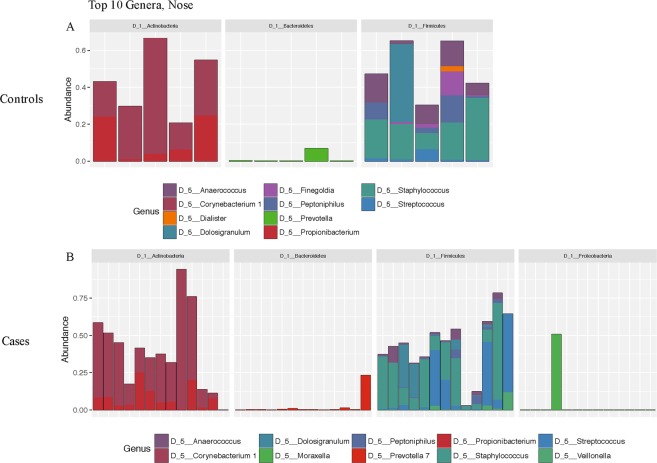
Age-related macular degeneration (AMD) is a chronic degenerative disease of the retina. Recent reports have highlighted the potential role of mucosal surface microbes in the pathogenesis of AMD. In this case-control study, the composition of the nasal and oral microbiota in newly diagnosed neovascular age-related macular degeneration cases (6 male, 7 female) was compared to controls without retinal diseases (2 male, 3 female). PCR amplification of 16S rRNA genes was performed with universal primers amplifying the V4 variable region (515F-806R). Distinct microbial community characterization was achieved using Principal Coordinates Analysis (PCoA) of the Bray-Curtis index with comparative analysis between cases and controls performed within QIIME 2. Sequencing of all cases and controls revealed clear separation with strong beta diversity between oral and nasal microbial communities (p < 0.001). Microbial composition differed between cases and controls in both oral and nasal samples. The top three oral microbes identified as different compared to controls included Burkholderiales (7.41 log2fold change, p = 3.29E-05), Actinomyceataceae (6.22 log2fold change, p = 3.73E-06) and Gemella (5.28 log2fold change, p = 0.0002). The top three nasal microbes identified as different compared to controls included Rothia (13.6 log2fold change, p = 3.63E-18), Actinobacteria (10.29 log2fold change, p = 9.81E-10) and Propionibacteriales (8.73 log2fold change, p = 6.74E-09). These relative shifts in communities of bacteria detected in newly diagnosed neovascular AMD patients may suggest additional mechanistic links in disease pathogenesis.
年龄相关性黄斑变性(AMD)是一种视网膜的慢性退行性疾病。最近的报告强调了黏膜表面微生物在 AMD 发病机制中的潜在作用。在这项病例对照研究中,比较了新诊断的新生血管性年龄相关性黄斑变性病例(6 男,7 女)和无视网膜疾病的对照组(2 男,3 女)的鼻腔和口腔微生物群落组成。使用通用引物扩增 16S rRNA 基因,扩增 V4 可变区(515F-806R)。使用 QIIME 2 内的对比分析,对 Bray-Curtis 指数进行主坐标分析(PCoA),实现了对微生物群落的独特特征描述。所有病例和对照的测序结果显示,口腔和鼻腔微生物群落之间存在明显的分离,具有很强的 beta 多样性(p < 0.001)。病例和对照组的口腔和鼻腔样本中的微生物组成不同。与对照组相比,口腔中差异最大的三种微生物包括伯克霍尔德氏菌(7.41 log2fold change,p = 3.29E-05)、放线菌科(6.22 log2fold change,p = 3.73E-06)和真杆菌(5.28 log2fold change,p = 0.0002)。与对照组相比,鼻腔中差异最大的三种微生物包括罗特氏菌(13.6 log2fold change,p = 3.63E-18)、放线菌(10.29 log2fold change,p = 9.81E-10)和丙酸杆菌(8.73 log2fold change,p = 6.74E-09)。这些在新诊断的新生血管性 AMD 患者中检测到的细菌群落的相对变化可能提示了疾病发病机制中的额外机制联系。