Center for Molecular Medicine and Center for Translational Research, Maine Medical Center Research Institute, 81 Research Drive, Scarborough, ME, 04074, USA.
University of Maine Graduate School of Biomedical Science and Engineering, Orono, ME, USA.
Curr Osteoporos Rep. 2020 Apr;18(2):85-94. doi: 10.1007/s11914-020-00569-4.
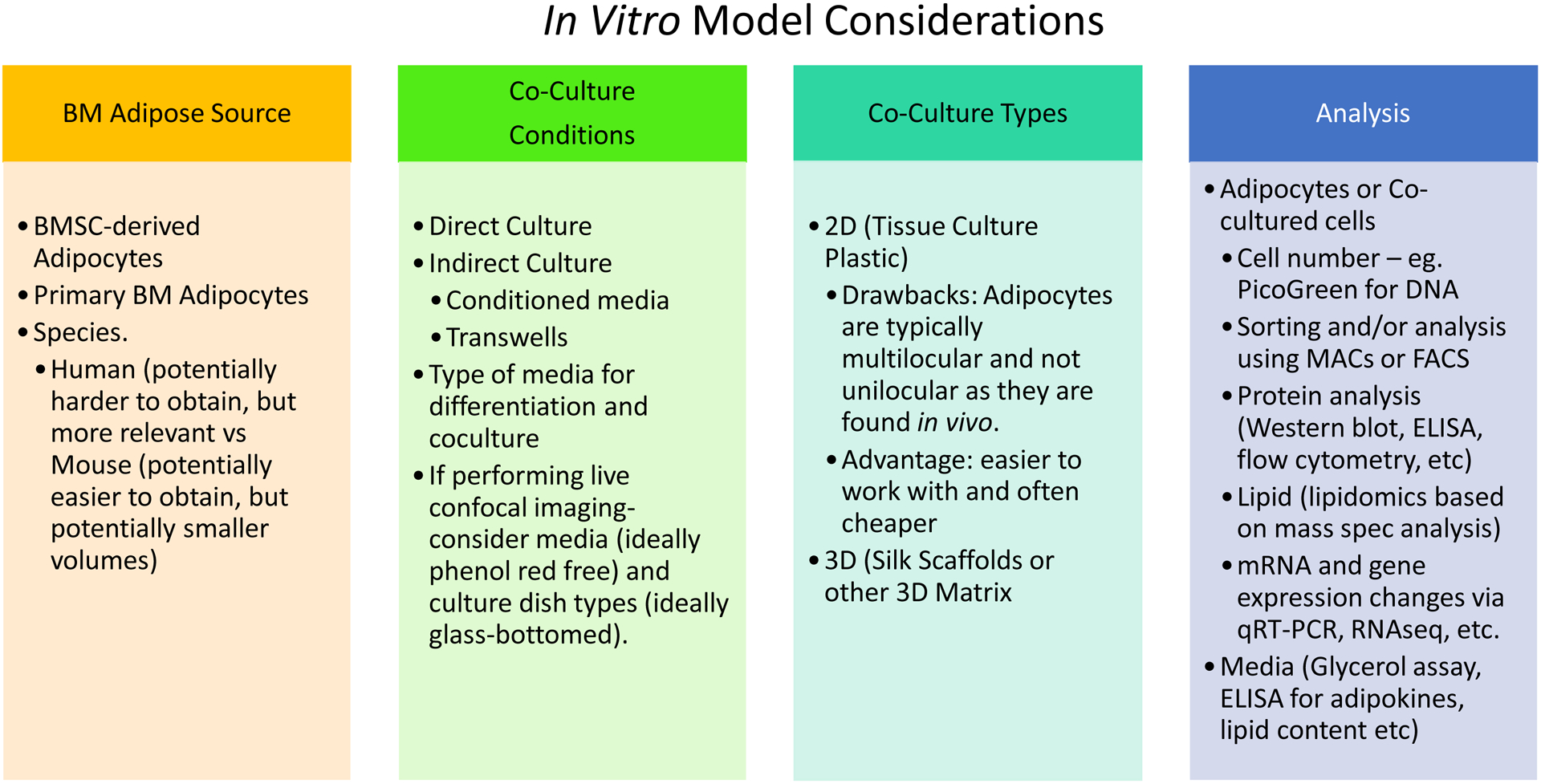
The purpose of this review is to describe the in vitro and in vivo methods that researchers use to model and investigate bone marrow adipocytes (BMAds).
The bone marrow (BM) niche is one of the most interesting and dynamic tissues of the human body. Relatively little is understood about BMAds, perhaps in part because these cells do not easily survive flow cytometry and histology processing and hence have been overlooked. Recently, researchers have developed in vitro and in vivo models to study normal function and dysfunction in the BM niche. Using these models, scientists and clinicians have noticed that BMAds, which form bone marrow adipose tissue (BMAT), are able to respond to numerous signals and stimuli, and communicate with local cells and distant tissues in the body. This review provides an overview of how BMAds are modeled and studied in vitro and in vivo.
本篇综述旨在描述研究人员用于模拟和研究骨髓脂肪细胞 (BMAds) 的体外和体内方法。
骨髓 (BM) 龛位是人体最有趣和最具活力的组织之一。人们对 BMAds 的了解相对较少,部分原因可能是这些细胞在流式细胞术和组织学处理过程中不易存活,因此被忽视了。最近,研究人员已经开发出体外和体内模型来研究 BM 龛位的正常功能和功能障碍。使用这些模型,科学家和临床医生注意到形成骨髓脂肪组织 (BMAT) 的 BMAds 能够对众多信号和刺激做出反应,并与体内的局部细胞和远处组织进行通信。本综述概述了如何在体外和体内对 BMAds 进行建模和研究。