Barnard-Kelly Katharine D, Cherñavvsky Daniel
Faculty of Health and Social Science, Bournemouth University, Bournemouth, UK.
Dexcom, Inc, San Diego, CA, USA.
Diabetes Ther. 2020 Apr;11(4):803-811. doi: 10.1007/s13300-020-00791-4. Epub 2020 Mar 2.
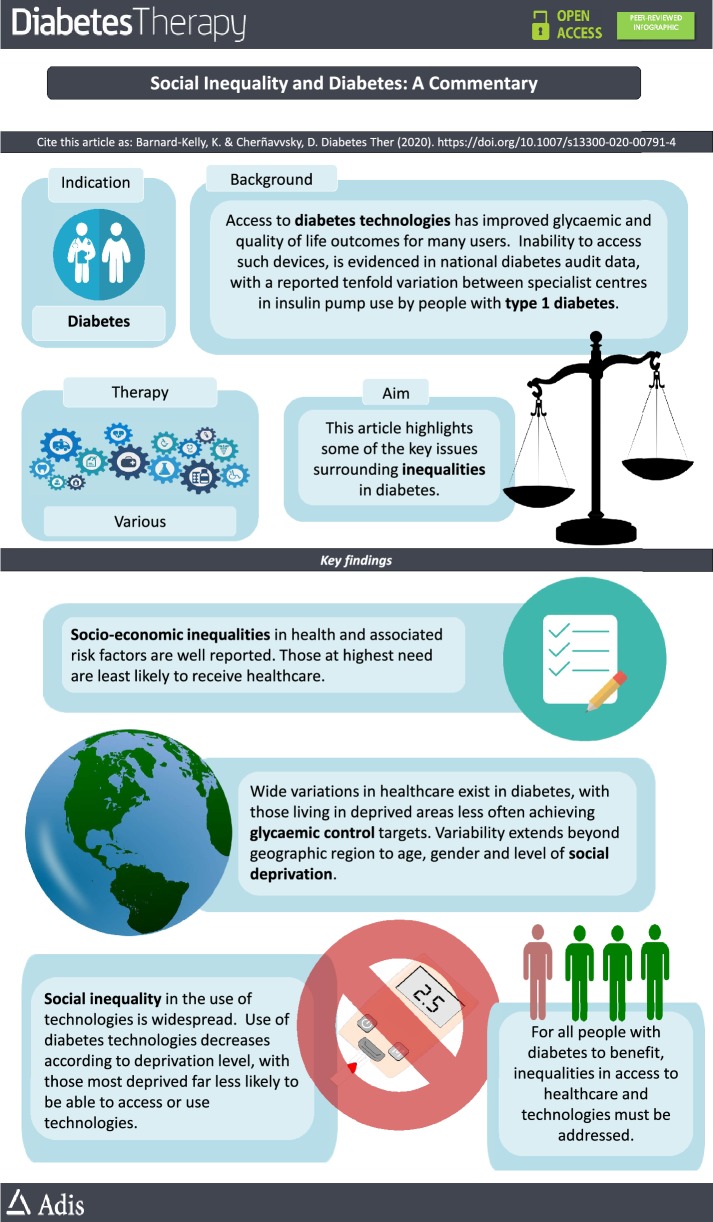
Socioeconomic inequality of access to healthcare is seen across the spectrum of healthcare, including diabetes. Health inequalities are defined as the 'preventable, unfair and unjust differences in health status between groups, populations or individuals that arise from the unequal distribution of social, environmental and economic conditions within societies, which determine the risk of people getting ill, their ability to prevent sickness or opportunities to take action and access treatment when ill health occurs' (NHS England; https://www.england.nhs.uk/about/equality/equality-hub/resources/). Access to diabetes technologies has improved glycaemic and quality-of-life outcomes for many users. Inability to access such devices, however, is evidenced in National Diabetes Audit data, with a reported tenfold variation in insulin pump use by people with type 1 diabetes across specialist centres. This variation suggests a lack of access to healthcare systems that should be investigated. This article highlights some of the key issues surrounding healthcare inequalities in the management of diabetes.
在包括糖尿病在内的整个医疗保健领域,都存在获得医疗保健服务方面的社会经济不平等现象。健康不平等被定义为“群体、人群或个体之间在健康状况上可预防、不公平和不公正的差异,这些差异源于社会内部社会、环境和经济条件的不平等分配,而这些条件决定了人们患病的风险、预防疾病的能力、患病时采取行动和获得治疗的机会”(英国国民健康服务体系;https://www.england.nhs.uk/about/equality/equality-hub/resources/)。对于许多使用者来说,获得糖尿病技术改善了血糖水平和生活质量。然而,国家糖尿病审计数据显示,无法获得此类设备的情况存在,据报道,1型糖尿病患者在各专科中心使用胰岛素泵的情况相差十倍。这种差异表明存在获得医疗保健系统的机会不足问题,值得进行调查。本文重点介绍了糖尿病管理中围绕医疗保健不平等的一些关键问题。