Department of Internal Medicine II (Cardiology, Pneumology, and Intensive Care), University Medical Centre Regensburg, Regensburg, Germany.
Medical Faculty, University of Novi Sad, Novi Sad, Serbia and Institute of cardiovascular diseases of Vojvodina, Sremska Kamenica, Serbia.
Clin Cardiol. 2020 May;43(5):430-440. doi: 10.1002/clc.23346. Epub 2020 Mar 3.
Hypertrophic cardiomyopathy (HCM) is the most common genetic cardiovascular disease with a broad spectrum of disease severity. HCM ranges from a benign course to a progressive disorder characterized by angina, heart failure, malignant arrhythmia, syncope, or sudden cardiac death. So far, no medical treatment has reliably shown to halt or reverse progression of HCM or to alleviate its symptoms. While the angiotensin receptor neprilysin inhibitor sacubitril/valsartan has shown to reduce mortality and hospitalization in heart failure with reduced ejection fraction, data on its effect on HCM are sparse.
A 4-month pharmacological (sacubitril/valsartan) or lifestyle intervention will significantly improve exercise tolerance (ie, peak oxygen consumption) in patients with nonobstructive HCM compared to the optimal standard therapy (control group).
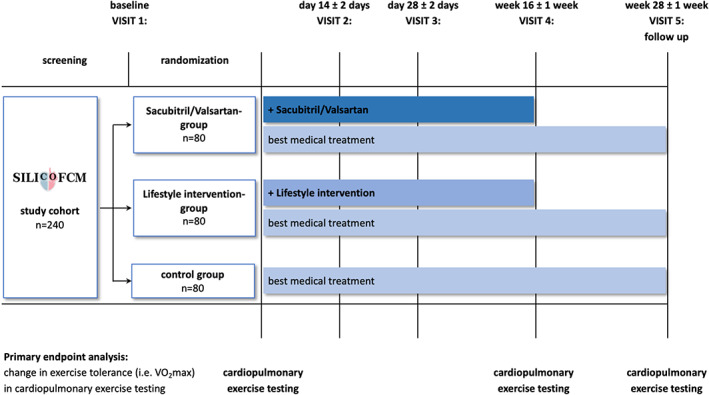
SILICOFCM is a prospective, multicenter, open-label, randomized, controlled, three-arm clinical trial (NCT03832660) that will recruit 240 adult patients with a confirmed diagnosis of nonobstructive HCM. Eligible patients are randomized to sacubitril/valsartan, lifestyle intervention (physical activity and dietary supplementation with inorganic nitrate), or optimal standard therapy alone (control group). The primary endpoint is the change in functional capacity (ie, peak oxygen consumption). Secondary endpoints include: (a) Change in cardiac structure and function as assessed by transthoracic echocardiography and cardiac magnetic resonance (MRI imaging), (b) change in biomarkers (ie, CK, CKMB, and NT-proBNP), (c) physical activity, and (d) quality of life.
Until December 2019, a total of 41 patients were recruited into the ongoing SILICOFCM study and were allocated to the study groups and the control group. There was no significant difference in key baseline characteristics between the three groups.
The SILICOFCM study will provide novel evidence about the effect of sacubitril/valsartan or lifestyle intervention on functional capacity, clinical phenotype, injury and stretch activation markers, physical activity, and quality of life in patients with nonobstructive HCM.
肥厚型心肌病(HCM)是最常见的遗传性心血管疾病,其疾病严重程度范围广泛。HCM 从轻症到进展性疾病不等,其特征包括心绞痛、心力衰竭、恶性心律失常、晕厥或心源性猝死。到目前为止,还没有任何医学治疗方法能够可靠地阻止或逆转 HCM 的进展或减轻其症状。虽然血管紧张素受体脑啡肽酶抑制剂沙库巴曲缬沙坦已被证明可降低射血分数降低的心力衰竭患者的死亡率和住院率,但关于其对 HCM 影响的数据尚少。
与最佳标准治疗(对照组)相比,为期 4 个月的药物治疗(沙库巴曲缬沙坦)或生活方式干预将显著改善非梗阻性 HCM 患者的运动耐量(即峰值耗氧量)。
SILICOFCM 是一项前瞻性、多中心、开放标签、随机、对照、三臂临床试验(NCT03832660),将招募 240 名确诊为非梗阻性 HCM 的成年患者。符合条件的患者被随机分配至沙库巴曲缬沙坦组、生活方式干预组(体力活动和无机硝酸盐饮食补充)或单纯最佳标准治疗组(对照组)。主要终点是功能能力的变化(即峰值耗氧量)。次要终点包括:(a)经胸超声心动图和心脏磁共振(MRI 成像)评估的心脏结构和功能变化,(b)生物标志物的变化(即 CK、CKMB 和 NT-proBNP),(c)体力活动,和(d)生活质量。
截至 2019 年 12 月,SILICOFCM 研究共招募了 41 名患者,并将其分配至研究组和对照组。三组间的关键基线特征无显著差异。
SILICOFCM 研究将提供关于沙库巴曲缬沙坦或生活方式干预对非梗阻性 HCM 患者功能能力、临床表型、损伤和伸展激活标志物、体力活动和生活质量的影响的新证据。