Marrotte Robby R, Bowman Jeff, Wilson Paul J
Environmental & Life Sciences Graduate Program Trent University Peterborough ON Canada.
Wildlife Research & Monitoring Section Ontario Ministry of Natural Resources & Forestry Peterborough ON Canada.
Ecol Evol. 2020 Jan 28;10(4):2131-2144. doi: 10.1002/ece3.6049. eCollection 2020 Feb.
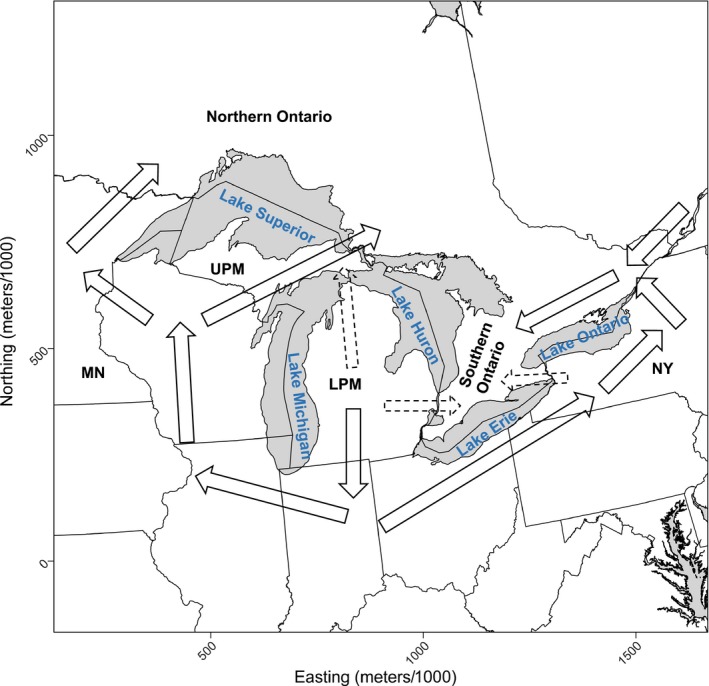
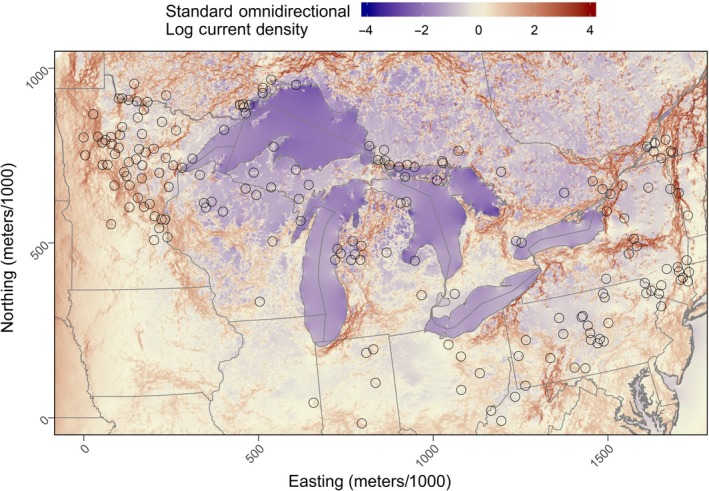
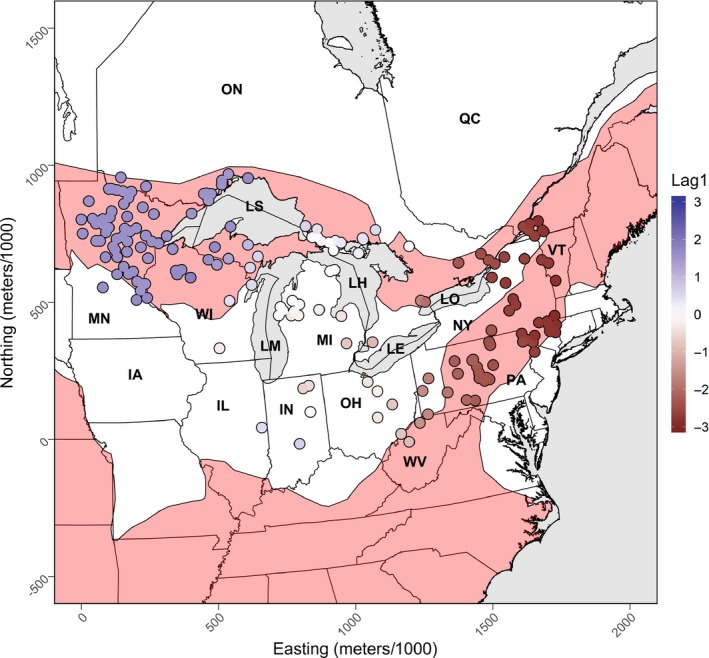
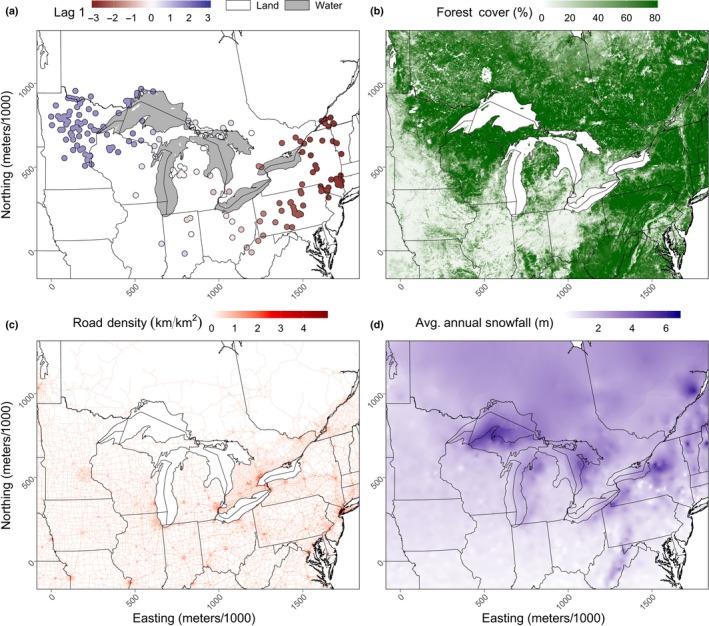
The Great Lakes and the St. Lawrence River are imposing barriers for wildlife, and the additive effect of urban and agricultural development that dominates the lower Great Lakes region likely further reduces functional connectivity for many terrestrial species. As the climate warms, species will need to track climate across these barriers. It is important therefore to investigate land cover and bioclimatic hypotheses that may explain the northward expansion of species through the Great Lakes. We investigated the functional connectivity of a vagile generalist, the bobcat, as a representative generalist forest species common to the region. We genotyped tissue samples collected across the region at 14 microsatellite loci and compared different landscape hypotheses that might explain the observed gene flow or functional connectivity. We found that the Great Lakes and the additive influence of forest stands with either low or high canopy cover and deep lake-effect snow have disrupted gene flow, whereas intermediate forest cover has facilitated gene flow. Functional connectivity in southern Ontario is relatively low and was limited in part by the low amount of forest cover. Pathways across the Great Lakes were through the Niagara region and through the Lower Peninsula of Michigan over the Straits of Mackinac and the St. Marys River. These pathways are important routes for bobcat range expansion north of the Great Lakes and are also likely pathways that many other mobile habitat generalists must navigate to track the changing climate. The extent to which species can navigate these routes will be important for determining the future biodiversity of areas north of the Great Lakes.
五大湖和圣劳伦斯河对野生动物来说是巨大的障碍,而主导五大湖下游地区的城市和农业发展的叠加效应可能会进一步降低许多陆地物种的功能连通性。随着气候变暖,物种将需要跨越这些障碍追踪气候。因此,研究可能解释物种通过五大湖向北扩张的土地覆盖和生物气候假说很重要。我们研究了一种易迁徙的泛化种——短尾猫的功能连通性,它是该地区常见的代表性泛化种森林物种。我们对在该地区采集的组织样本在14个微卫星位点进行了基因分型,并比较了可能解释观察到的基因流动或功能连通性的不同景观假说。我们发现,五大湖以及低冠层或高冠层覆盖的林分和深厚的湖泊效应降雪的叠加影响扰乱了基因流动,而中等森林覆盖则促进了基因流动。安大略省南部的功能连通性相对较低,部分原因是森林覆盖面积较少。穿越五大湖的路径是通过尼亚加拉地区以及穿过密歇根下半岛的麦基诺海峡和圣玛丽斯河。这些路径是短尾猫在五大湖以北范围扩张的重要路线,也可能是许多其他流动栖息地泛化种为追踪气候变化而必须穿越的路径。物种能够穿越这些路线的程度对于确定五大湖以北地区未来的生物多样性至关重要。