Fundação Oswaldo Cruz, Laboratório de Imunologia Celular Aplicada à Saúde, Porto Velho, RO, Brasil.
Agência Estadual de Vigilância em Saúde, Coordenação Estadual de Acidentes por Animais Peçonhentos, Porto Velho, RO, Brasil.
Rev Soc Bras Med Trop. 2020 Feb 21;53:e20190377. doi: 10.1590/0037-8682-0377-2019. eCollection 2020.
Snakebites represent a serious global public health problem, especially in tropical countries. In Brazil, the incidence of snakebites ranges from 19 to 22 thousand cases per 100000 persons annually. The state of Rondônia, in particular, has had an increasing incidence of snakebites.
A retrospective cross-sectional study on snakebites was conducted from January 2007 to December 2018. Brazil's Information System for Notifiable Diseases was queried for all snakebites reported in Porto Velho, Ariquemes, Cacoal, and Vilhena. Data on land surface temperatures during the day and night, precipitation, and humidity were obtained using the Google Earth Engine. A Bayesian time series model was constructed to describe the pattern of snakebites and their relationship with climate data.
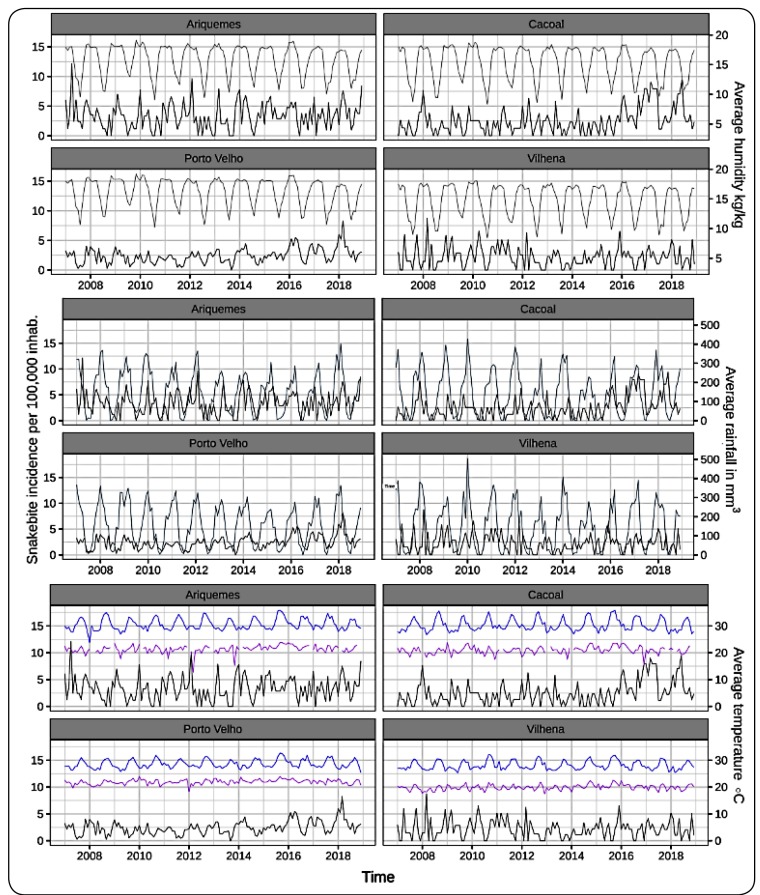
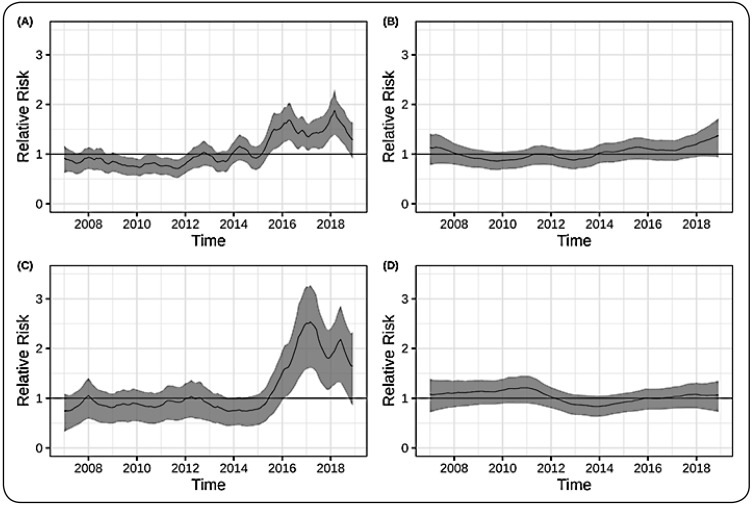
In total, 6326 snakebites were reported in Rondônia. Accidents were commonly caused by Bothrops sp. (n=2171, 81.80%). Snakebites most frequently occurred in rural areas (n=2271, 85.5%). Men, with a median age of 34 years (n=2101, 79.1%), were the most frequent bitten. Moderate clinical manifestation was the most common outcome of an accident (n=1101, 41.50%). There were clear seasonal patterns with respect to rainfall, humidity, and temperature. Rainfall and land surface temperature during the day or night did not increase the risk of snakebites in any city; however, changes in humidity increased the risk of snakebites in all cities.
This study identified the population exposed to snakes and the influence of anthropic and climatic factors on the incidence of snakebites. According to climate data, changes in humidity increased the risk of snakebites.
蛇咬伤是一个严重的全球公共卫生问题,尤其是在热带国家。在巴西,每年每 10 万人中有 19 到 22000 例蛇咬伤病例。特别是朗多尼亚州,蛇咬伤的发病率一直在上升。
对 2007 年 1 月至 2018 年 12 月期间发生的蛇咬伤进行了回顾性横断面研究。对波多韦柳、阿里奎姆、卡科阿和维莱纳报告的所有蛇咬伤病例进行了巴西传染病报告信息系统查询。使用谷歌地球引擎获取白天和夜间的地表温度、降水和湿度数据。构建了贝叶斯时间序列模型,以描述蛇咬伤的模式及其与气候数据的关系。
在朗多尼亚州共报告了 6326 例蛇咬伤。事故通常由 Bothrops sp.(n=2171,81.80%)引起。蛇咬伤最常发生在农村地区(n=2271,85.5%)。男性(n=2101,79.1%)最常被咬伤,中位年龄为 34 岁。中等临床症状是最常见的(n=1101,41.50%)。在所有城市中,降水、湿度和温度都存在明显的季节性模式。降雨和白天或夜间的地表温度均未增加任何城市的蛇咬伤风险;然而,湿度的变化增加了所有城市的蛇咬伤风险。
本研究确定了暴露于蛇类的人群以及人为和气候因素对蛇咬伤发病率的影响。根据气候数据,湿度的变化增加了蛇咬伤的风险。