Liesner Marvin, Kirsch Wladimir, Pfister Roland, Kunde Wilfried
Department of Psychology, University of Würzburg, Würzburg, Germany.
Atten Percept Psychophys. 2020 Jul;82(5):2531-2543. doi: 10.3758/s13414-020-02013-2.
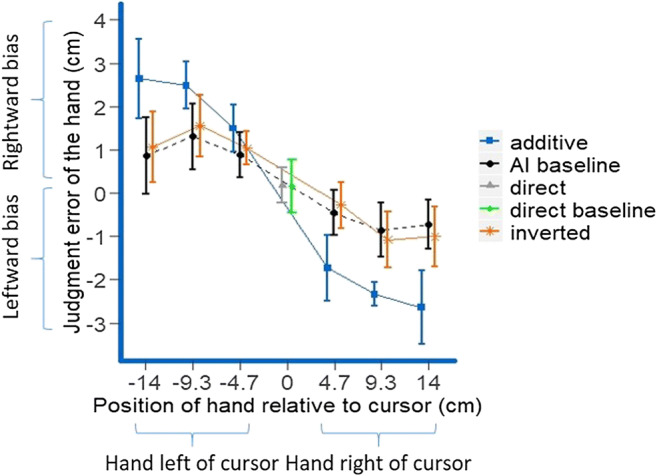
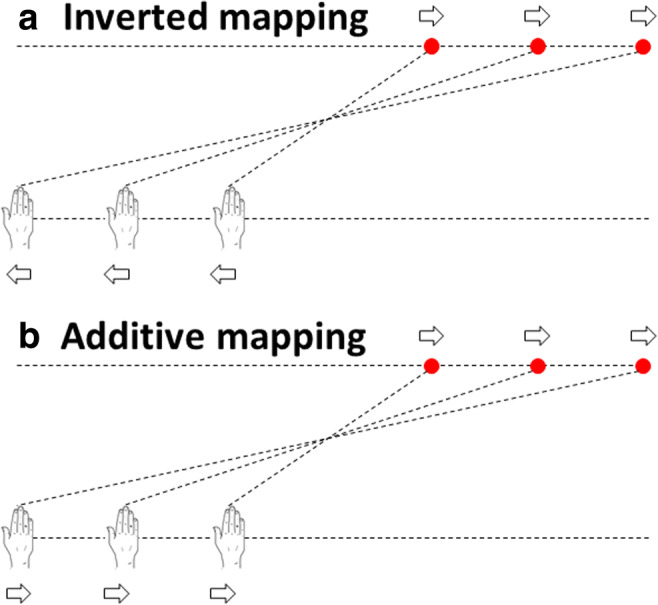
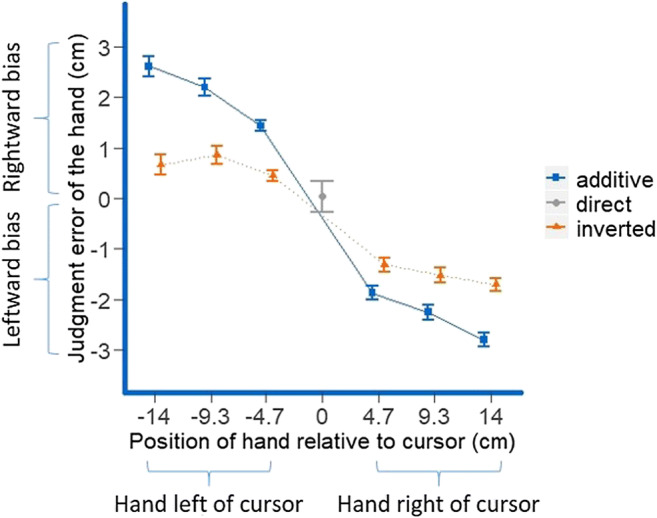
Spatial action-effect binding denotes the mutual attraction between the perceived position of an effector (e.g., one's own hand) and a distal object that is controlled by this effector. Such spatial binding can be construed as an implicit measure of object ownership, thus the belonging of a controlled object to the own body. The current study investigated how different transformations of hand movements (body-internal action component) into movements of a visual object (body-external action component) affect spatial action-effect binding, and thus implicit object ownership. In brief, participants had to bring a cursor on the computer screen into a predefined target position by moving their occluded hand on a tablet and had to estimate their final hand position. In Experiment 1, we found a significantly lower drift of the proprioceptive position of the hand towards the visual object when hand movements were transformed into laterally inverted cursor movements, rather than cursor movements in the same direction. Experiment 2 showed that this reduction reflected an elimination of spatial action-effect binding in the inverted condition. The results are discussed with respect to the prerequisites for an experience of ownership over artificial, noncorporeal objects. Our results show that predictability of an object movement alone is not a sufficient condition for ownership because, depending on the type of transformation, integration of the effector and a distal object can be fully abolished even under conditions of full controllability.
空间动作-效应绑定指的是效应器(如自己的手)的感知位置与受该效应器控制的远端物体之间的相互吸引。这种空间绑定可以被理解为对物体所有权的一种隐性度量,即被控制物体归属于自身身体。当前的研究调查了手部动作(身体内部动作成分)向视觉物体动作(身体外部动作成分)的不同转换如何影响空间动作-效应绑定,进而影响隐性物体所有权。简而言之,参与者必须通过在平板电脑上移动被遮挡的手,将电脑屏幕上的光标移动到预定义的目标位置,并必须估计他们最终的手部位置。在实验1中,我们发现当手部动作转换为横向反转的光标动作,而不是相同方向的光标动作时,手部本体感觉位置向视觉物体的漂移显著降低。实验2表明,这种降低反映了在反转条件下空间动作-效应绑定的消除。我们结合对人造非实体物体所有权体验的前提条件对结果进行了讨论。我们的结果表明,仅物体运动的可预测性并不是所有权的充分条件,因为根据转换类型的不同,即使在完全可控的条件下,效应器与远端物体的整合也可能完全被消除。