Department of Psychiatry and Behavioral Science, Seoul National University College of Medicine and Seoul National University Hospital, 101, Daehak-ro, Jongno-gu, Seoul, 110-744, South Korea.
Department of Psychiatry, School of Medicine, Kyungpook National University, 80, Daehak-ro, Buk-gu, Daegu, Republic of Korea.
BMC Geriatr. 2020 Mar 4;20(1):89. doi: 10.1186/s12877-020-1495-2.
Although a focus on late-life depression may help preventing suicide in older adults, many older people, especially those living in rural areas, have relatively low accessibility to treatment. This study examined the feasibility and effectiveness of a village-based intervention for depression targeting older adults living in rural areas.
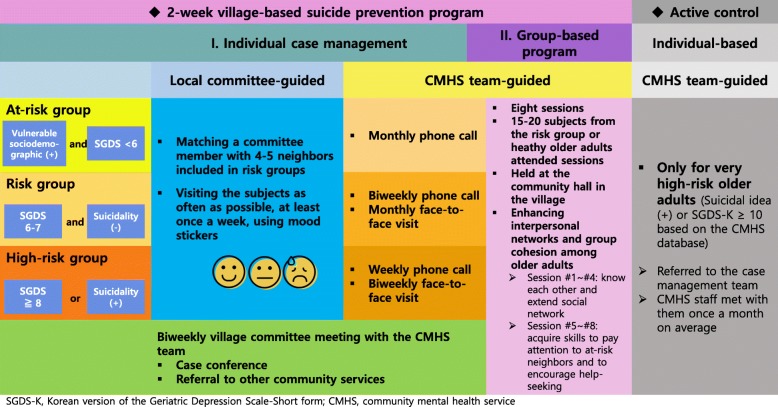
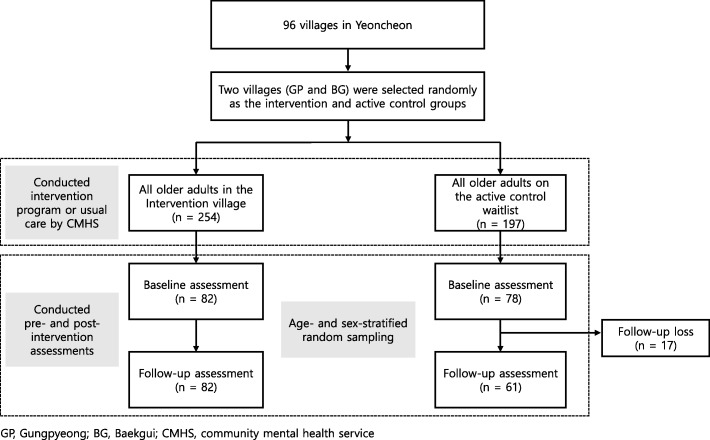
A community-based randomised pilot trial was performed in two small rural villages in South Korea. Two villages were randomly selected and assigned to the intervention or active control group; all older adults living in the two villages (n = 451) were included in the intervention program or received standard Community Mental Health Service (CMHS) care, and the effectiveness of the program was examined using representative samples from both groups (n = 160). The 12-week intervention included case management according to individual risk level and group-based activities. Healthy residents living in the intervention village who played major roles in monitoring at-risk older individuals were supervised by CMHS staff. The score on the Korean version of the Geriatric Depression Scale-Short Form (SGDS-K) was the primary outcome, while social network, functional status, and global cognitive function were secondary outcomes. Linear mixed models including the factors of intervention group, time, and their interaction were used to examine group differences in changes in primary and secondary outcomes from baseline to follow up.
Overall, there was no significant group × time interaction with respect to the SGDS-K score, but older individuals with more depressive symptoms at baseline (SGDS-K ≥ 6) tended to have a lower likelihood of progressing to severe depression at post-intervention. The social network was strengthened in the intervention group, and there was a significant group × time interaction (F[df1, df2], 5.29 [1, 153], p = 0.023).
This study examined a 12-week village-based intervention for late-life depression in which the CMHS helped village-dwellers deal with late-life depression in their communities. Although the intervention improved social interactions among older adults, it did not reduce depressive symptoms. Further studies including more rural villages and long-term follow up are needed to confirm the effectiveness of this prevention program.
NCT04013165 (date: 9 July 2019, retrospectively registered).
尽管关注老年人的抑郁问题可能有助于预防老年人自杀,但许多老年人,尤其是生活在农村地区的老年人,获得治疗的机会相对较低。本研究旨在检验一项针对农村地区老年人群的基于村庄的抑郁干预措施的可行性和效果。
本研究在韩国的两个小村庄进行了一项基于社区的随机试点试验。两个村庄被随机选中并分配到干预组或活动对照组;所有居住在两个村庄的老年人(n=451)都被纳入干预项目或接受标准社区精神卫生服务(CMHS)护理,并且使用两组的代表性样本(n=160)来检验项目的效果。为期 12 周的干预措施包括根据个体风险水平进行病例管理和基于小组的活动。居住在干预村庄的健康居民,在 CMHS 工作人员的监督下,在监测高危老年人方面发挥主要作用。主要结局指标为韩国版老年抑郁量表-短表(SGDS-K)评分,次要结局指标为社会网络、功能状态和整体认知功能。采用线性混合模型,包括干预组、时间以及它们之间的交互作用等因素,来检验组间在从基线到随访期间主要和次要结局变化上的差异。
总体而言,在 SGDS-K 评分方面,干预组与时间之间没有显著的交互作用,但基线时抑郁症状更严重(SGDS-K≥6)的老年人在干预后进展为重度抑郁的可能性较低。干预组的社会网络得到了加强,且干预组与时间之间存在显著的交互作用(F[df1, df2],5.29[1, 153],p=0.023)。
本研究检验了一项为期 12 周的基于村庄的老年抑郁症干预措施,该措施中 CMHS 帮助村民在社区中处理老年人的抑郁症问题。尽管该干预措施改善了老年人之间的社交互动,但并未减轻抑郁症状。需要进一步开展包括更多农村村庄和长期随访的研究,以确认该预防计划的有效性。
NCT04013165(日期:2019 年 7 月 9 日,回溯注册)。