Priority Research Centre for Reproductive Science, Schools of Biomedical Science & Pharmacy and Environmental & Life Sciences, University of Newcastle, Ring Road, Callaghan, New South Wales, 2308, Australia.
Hunter Medical Research Institute, New Lambton Heights, New South Wales, 2305, Australia.
BMC Womens Health. 2020 Mar 4;20(1):45. doi: 10.1186/s12905-020-00912-y.
Previous studies have identified that women living in developed countries have insufficient knowledge of factors which may be contributing to the increasingly high global infertility rates such as maternal age and assisted reproductive technologies. There is a large market of reproductive health smartphone applications, yet little is known about the advantages these apps may confer to users in regards to reproductive health knowledge.
An anonymous, online survey of women living in Australia aged 18 and above was open March-June 2018, until ≥200 responses were acquired for statistical power. Respondents answered questions regarding knowledge about general fertility and related factors (age, cyclic fertility, smoking, obesity, miscarriage rate, and success of assisted reproductive technologies). Fertility knowledge was compared in respondents who did or did not use apps relating to female reproductive health. Additionally the functions preferred in reproductive health apps was described by app using respondents. Sociodemographic information was also collected, and relevant data within the dataset was subject to multivariable modelling for the outcome of the fertility knowledge questions.
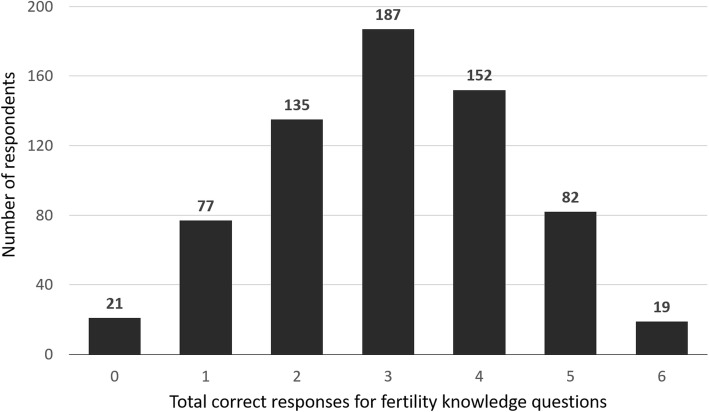
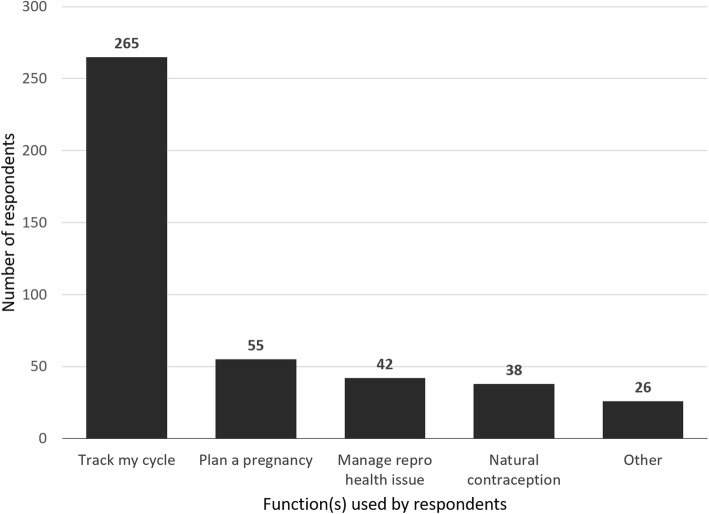
Of the 673 respondents that completed the survey, 43.09% reported using mobile phone applications relating to female reproductive health. On average, respondents answered only three of the six fertility knowledge questions correctly. App using respondents were more likely to score better on one question, related to fertility during the menstrual cycle (p < 0.001). App users most commonly reported using the menstrual tracking function in apps (82.4%), which may account for the increased knowledge of cyclic fertility.
This data provides preliminary evidence toward the usefulness of smartphone applications as a medium for providing information about fertility to women. A limited understanding of one's own fertility was demonstrated despite being essential for the decision-making of women throughout their reproductive years.
之前的研究表明,生活在发达国家的女性对可能导致全球不孕率不断上升的因素(如产妇年龄和辅助生殖技术)了解不足。有大量的生殖健康智能手机应用程序,但对于这些应用程序可能为用户提供的生殖健康知识优势,我们知之甚少。
2018 年 3 月至 6 月期间,对居住在澳大利亚的年龄在 18 岁及以上的女性进行了一项匿名在线调查,直到获得≥200 份回复以获得统计效力。受访者回答了有关一般生育能力和相关因素(年龄、周期性生育能力、吸烟、肥胖、流产率和辅助生殖技术成功率)的知识问题。比较了使用和不使用与女性生殖健康相关应用程序的受访者的生育知识。此外,还描述了使用生殖健康应用程序的受访者所偏好的功能。还收集了社会人口统计学信息,并对数据集中的相关数据进行了多变量建模,以评估生育知识问题的结果。
在完成调查的 673 名受访者中,有 43.09%的人报告使用过与女性生殖健康相关的移动电话应用程序。平均而言,受访者仅正确回答了六个生育知识问题中的三个。使用应用程序的受访者在一个问题上的得分更高,该问题与月经周期中的生育能力有关(p<0.001)。应用程序用户最常报告在应用程序中使用的功能是月经跟踪功能(82.4%),这可能是他们对周期性生育能力知识增加的原因。
这些数据初步证明了智能手机应用程序作为向女性提供生育信息的媒介的有用性。尽管在女性生育期间的决策中至关重要,但调查显示,女性对自身生育能力的了解有限。