Laboratoire Ecologie & Biologie des Interactions, UMR CNRS 7267, Université de Poitiers, 1 Rue Georges Bonnet, TSA 51106, 86073, POITIERS, Cedex 9, France.
Laboratoire Inflammation, Tissus Epithéliaux et Cytokines, UPRES EA4331, Université de Poitiers, 1 Rue Georges Bonnet, TSA 51106, 86073, POITIERS, Cedex 9, France.
Sci Rep. 2020 Mar 4;10(1):3978. doi: 10.1038/s41598-020-60829-2.
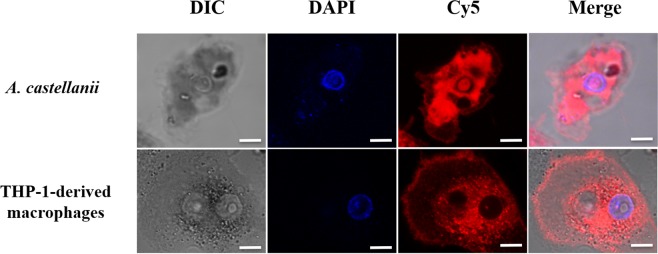
Temporin-SHa (SHa) is a small cationic host defence peptide (HDP) produced in skin secretions of the Sahara frog Pelophylax saharicus. This peptide has a broad-spectrum activity, efficiently targeting bacteria, parasites and viruses. Noticeably, SHa has demonstrated an ability to kill Leishmania infantum parasites (amastigotes) within macrophages. Recently, an analog of SHa with an increased net positive charge, named [K]SHa, has been designed to improve those activities. SHa and [K]SHa were both shown to exhibit leishmanicidal activity mainly by permeabilization of cell membranes but could also induce apoptotis-like death. Temporins are usually poorly active against Gram-negative bacteria whereas many of these species are of public health interest. Among them, Legionella pneumophila, the etiological agent of Legionnaire's disease, is of major concern. Indeed, this bacterium adopts an intracellular lifestyle and replicate inside alveolar macrophages likewise inside its numerous protozoan hosts. Despite several authors have studied the antimicrobial activity of many compounds on L. pneumophila released from host cells, nothing is known about activity on intracellular L. pneumophila within their hosts, and subsequently mechanisms of action that could be involved. Here, we showed for the first time that SHa and [K]SHa were active towards several species of Legionella. Both peptides displayed bactericidal activity and caused a loss of the bacterial envelope integrity leading to a rapid drop in cell viability. Regarding amoebae and THP-1-derived macrophages, SHa was less toxic than [K]SHa and exhibited low half maximal lethal concentrations (LC). When used at non-toxic concentration (6.25 µM), SHa killed more than 90% L. pneumophila within amoebae and around 50% within macrophages. Using SHa labeled with the fluorescent dye Cy5, we showed an evenly diffusion within cells except in vacuoles. Moreover, SHa was able to enter the nucleus of amoebae and accumulate in the nucleolus. This subcellular localization seemed specific as macrophages nucleoli remained unlabeled. Finally, no modifications in the expression of cytokines and HDPs were recorded when macrophages were treated with 6.25 µM SHa. By combining all data, we showed that temporin-SHa decreases the intracellular L. pneumophila load within amoebae and macrophages without being toxic for eukaryotic cells. This peptide was also able to reach the nucleolus of amoebae but was not capable to penetrate inside vacuoles. These data are in favor of an indirect action of SHa towards intracellular Legionella and make this peptide a promising template for further developments.
沙蛙防御素 -Sha(SHa)是一种小的阳离子宿主防御肽(HDP),存在于撒哈拉蛙 Pelophylax saharicus 的皮肤分泌物中。该肽具有广谱活性,能有效靶向细菌、寄生虫和病毒。值得注意的是,SHa 已被证明能够杀死巨噬细胞内的利什曼原虫寄生虫(无鞭毛体)。最近,设计了一种带正电荷的 SHa 类似物,命名为 [K]SHa,以提高这些活性。SHa 和 [K]SHa 均表现出杀利什曼原虫活性,主要通过细胞膜的通透化,但也能诱导类似凋亡的死亡。Temporins 通常对革兰氏阴性菌的活性较差,而这些物种中有许多对公共卫生有意义。其中,嗜肺军团菌是军团病的病原体,是主要关注的对象。事实上,这种细菌采用细胞内生活方式,并在肺泡巨噬细胞内及其许多原生动物宿主内复制。尽管有几位作者研究了从宿主细胞释放的许多化合物对嗜肺军团菌的抗菌活性,但对其宿主内的细胞内嗜肺军团菌的活性以及可能涉及的作用机制一无所知。在这里,我们首次表明 SHa 和 [K]SHa 对几种军团菌有活性。两种肽都表现出杀菌活性,并导致细菌包膜完整性丧失,从而导致细胞活力迅速下降。关于变形虫和 THP-1 衍生的巨噬细胞,SHa 比 [K]SHa 的毒性更小,并且表现出较低的半最大致死浓度(LC)。当以非毒性浓度(6.25 μM)使用时,SHa 可在变形虫中杀死超过 90%的嗜肺军团菌,在巨噬细胞中杀死约 50%。用荧光染料 Cy5 标记 SHa,我们发现它在细胞内均匀扩散,除了在液泡中。此外,SHa 能够进入变形虫的细胞核,并在核仁中积累。这种亚细胞定位似乎是特异性的,因为巨噬细胞核仁没有被标记。最后,当用 6.25 μM SHa 处理巨噬细胞时,细胞因子和 HDPs 的表达没有发生变化。综合所有数据,我们表明沙蛙防御素 -Sha 可降低变形虫和巨噬细胞内的嗜肺军团菌负荷,而对真核细胞无毒性。该肽还能够到达变形虫的核仁,但不能穿透液泡。这些数据支持 SHa 对细胞内军团菌的间接作用,并使该肽成为进一步开发的有前途的模板。