Buckwar Evelyn, Tamborrino Massimiliano, Tubikanec Irene
Institute for Stochastics, Johannes Kepler University Linz, Altenberger Straße 69, 4040 Linz, Austria.
Stat Comput. 2020;30(3):627-648. doi: 10.1007/s11222-019-09909-6. Epub 2019 Nov 5.
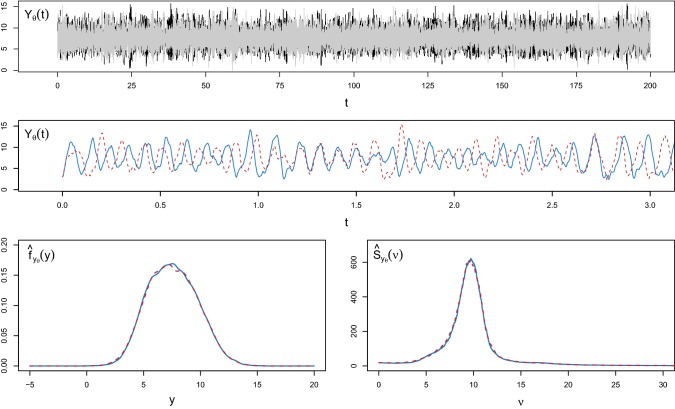
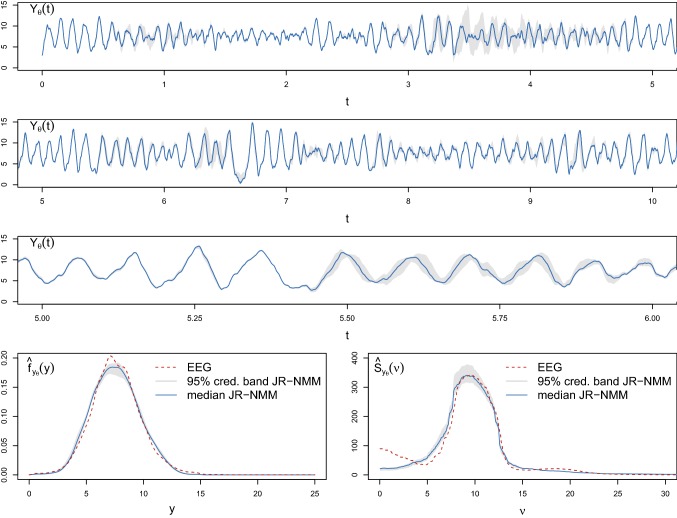
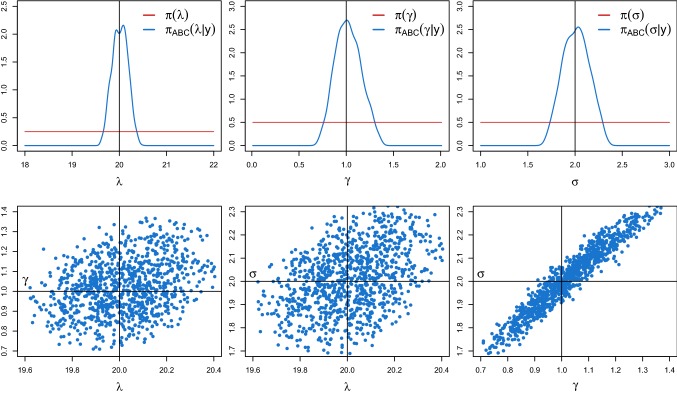
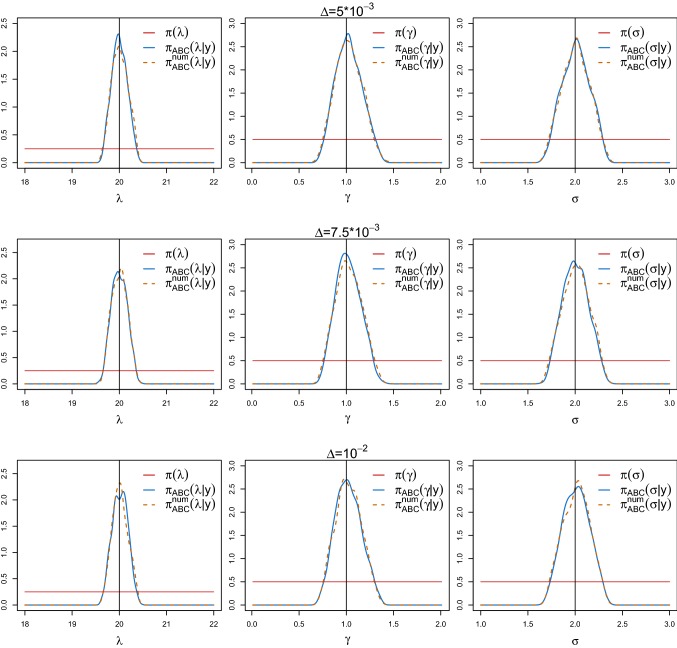
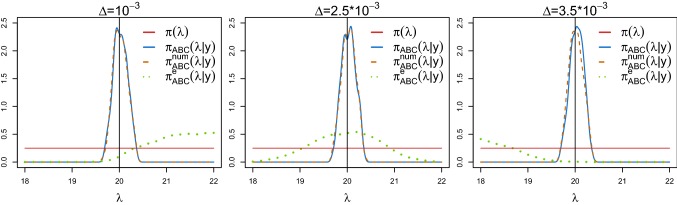
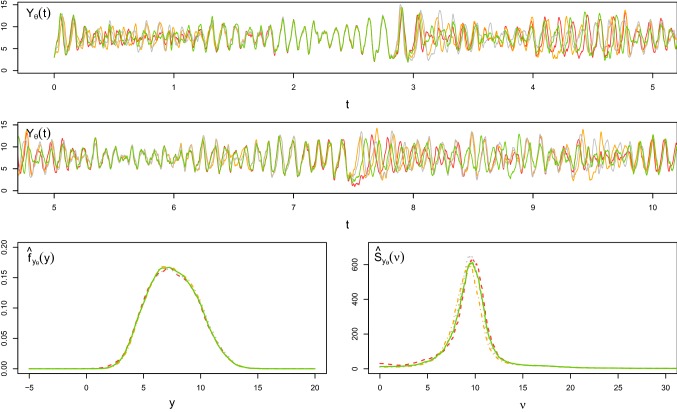
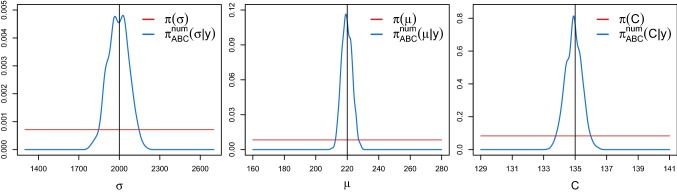
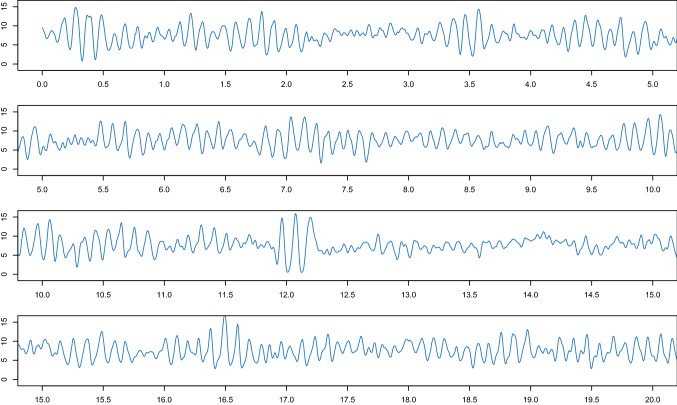
Approximate Bayesian computation (ABC) has become one of the major tools of likelihood-free statistical inference in complex mathematical models. Simultaneously, stochastic differential equations (SDEs) have developed to an established tool for modelling time-dependent, real-world phenomena with underlying random effects. When applying ABC to stochastic models, two major difficulties arise: First, the derivation of effective summary statistics and proper distances is particularly challenging, since simulations from the stochastic process under the same parameter configuration result in different trajectories. Second, exact simulation schemes to generate trajectories from the stochastic model are rarely available, requiring the derivation of suitable numerical methods for the synthetic data generation. To obtain summaries that are less sensitive to the intrinsic stochasticity of the model, we propose to build up the statistical method (e.g. the choice of the summary statistics) on the underlying structural properties of the model. Here, we focus on the existence of an invariant measure and we map the data to their estimated invariant density and invariant spectral density. Then, to ensure that these model properties are kept in the synthetic data generation, we adopt measure-preserving numerical splitting schemes. The derived property-based and measure-preserving ABC method is illustrated on the broad class of partially observed Hamiltonian type SDEs, both with simulated data and with real electroencephalography data. The derived summaries are particularly robust to the model simulation, and this fact, combined with the proposed reliable numerical scheme, yields accurate ABC inference. In contrast, the inference returned using standard numerical methods (Euler-Maruyama discretisation) fails. The proposed ingredients can be incorporated into any type of ABC algorithm and directly applied to all SDEs that are characterised by an invariant distribution and for which a measure-preserving numerical method can be derived.
近似贝叶斯计算(ABC)已成为复杂数学模型中无似然统计推断的主要工具之一。同时,随机微分方程(SDEs)已发展成为一种成熟的工具,用于对具有潜在随机效应的随时间变化的现实世界现象进行建模。将ABC应用于随机模型时,会出现两个主要困难:第一,推导有效的汇总统计量和合适的距离特别具有挑战性,因为在相同参数配置下从随机过程进行模拟会产生不同的轨迹。第二,很少有精确的模拟方案可用于从随机模型生成轨迹,这需要推导适用于合成数据生成的数值方法。为了获得对模型内在随机性不太敏感的汇总,我们建议基于模型的潜在结构属性构建统计方法(例如汇总统计量的选择)。在此,我们关注不变测度的存在性,并将数据映射到其估计的不变密度和不变谱密度。然后,为确保这些模型属性在合成数据生成中得以保留,我们采用保测度数值分裂方案。基于属性和保测度的ABC方法在广泛的部分观测哈密顿型SDEs上进行了说明,包括模拟数据和真实脑电图数据。所推导的汇总对模型模拟特别稳健,这一事实与所提出的可靠数值方案相结合,产生了准确的ABC推断。相比之下,使用标准数值方法(欧拉 - 丸山离散化)返回的推断失败。所提出的要素可以纳入任何类型的ABC算法,并直接应用于所有具有不变分布且可以推导保测度数值方法的SDEs。