White S R, Kypraios T, Preston S P
MRC Biostatistics Unit, Cambridge, CB2 0SR UK.
School of Mathematical Sciences, University of Nottingham, Nottingham, NG7 2RD UK.
Stat Comput. 2015;25(2):289-301. doi: 10.1007/s11222-013-9432-2. Epub 2013 Nov 29.
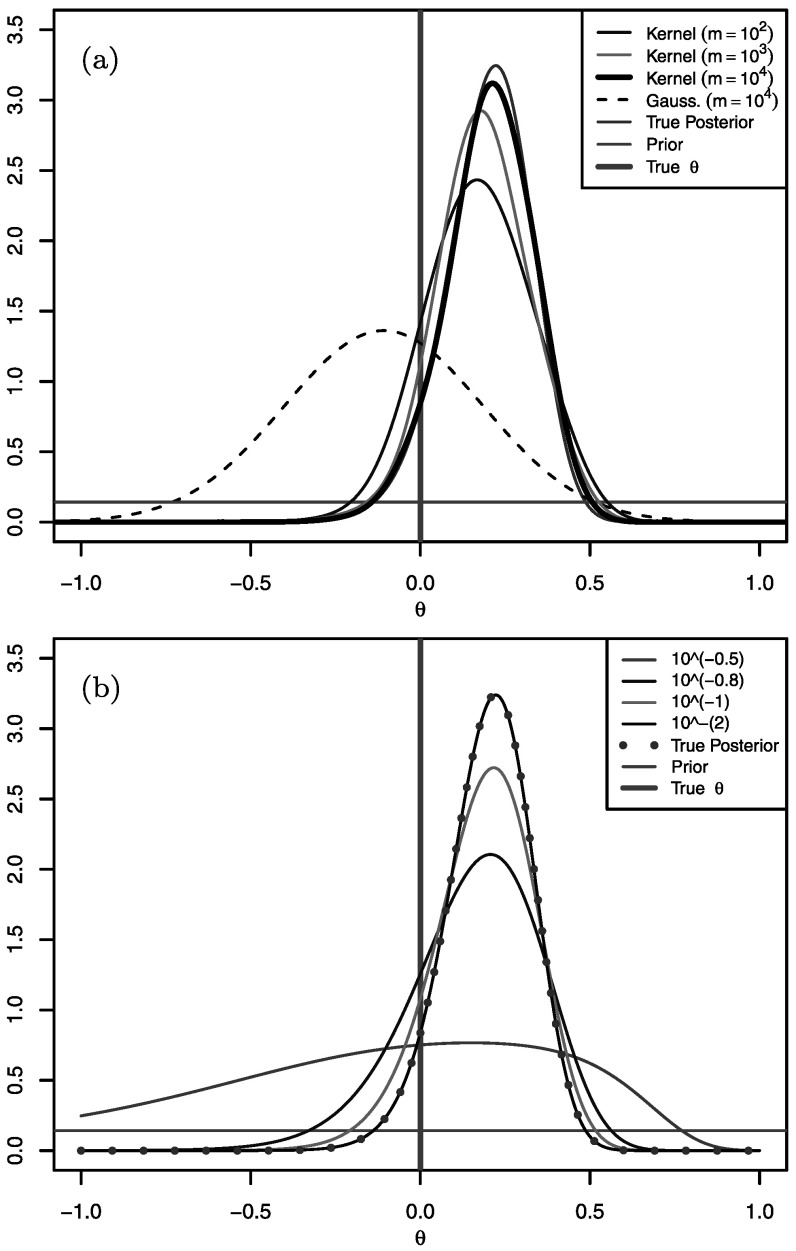
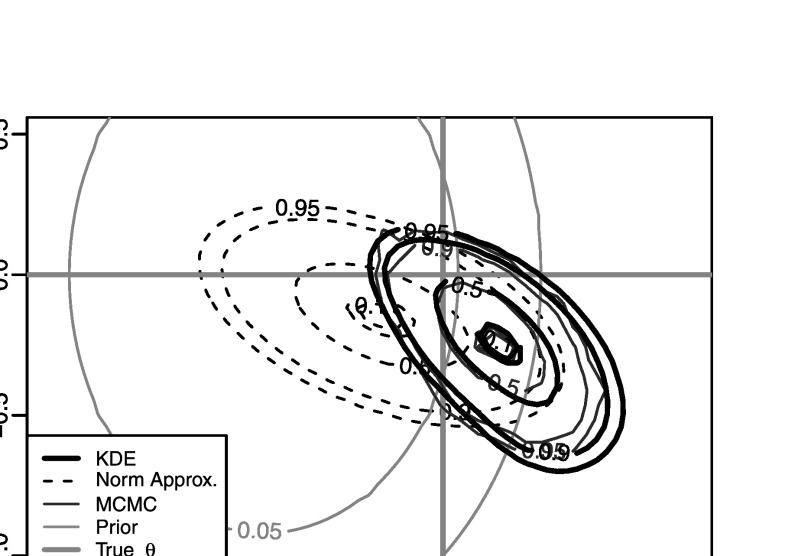
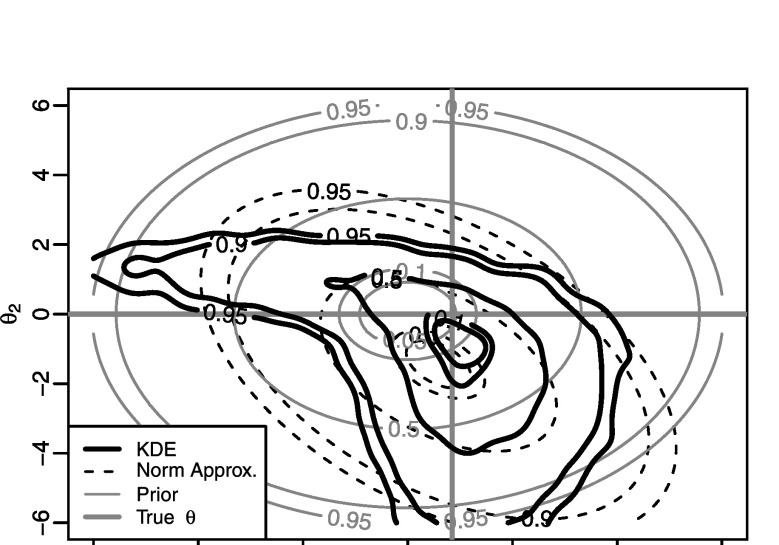
Many modern statistical applications involve inference for complicated stochastic models for which the likelihood function is difficult or even impossible to calculate, and hence conventional likelihood-based inferential techniques cannot be used. In such settings, Bayesian inference can be performed using Approximate Bayesian Computation (ABC). However, in spite of many recent developments to ABC methodology, in many applications the computational cost of ABC necessitates the choice of summary statistics and tolerances that can potentially severely bias the estimate of the posterior. We propose a new "piecewise" ABC approach suitable for discretely observed Markov models that involves writing the posterior density of the parameters as a product of factors, each a function of only a subset of the data, and then using ABC within each factor. The approach has the advantage of side-stepping the need to choose a summary statistic and it enables a stringent tolerance to be set, making the posterior "less approximate". We investigate two methods for estimating the posterior density based on ABC samples for each of the factors: the first is to use a Gaussian approximation for each factor, and the second is to use a kernel density estimate. Both methods have their merits. The Gaussian approximation is simple, fast, and probably adequate for many applications. On the other hand, using instead a kernel density estimate has the benefit of consistently estimating the true piecewise ABC posterior as the number of ABC samples tends to infinity. We illustrate the piecewise ABC approach with four examples; in each case, the approach offers fast and accurate inference.
许多现代统计应用涉及对复杂随机模型的推断,对于这些模型,似然函数很难甚至无法计算,因此无法使用传统的基于似然的推断技术。在这种情况下,可以使用近似贝叶斯计算(ABC)进行贝叶斯推断。然而,尽管最近ABC方法有了许多发展,但在许多应用中,ABC的计算成本使得必须选择汇总统计量和容差,而这可能会严重偏差后验估计。我们提出了一种适用于离散观测马尔可夫模型的新“分段”ABC方法,该方法涉及将参数的后验密度写成因子的乘积,每个因子仅是数据子集的函数,然后在每个因子内使用ABC。该方法的优点是无需选择汇总统计量,并且能够设置严格的容差,使后验“近似程度降低”。我们研究了基于每个因子的ABC样本估计后验密度的两种方法:第一种是对每个因子使用高斯近似,第二种是使用核密度估计。两种方法都有其优点。高斯近似简单、快速,可能适用于许多应用。另一方面,使用核密度估计的好处是,随着ABC样本数量趋于无穷大,能够一致地估计真正的分段ABC后验。我们用四个例子说明了分段ABC方法;在每种情况下,该方法都能提供快速准确的推断。