Alldritt Benjamin, Hapala Prokop, Oinonen Niko, Urtev Fedor, Krejci Ondrej, Federici Canova Filippo, Kannala Juho, Schulz Fabian, Liljeroth Peter, Foster Adam S
Department of Applied Physics, Aalto University, 00076 Aalto, Espoo, Finland.
Department of Computer Science, Aalto University, 00076 Aalto, Espoo, Finland.
Sci Adv. 2020 Feb 26;6(9):eaay6913. doi: 10.1126/sciadv.aay6913. eCollection 2020 Feb.
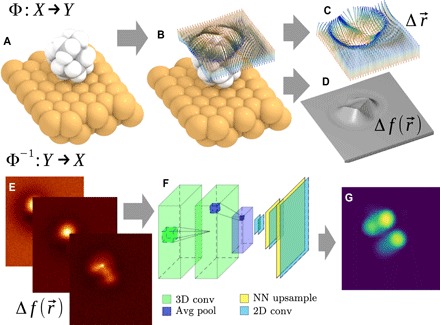
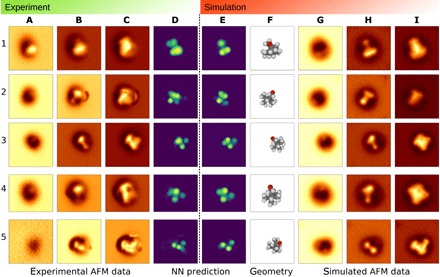
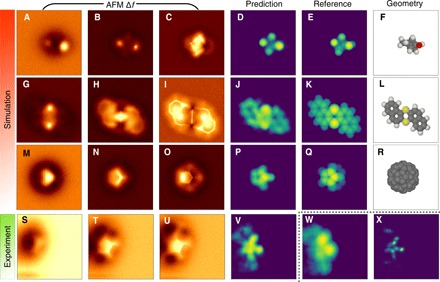
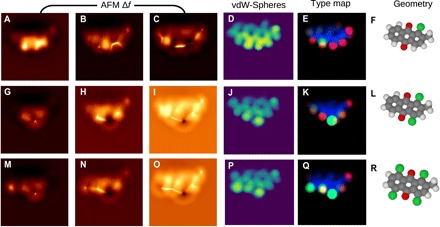
Atomic force microscopy (AFM) with molecule-functionalized tips has emerged as the primary experimental technique for probing the atomic structure of organic molecules on surfaces. Most experiments have been limited to nearly planar aromatic molecules due to difficulties with interpretation of highly distorted AFM images originating from nonplanar molecules. Here, we develop a deep learning infrastructure that matches a set of AFM images with a unique descriptor characterizing the molecular configuration, allowing us to predict the molecular structure directly. We apply this methodology to resolve several distinct adsorption configurations of 1-camphor on Cu(111) based on low-temperature AFM measurements. This approach will open the door to applying high-resolution AFM to a large variety of systems, for which routine atomic and chemical structural resolution on the level of individual objects/molecules would be a major breakthrough.
配备分子功能化探针的原子力显微镜(AFM)已成为探测表面有机分子原子结构的主要实验技术。由于难以解释源自非平面分子的高度扭曲的AFM图像,大多数实验仅限于近乎平面的芳香族分子。在此,我们开发了一种深度学习框架,该框架将一组AFM图像与表征分子构型的独特描述符相匹配,使我们能够直接预测分子结构。我们应用这种方法,基于低温AFM测量结果解析了1-樟脑在Cu(111)上的几种不同吸附构型。这种方法将为在各种系统中应用高分辨率AFM打开大门,对于这些系统而言,在单个物体/分子水平上实现常规的原子和化学结构解析将是一个重大突破。