The First Department of Internal Medicine, School of Medicine, University of Occupational and Environmental Health, Japan, Kitakyushu, Japan.
Int J Rheum Dis. 2020 Apr;23(4):465-471. doi: 10.1111/1756-185X.13817. Epub 2020 Mar 5.
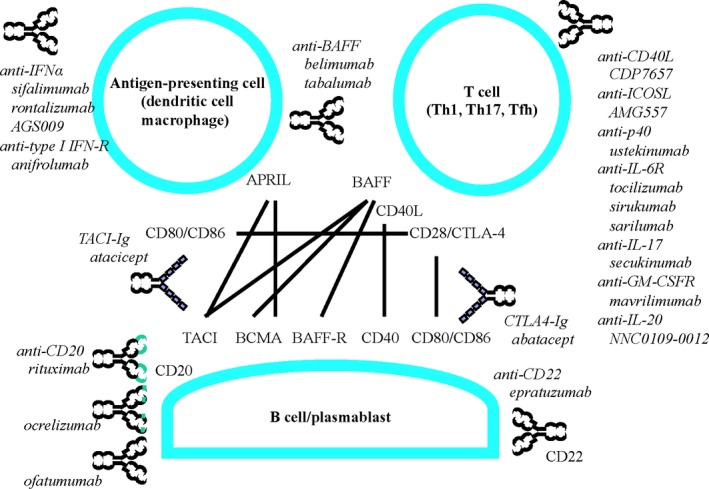
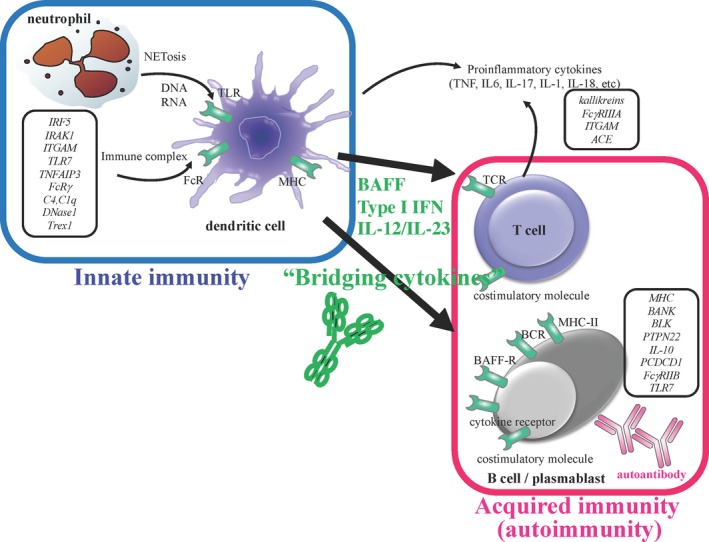
As glucocorticoids and immunosuppressive drugs are non-specific therapeutic agents that cause many adverse reactions, the development of biologicals aiming to control specific molecular targets is anticipated for the treatment of systemic lupus erythematosus (SLE). The antibody targeting B cell-activating factor belonging to the tumor necrosis factor family (BAFF) belimumab was the first biological approved for SLE. At present, many biologicals, such as anifrolumab (anti-type I interferon receptor antibody) and ustekinumab (antibody against interleukin 12/23 [p40]), are in clinical trials. Thus, successful treatments with biologicals targeting "bridging cytokines" produced by dendritic cells, which form a bridge between the innate and acquired immune/autoimmune systems, is of particular interest. Moreover, a phase IIb clinical trial of baricitinib, a low-molecular-weight compound targeting Janus kinase 1/2, in patients with SLE revealed that baricitinib was significantly more effective for relieving arthritis and skin manifestations than placebo, and the trial met the primary endpoint. In the future, it is expected that drugs with better efficacy and safety profiles will be used to apply therapeutic strategies, such as precision medicine, in which different molecular target drugs are used for patients classified by their conditions, and to set a therapeutic goal of the discontinuation of glucocorticoids.
由于糖皮质激素和免疫抑制剂等非特异性治疗药物会引起许多不良反应,因此人们期望开发针对特定分子靶点的生物制剂来治疗系统性红斑狼疮(SLE)。靶向 B 细胞激活因子属于肿瘤坏死因子家族(BAFF)的抗体贝利尤单抗是首个获批用于治疗 SLE 的生物制剂。目前,许多生物制剂,如阿尼鲁单抗(抗 I 型干扰素受体抗体)和乌司奴单抗(抗白细胞介素 12/23[p40]抗体),正在临床试验中。因此,针对树突状细胞产生的“桥接细胞因子”的靶向生物治疗具有特别的意义,这些细胞因子在先天和获得性免疫/自身免疫之间形成桥梁。此外,在 SLE 患者中进行的巴利昔单抗(一种靶向 Janus 激酶 1/2 的低分子量化合物)的 IIb 期临床试验表明,巴利昔单抗在缓解关节炎和皮肤表现方面的疗效明显优于安慰剂,且试验达到了主要终点。未来,预计将使用具有更好疗效和安全性特征的药物来应用治疗策略,如精准医学,根据患者的病情使用不同的分子靶向药物,并设定停用糖皮质激素的治疗目标。