MMWR Morb Mortal Wkly Rep. 2020 Mar 6;69(9):236-240. doi: 10.15585/mmwr.mm6909a4.
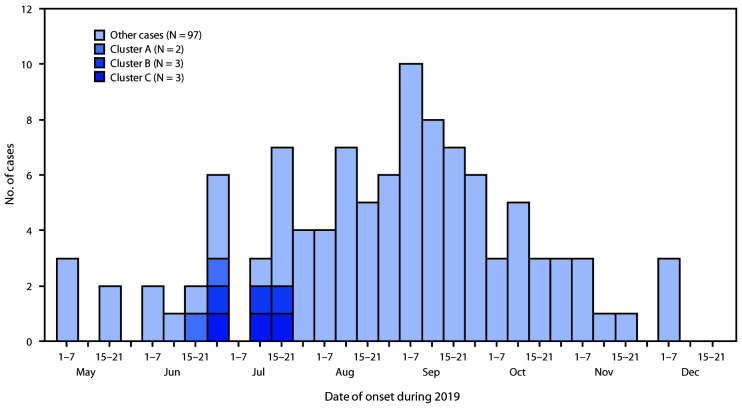
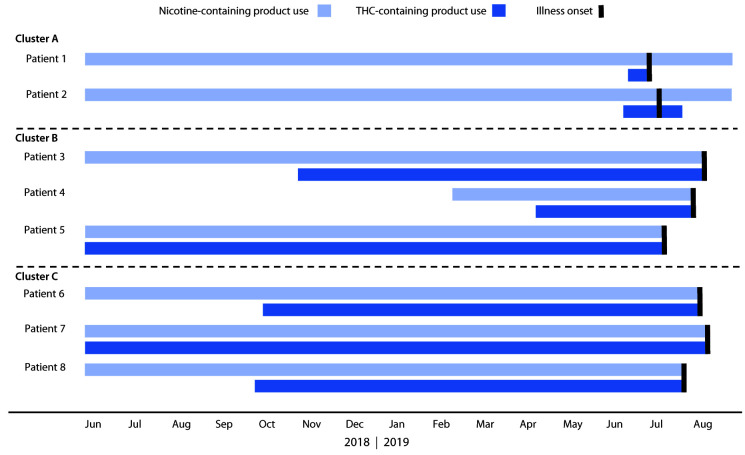
On July 10, 2019, Wisconsin Department of Health Services (WDHS) was notified of five previously healthy adolescents with severe lung injuries who reported use of e-cigarette, or vaping, products before symptom onset. As of December 31, 2019, 105 confirmed or probable cases of e-cigarette, or vaping, product use-associated lung injury (EVALI)* had been reported to WDHS . Three social clusters (A, B, and C), comprising eight EVALI patients (cluster A = two patients, cluster B = three, and cluster C = three) were identified. WDHS investigated these clusters with standard and follow-up interviews; laboratory analysis of e-cigarette, or vaping, products; and analysis of bronchoalveolar lavage (BAL) fluid. All eight patients reported daily use of tetrahydrocannabinol (THC)-containing e-cigarette, or vaping, product cartridges (THC cartridges) in the month preceding symptom onset. All THC cartridges were purchased from local illicit dealers, and all patients reported using THC cartridges labeled as "Dank Vapes," among other illicit brand names. At least two members of each cluster reported frequent sharing of THC cartridges before symptom onset. All eight patients also reported daily use of nicotine-containing e-cigarette, or vaping, products. Vitamin E acetate (VEA) was detected in all five THC cartridges tested from two patients, and in BAL fluid from two other patients. These findings suggest that THC cartridges containing VEA and sold on the illicit market were likely responsible for these small clusters of EVALI. Based on information presented in this and previous reports (1,2) CDC recommends not using THC-containing e-cigarette, or vaping, products, especially those obtained from informal sources such as friends, family, or in-person or online dealers (1). VEA is strongly linked to the EVALI outbreak and should not be added to e-cigarette, or vaping, products (1).
2019 年 7 月 10 日,威斯康星州卫生服务部(WDHS)接到报告,称有五名以前身体健康的青少年在出现症状前报告使用电子烟或蒸气烟产品,导致严重肺部损伤。截至 2019 年 12 月 31 日,WDHS 已收到 105 例确诊或疑似与电子烟或蒸气烟产品使用相关的肺损伤(EVALI)病例报告。已确定三个社交聚集群(A、B 和 C),其中包含 8 例 EVALI 患者(聚集群 A = 2 例,聚集群 B = 3 例,聚集群 C = 3 例)。WDHS 通过标准和后续访谈、对电子烟或蒸气烟产品的实验室分析以及对支气管肺泡灌洗液(BAL)的分析对这些聚集群进行了调查。所有 8 名患者报告在出现症状前一个月每天使用含有四氢大麻酚(THC)的电子烟或蒸气烟产品罐(THC 罐)。所有 THC 罐均从当地非法经销商处购买,所有患者报告使用的 THC 罐标有“Dank Vapes”等非法品牌。每个聚集群至少有两名成员报告在出现症状前经常共享 THC 罐。所有 8 名患者还报告每天使用含有尼古丁的电子烟或蒸气烟产品。从两名患者的两个 THC 罐中以及从另外两名患者的 BAL 液中均检测到维生素 E 醋酸盐(VEA)。这些发现表明,含有 VEA 的 THC 罐和在非法市场上销售的 THC 罐可能是导致这些小型 EVALI 聚集群的原因。根据本报告和以前报告(1、2)中的信息,CDC 建议不要使用含有四氢大麻酚的电子烟或蒸气烟产品,尤其是那些从朋友、家人或线下或线上经销商等非正规来源获得的产品(1)。VEA 与 EVALI 疫情密切相关,不应添加到电子烟或蒸气烟产品中(1)。