Donti Olyvia, Gaspari Vasiliki, Papia Kostantina, Panidi Ioli, Donti Anastasia, Bogdanis Gregory C
School of Physical Education & Sport Science, National and Kapodistrian University of Athens, 17237 Athens, Greece.
Sports (Basel). 2020 Mar 3;8(3):28. doi: 10.3390/sports8030028.
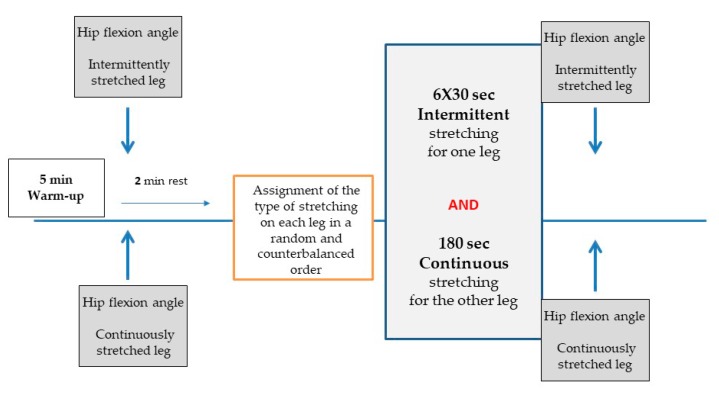
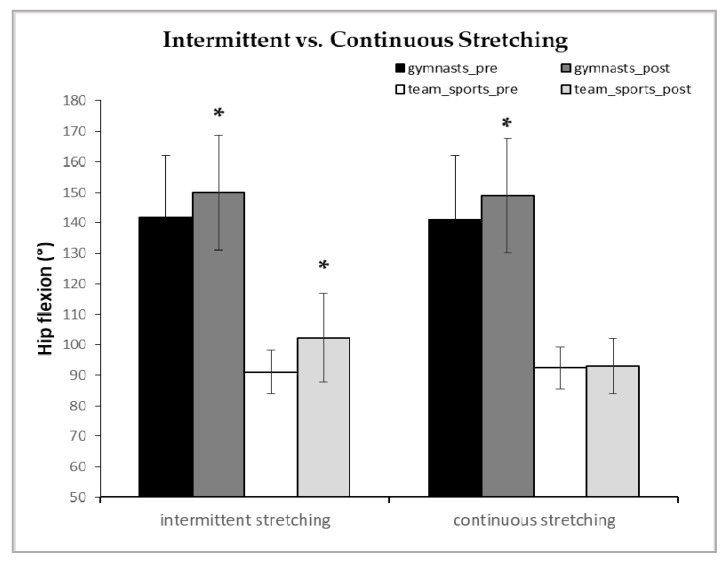
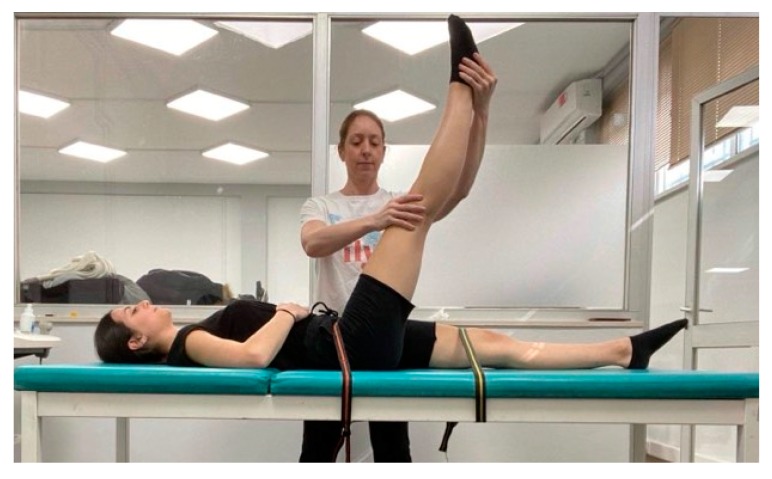
Τhis study examined changes in hip joint flexion angle after an intermittent or a continuous static stretching protocol of equal total duration. Twenty-seven female subjects aged 19.9 ± 3.0 years (14 artistic and rhythmic gymnasts and 13 team sports athletes), performed 3 min of intermittent (6 × 30 s with 30 s rest) or continuous static stretching (3 min) of the hip extensors, with an intensity of 80-90 on a 100-point visual analogue scale. The order of stretching was randomized and counterbalanced, and each subject performed both conditions. Hip flexion angle was measured with the straight leg raise test for both legs after warm-up and immediately after stretching. Both stretching types equally increased hip flexion angle by ~6% (continuous: 140.9° ± 20.4° to 148.6° ± 18.8°, = 0.047; intermittent: 141.8° ± 20.3° to 150.0° ± 18.8°, = 0.029) in artistic and rhythmic gymnasts. In contrast, in team sports athletes, only intermittent stretching increased hip flexion angle by 13% (from 91.0° ± 7.2° to 102.4° ± 14.5°, = 0.001), while continuous stretching did not affect hip angle (from 92.4° ± 6.9° vs. 93.1° ± 9.2°, = 0.99). The different effect of intermittent vs. continuous stretching on hip flexion between gymnasts and team sports athletes suggests that responses to static stretching are dependent on stretching mode and participants training experience.
本研究考察了在总时长相等的间歇性或持续性静态拉伸方案后髋关节屈曲角度的变化。27名年龄在19.9±3.0岁的女性受试者(14名艺术体操和韵律体操运动员以及13名团队运动运动员)进行了3分钟的髋关节伸肌间歇性(6×30秒,休息30秒)或持续性静态拉伸(3分钟),在100分视觉模拟量表上的强度为80 - 90。拉伸顺序随机且平衡,每位受试者都进行了两种情况的测试。在热身之后以及拉伸结束后立即使用直腿抬高试验测量双腿的髋关节屈曲角度。在艺术体操和韵律体操运动员中,两种拉伸方式均使髋关节屈曲角度同等增加了约6%(持续性:从140.9°±20.4°增加到148.6°±18.8°,P = 0.047;间歇性:从141.8°±20.3°增加到150.0°±18.8°,P = 0.029)。相比之下,在团队运动运动员中,只有间歇性拉伸使髋关节屈曲角度增加了13%(从91.0°±7.2°增加到102.4°±14.5°,P = 0.001),而持续性拉伸未影响髋关节角度(从92.4°±6.9°变为93.1°±9.2°,P = 0.99)。间歇性与持续性拉伸对体操运动员和团队运动运动员髋关节屈曲的不同影响表明,对静态拉伸的反应取决于拉伸方式和参与者的训练经验。