Department of Special Education, Stockholm University, Se-106 91 Stockholm, Sweden.
Department of Health, Medicine and Caring Sciences, Linköping University, Linköping, Sweden.
Int J Environ Res Public Health. 2020 Mar 3;17(5):1639. doi: 10.3390/ijerph17051639.
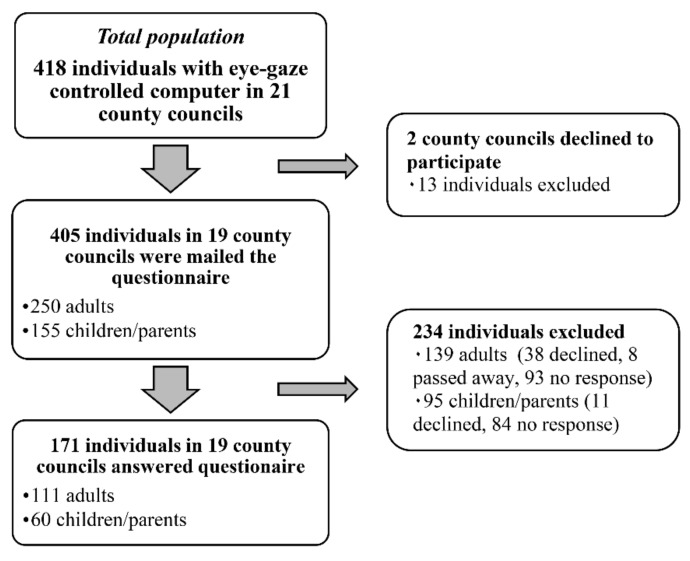
Eye-gaze technology allows individuals with severe physical disabilities and complex communication needs to control a computer or other devices with eye-gaze, thereby enabling them to communicate and participate in society. To date, most research on eye-gaze controlled devices related to persons with disabilities has focused on a single diagnosis in either adults or children and has included only a few participants. This current study utilized a total population survey to identify the prevalence and perceived usability of eye-gaze technology among adults and children in Sweden. Participants were 171 eye-gaze technology users with severe physical and communication impairments, ranging between 4 and 81 years. Cerebral palsy was the most common diagnosis. Daily usage was found in 63%, while 33% had weekly, and 4% had less frequent usage. Adults, compared with children, reported using their computers more frequently (65%/38%; p < 0.01), and for the activities they needed to perform (59%/31%; p < 0.01) and were more satisfied with services, indicating that service providers should prioritize and develop more effective services for children and their parents.
眼动技术使患有严重身体残疾和复杂沟通需求的个体能够通过眼动来控制计算机或其他设备,从而使他们能够进行沟通并参与社会生活。迄今为止,大多数与残疾人士相关的眼动控制设备的研究都集中在成年人或儿童的单一诊断上,并且只包括少数参与者。本研究利用全人群调查,在瑞典确定了成年人和儿童中眼动技术的流行程度和感知可用性。参与者为 171 名患有严重身体和沟通障碍的眼动技术使用者,年龄在 4 至 81 岁之间。脑瘫是最常见的诊断。每天使用的比例为 63%,每周使用的比例为 33%,而使用频率较低的比例为 4%。与儿童相比,成年人报告称更频繁地使用计算机(65%/38%;p < 0.01),并用于他们需要执行的活动(59%/31%;p < 0.01),并且对服务更满意,这表明服务提供者应该优先考虑并为儿童及其父母开发更有效的服务。