College of Plant Protection, Jilin Agricultural University, Changchun, 130118, Jilin Province, People's Republic of China.
School of Environmental and Forest Sciences, University of Washington, Seattle, Washington, 98195, USA.
BMC Microbiol. 2020 Mar 5;20(1):51. doi: 10.1186/s12866-020-01731-9.
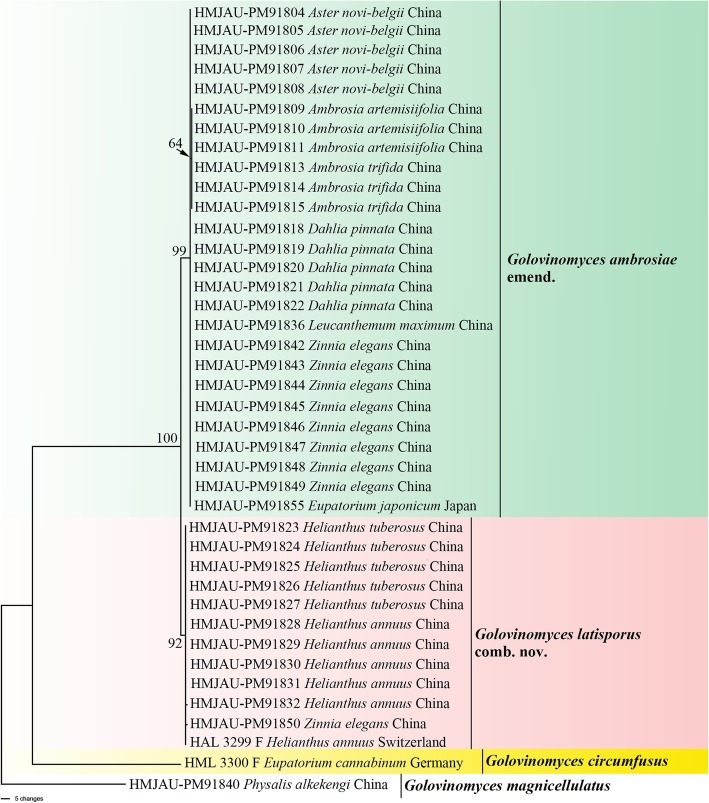
Previous phylogenetic analyses of species within the genus Golovinomyces (Ascomycota, Erysiphales), based on ITS and 28S rDNA sequence data, revealed a co-evolutionary relationship between powdery mildew species and hosts of certain tribes of the plant family Asteraceae. Golovinomyces growing on host plants belonging to the Heliantheae formed a single lineage, comprised of a morphologically differentiated complex of species, which included G. ambrosiae, G. circumfusus, and G. spadiceus. However, the lineage also encompassed sequences retrieved from Golovinomyces specimens on other Asteraceae tribes as well as other plant families, suggesting the involvement of a plurivorous species. A multilocus phylogenetic examination of this complex, using ITS, 28S, IGS (intergenic spacer), TUB2 (beta-tubulin), and CHS1 (chitin synthase I) sequence data was carried out to clarify the discrepancies between ITS and 28S rDNA sequence data and morphological differences. Furthermore, the circumscription of species and their host ranges were emended.
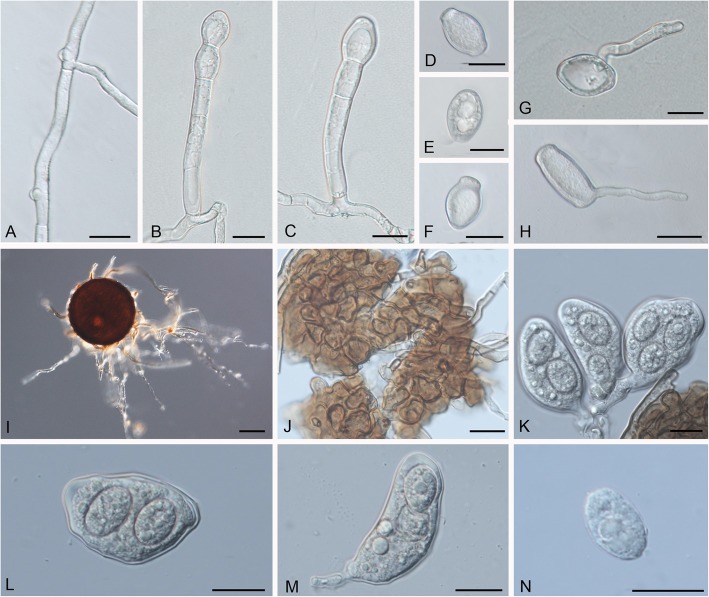
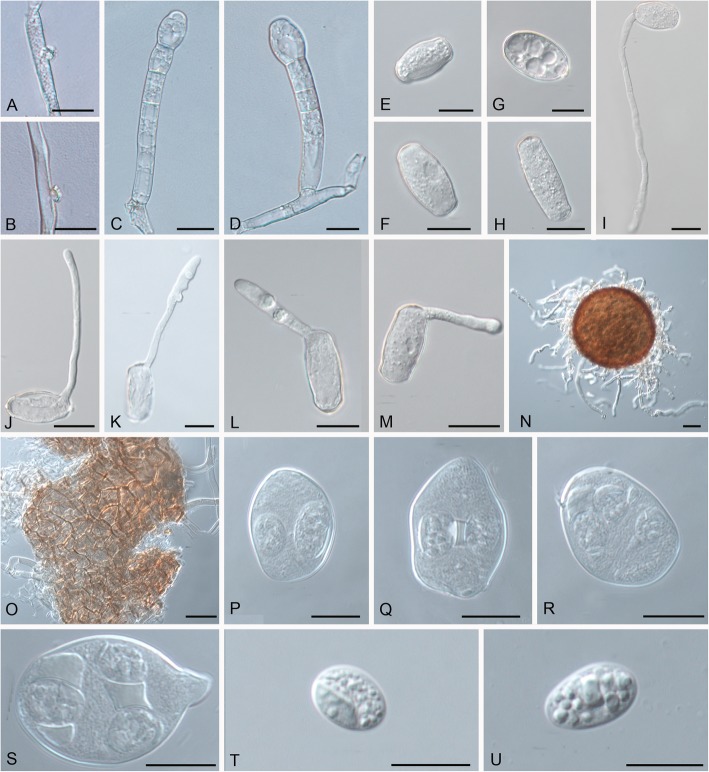
The phylogenetic and morphological analyses conducted in this study revealed three distinct species named, viz., (1) G. ambrosiae emend. (including G. spadiceus), a plurivorous species that occurs on a multitude of hosts including, Ambrosia spp., multiple species of the Heliantheae and plant species of other tribes of Asteraceae including the Asian species of Eupatorium; (2) G. latisporus comb. nov. (≡ Oidium latisporum), the closely related, but morphologically distinct species confined to hosts of the Heliantheae genera Helianthus, Zinnia, and most likely Rudbeckia; and (3) G. circumfusus confined to Eupatorium cannabinum in Europe.
The present results provide strong evidence that the combination of multi-locus phylogeny and morphological analysis is an effective way to identify species in the genus Golovinomyces.
基于 ITS 和 28S rDNA 序列数据的 Golovinomyces 属(子囊菌门,白粉菌目)种的系统发育分析表明,白粉菌种与菊科某些族的宿主之间存在共同进化关系。在属于半日花族的宿主植物上生长的 Golovinomyces 形成了一个单一谱系,包括一个形态分化的种复合体,其中包括 G. ambrosiae、G. circumfusus 和 G. spadiceus。然而,该谱系还包括从半日花族和其他科的植物上的 Golovinomyces 标本中获得的序列,这表明存在一种多食性物种。使用 ITS、28S、IGS(基因间 spacer)、TUB2(β-微管蛋白)和 CHS1(几丁质合酶 I)序列数据对该复合体进行多基因座系统发育研究,以澄清 ITS 和 28S rDNA 序列数据与形态差异之间的差异。此外,还修正了种的范围及其宿主范围。
本研究进行的系统发育和形态分析揭示了三个不同的种,分别是:(1)G. ambrosiae emend.(包括 G. spadiceus),一种多食性物种,发生在多种宿主上,包括 Ambrosia spp.、半日花族的多个种以及菊科其他族的植物种,包括菊属的亚洲种;(2)G. latisporus comb. nov.(≡ Oidium latisporum),密切相关但形态明显不同的种,局限于半日花族的 Helianthus、Zinnia 属和可能的 Rudbeckia 属的宿主;(3)G. circumfusus 局限于欧洲的大麻。
本研究结果提供了有力的证据,表明多基因座系统发育和形态分析相结合是识别 Golovinomyces 属种的有效方法。