Research School of Population Health, Australian National University, Building 62, Mills Rd, Acton, ACT, 2601, Australia.
The Sax Institute, Ultimo, Australia.
BMC Med Res Methodol. 2020 Mar 5;20(1):55. doi: 10.1186/s12874-020-00938-8.
Single time-point assessments of psychological distress are often used to indicate chronic mental health problems, but the validity of this approach is unclear. The aims of this study were to investigate how a single assessment of distress relates to longer-term assessment and quantify misclassification from using single measures to indicate chronic distress.
Data came from the Household, Income and Labour Dynamics in Australia Survey, a nationally representative study of Australian adults. Psychological distress, measured with the Kessler10 and categorised into low (scores:10- < 12), mild (12- < 16), moderate (16- < 22) and high (22-50), has been assessed in the Survey biennially since wave 7. Among respondents who were aged ≥25 years and participated in all waves in which distress was measured, we describe agreement in distress categories, and using a mixed linear model adjusting for age and sex we estimate change in scores, over a two-, four-, six- and eight-year follow-up period. We applied weights, benchmarked to the Australian population, to all analyses.
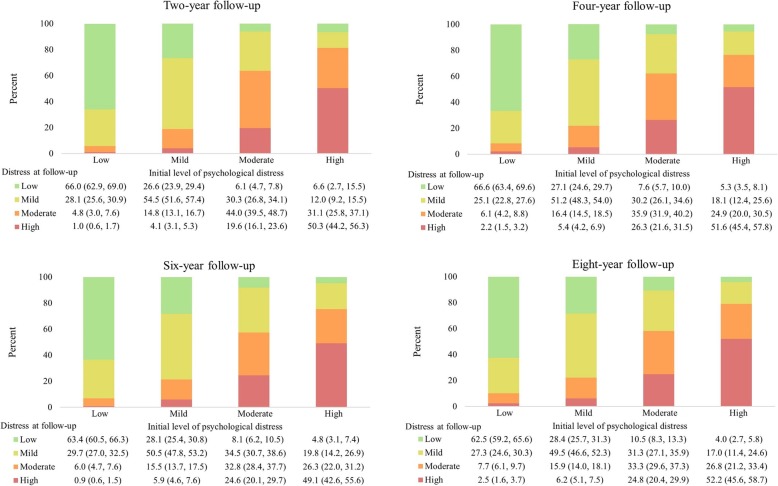
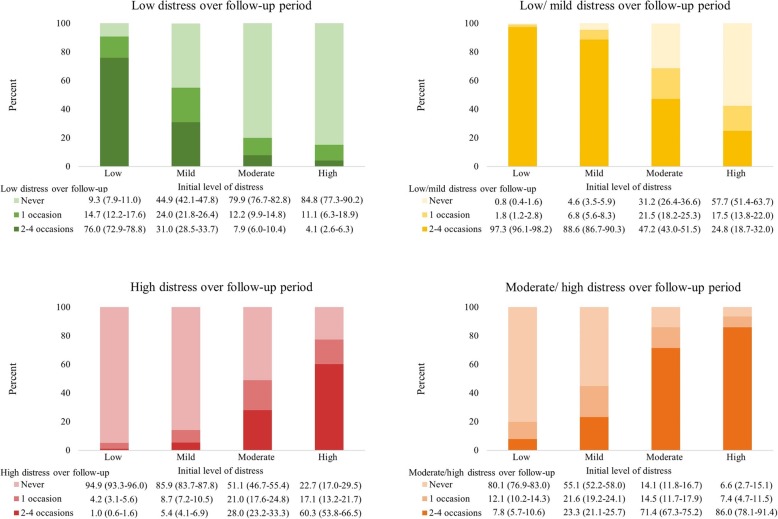
Two-years following initial assessment, proportions within identical categories of distress were 66.0% for low, 54.5% for mild, 44.0% for moderate and 50.3% for high, while 94.1% of those with low distress initially had low/mild distress and 81.4% with high distress initially had moderate/high distress. These patterns did not change materially as follow-up time increased. Over the full eight-year period, 77.3% of individuals with high distress initially reported high distress on ≥1 follow-up occasion. Age-and sex- adjusted change in K10 scores over a two-year period was 1.1, 0.5, - 0.7 and - 4.9 for low, mild, moderate and high distress, respectively, and also did not change materially as follow-up time increased.
In the absence of repeated measures, single assessments are useful proxies for chronic distress. Our estimates could be used in bias analyses to quantify the magnitude of the bias resulting from use of single assessments to indicate chronic distress.
单次评估心理困扰通常用于表示慢性心理健康问题,但这种方法的有效性尚不清楚。本研究旨在探讨单次评估的困扰与长期评估的关系,并量化使用单次测量来指示慢性困扰的错误分类。
数据来自澳大利亚家庭、收入和劳动力动态调查,这是一项针对澳大利亚成年人的全国代表性研究。心理困扰使用 Kessler10 进行测量,分为低(得分:<10-12)、轻度(12-<16)、中度(16-<22)和高(22-50),自第七波以来,该调查每两年评估一次。在年龄≥25 岁且参加了所有测量困扰的波次的受访者中,我们描述了困扰类别的一致性,并使用混合线性模型,根据年龄和性别调整分数,在两年、四年、六年和八年的随访期间进行了估计。我们对所有分析都应用了加权,基准为澳大利亚人口。
在初次评估后的两年内,低、轻度、中度和重度困扰的相同类别比例分别为 66.0%、54.5%、44.0%和 50.3%,而最初低困扰的人群中,94.1%的人群有低/轻度困扰,而最初高困扰的人群中,81.4%的人群有中度/高困扰。随着随访时间的增加,这些模式并没有实质性的变化。在整个八年期间,最初报告高困扰的人群中有 77.3%在至少一次随访中报告了高困扰。在两年期间,K10 评分的年龄和性别调整变化分别为低、轻度、中度和重度困扰为 1.1、0.5、-0.7 和-4.9,随着随访时间的增加,这些变化也没有实质性的变化。
在没有重复测量的情况下,单次评估是慢性困扰的有用指标。我们的估计可以用于偏差分析,以量化使用单次评估来指示慢性困扰所导致的偏差的大小。