van Campen C Linda M C, Verheugt Freek W A, Rowe Peter C, Visser Frans C
Stichting CardioZorg, Planetenweg 5, 2132 HN Hoofddorp, The Netherlands.
Department of Cardiology, Onze Lieve Vrouwe Gasthuis (OLVG), Oosterpark 9, 1091 AC Amsterdam, The Netherlands.
Clin Neurophysiol Pract. 2020 Feb 8;5:50-58. doi: 10.1016/j.cnp.2020.01.003. eCollection 2020.
The underlying hypothesis in orthostatic intolerance (OI) syndromes is that symptoms are associated with cerebral blood flow (CBF) reduction. Indirect CBF measurements (transcranial Doppler flow velocities), provide inconsistent support of this hypothesis. The aim of the study was to measure CBF during a 30 min head-up tilt test (HUT), using Doppler flow imaging of carotid and vertebral arteries, in individuals with chronic fatigue syndrome/myalgic encephalomyelitis (ME/CFS), a condition with a high prevalence of OI.
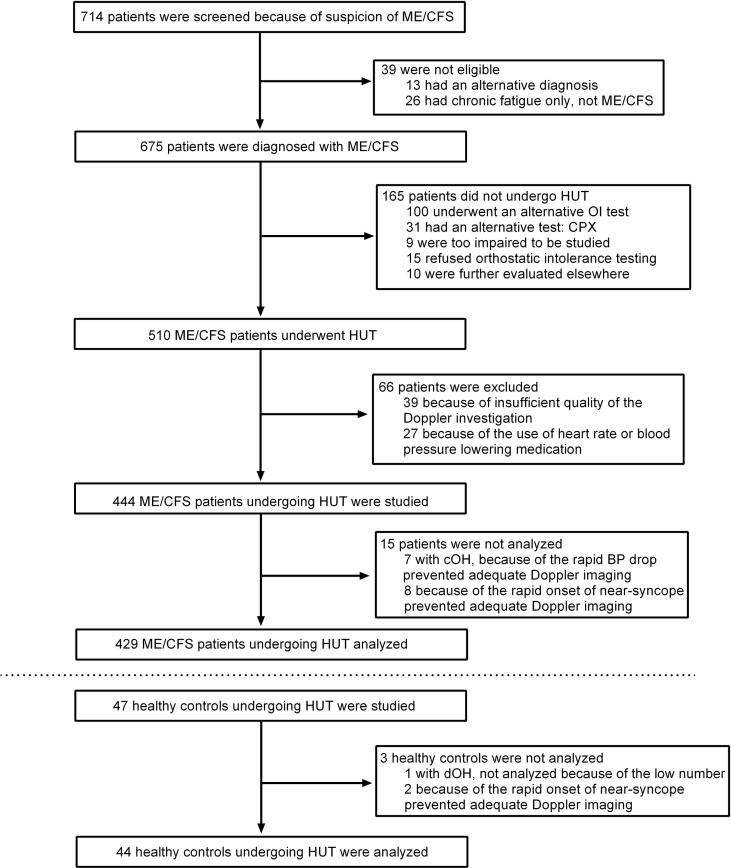
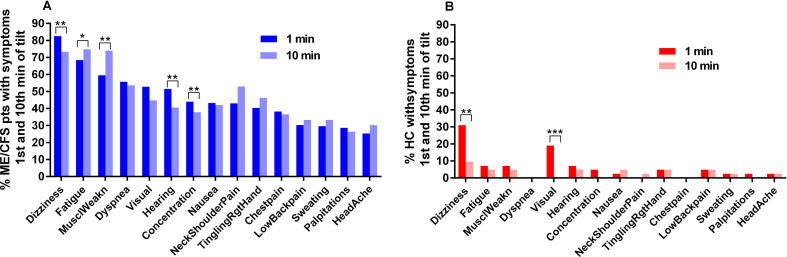
429 ME/CFS patients were studied: 247 had a normal heart rate (HR) and blood pressure (BP) response to HUT, 62 had delayed orthostatic hypotension (dOH), and 120 had postural orthostatic tachycardia syndrome (POTS). We also studied 44 healthy controls (HC). CBF measurements were made at mid-tilt and end-tilt. Before mid-tilt, we administered a verbal questionnaire to ascertain for 15 OI symptoms.
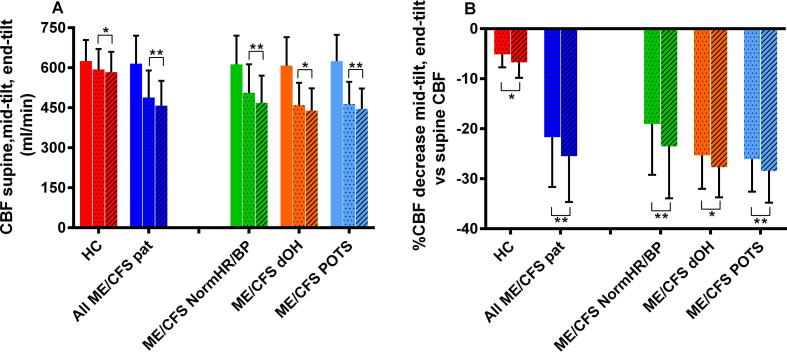
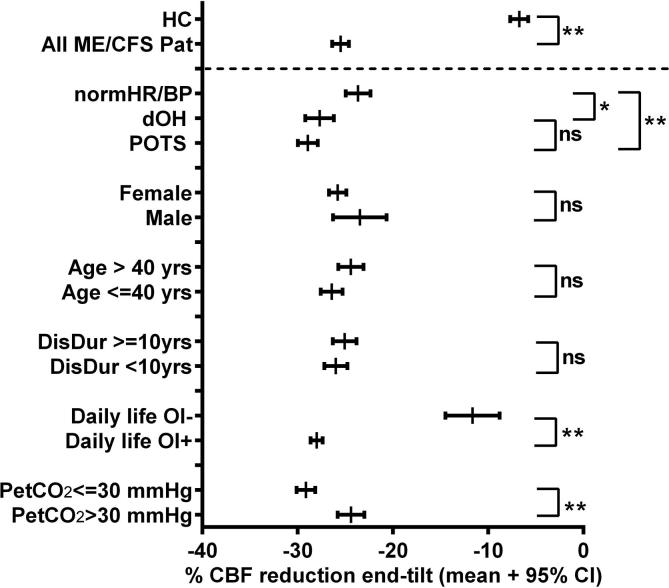
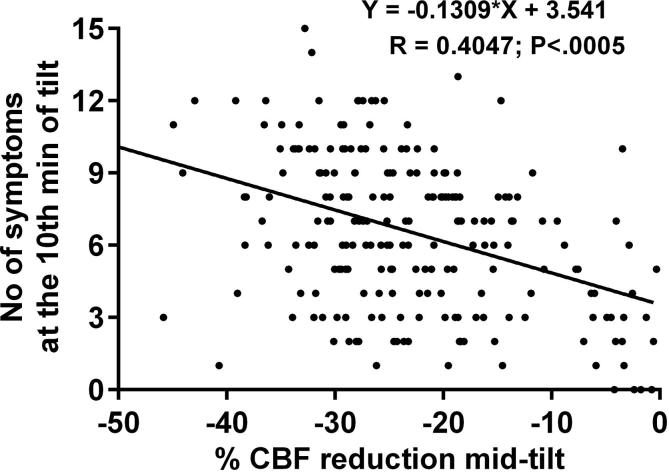
End-tilt CBF reduction was 7% in HC versus 26% in the overall ME/CFS group, 24% in patients with a normal HR/BP response, 28% in those with dOH, and 29% in POTS patients (all P < .0005). Using a lower limit of normal of 2SD of CBF reduction in HC (13% reduction), 82% of patients with normal HR/BP response, 98% with dOH and 100% with POTS showed an abnormal CBF reduction. There was a linear correlation of summed OI symptoms with the degree of CBF reduction at mid-tilt (P < .0005).
During HUT, extracranial Doppler measurements demonstrate that CBF is reduced in ME/CFS patients with POTS, dOH, and even in those without HR/BP abnormalities.
This study shows that orthostatic intolerance symptoms are related to CBF reduction, and that the majority of ME/CFS patients (90%) show an abnormal cerebral flow reduction during orthostatic stress testing. This may have implications for the diagnosis and treatment of ME/CFS patients.
体位性不耐受(OI)综合征的潜在假设是症状与脑血流量(CBF)减少有关。间接CBF测量(经颅多普勒血流速度)对这一假设的支持并不一致。本研究的目的是在30分钟的头高位倾斜试验(HUT)期间,使用颈动脉和椎动脉的多普勒血流成像,测量慢性疲劳综合征/肌痛性脑脊髓炎(ME/CFS)患者的CBF,ME/CFS是一种OI患病率很高的疾病。
对429例ME/CFS患者进行研究:247例对HUT的心率(HR)和血压(BP)反应正常,62例有延迟性体位性低血压(dOH),120例有体位性心动过速综合征(POTS)。我们还研究了44名健康对照者(HC)。在倾斜中期和倾斜末期进行CBF测量。在倾斜中期之前,我们发放了一份口头问卷,以确定15种OI症状。
HC的倾斜末期CBF减少7%,而ME/CFS总体组为26%,HR/BP反应正常的患者为24%,dOH患者为28%,POTS患者为29%(所有P<0.0005)。以HC中CBF减少2个标准差的正常下限(减少13%)为标准,HR/BP反应正常的患者中有82%、dOH患者中有98%、POTS患者中有100%的CBF减少异常。倾斜中期OI症状总和与CBF减少程度呈线性相关(P<0.0005)。
在HUT期间,颅外多普勒测量表明,患有POTS、dOH的ME/CFS患者,甚至那些没有HR/BP异常的患者,CBF都会减少。
本研究表明,体位性不耐受症状与CBF减少有关,并且大多数ME/CFS患者(90%)在体位性应激测试期间表现出异常的脑血流减少。这可能对ME/CFS患者的诊断和治疗有影响。