van Campen C Linda M C, Verheugt Freek W A, Visser Frans C
Stichting CardioZorg, Planetenweg 5, 2132 HN Hoofddorp, The Netherlands.
Radboud UMC, Geert Grooteplein Zuid 10, 6525 GA Nijmegen, The Netherlands.
Clin Neurophysiol Pract. 2018 Mar 23;3:91-95. doi: 10.1016/j.cnp.2018.02.004. eCollection 2018.
Using different techniques, reduction of cerebral blood flow (CBF) during orthostatic stress were demonstrated. One study reported flow reduction of the right internal carotid (ICA) and vertebral (VA) artery during orthostatic stress by Doppler imaging, with different effects on the 2 vessels. Global CBF changes, using this technique, have not been reported. Therefore, flow of the ICA, VA and global CBF were measured during head-up tilt testing.
33 healthy volunteers underwent tilt testing. At three time points (supine, half way and at the end of the test) Doppler imaging of the ICA and VA was performed, as well as PetCO2 measurements.
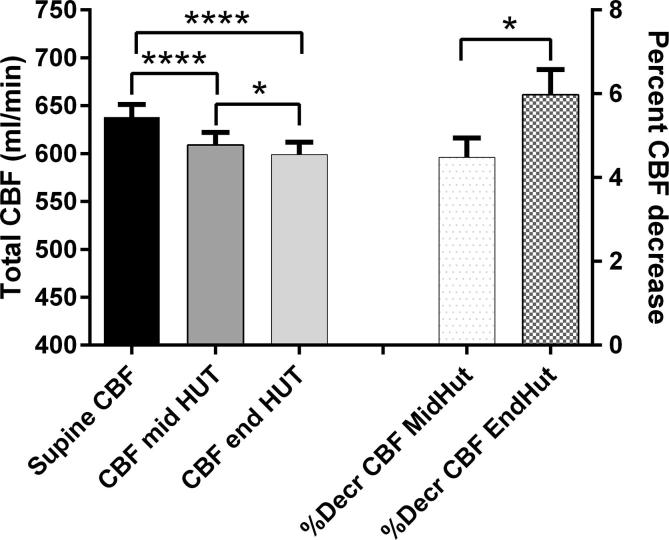
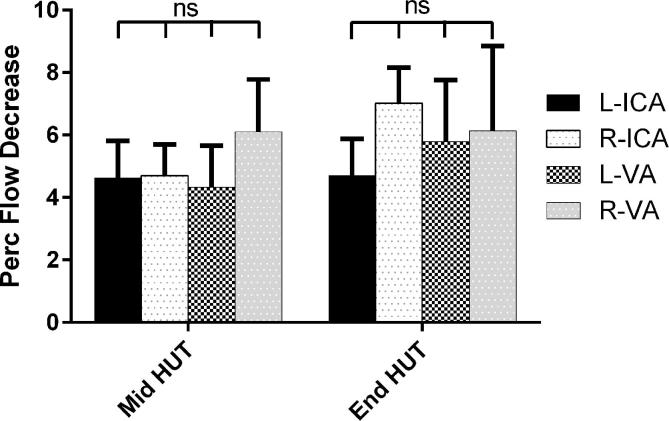
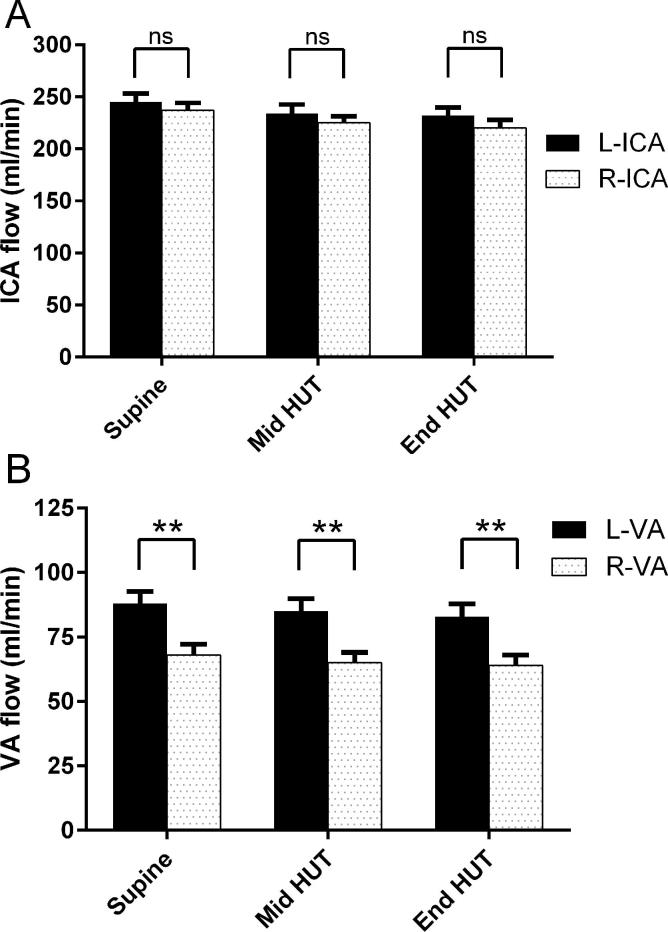
Global CBF was significantly reduced by 4.5 ± 2.8% halfway the test and by 6.0 ± 3.4% at the end. All 4 artery flows were significantly reduced during the tilt, without differences between them. Despite small changes in PetCO2 there was a significant relation between de CBF decrease and PetCO2 decrease (p < 0.05).
Orthostatic stress in HV results in a small but significant reduction of CBF by a homogenous reduction in the four cerebral vessels and is modulated by PetCO2 changes.
CBF changes can be measured during tilt testing using Doppler VA and ICA imaging.
运用不同技术,已证实体位性应激期间脑血流量(CBF)会降低。一项研究通过多普勒成像报告了体位性应激期间右侧颈内动脉(ICA)和椎动脉(VA)血流减少,且对这两支血管的影响不同。尚未有研究报告运用该技术时全脑CBF的变化情况。因此,在头高位倾斜试验期间测量了ICA、VA血流及全脑CBF。
33名健康志愿者接受倾斜试验。在三个时间点(仰卧位、试验中途和试验结束时)对ICA和VA进行多普勒成像,并测量呼气末二氧化碳分压(PetCO2)。
试验中途全脑CBF显著降低4.5±2.8%,试验结束时降低6.0±3.4%。倾斜期间所有4支动脉血流均显著减少,且它们之间无差异。尽管PetCO2有微小变化,但CBF降低与PetCO2降低之间存在显著相关性(p<0.05)。
健康志愿者的体位性应激会导致4支脑血管均匀减少,进而使CBF出现小幅度但显著的降低,且受PetCO2变化调节。
在倾斜试验期间可使用多普勒VA和ICA成像测量CBF变化。