Research Institute of Asian Women, Sookmyung Women's University, 47 Na-gil 36 Cheongpa-ro, Yongsan-gu, Seoul, 04309, Republic of Korea.
Department of Preventive Medicine, Yonsei University College of Medicine, Seoul, Republic of Korea.
BMC Pregnancy Childbirth. 2020 Mar 6;20(1):148. doi: 10.1186/s12884-020-2820-7.
As the rate of cesarean section delivery has increased, the incidence of severe maternal morbidity continues to increase. Severe maternal morbidity is associated with high medical costs, extended length of hospital stay, and long-term rehabilitation. However, there is no evidence whether severe maternal morbidity affects postpartum readmission. Therefore, this study aimed to determine the relationship between severe maternal morbidity and postpartum readmission.
This nationwide population-based cohort study used the Korean National Health Insurance Service-National Sample cohort of 90,035 delivery cases between January 2003 and November 2013. The outcome variable was postpartum readmission until 6 weeks after the first date of delivery in the hospital. Another variable of interest was the occurrence of severe maternal morbidity, which was determined using the Center for Disease Control and Prevention's algorithm. The Cox proportional hazard model was used to assess the association between postpartum readmission and severe maternal morbidity after all covariates were adjusted.
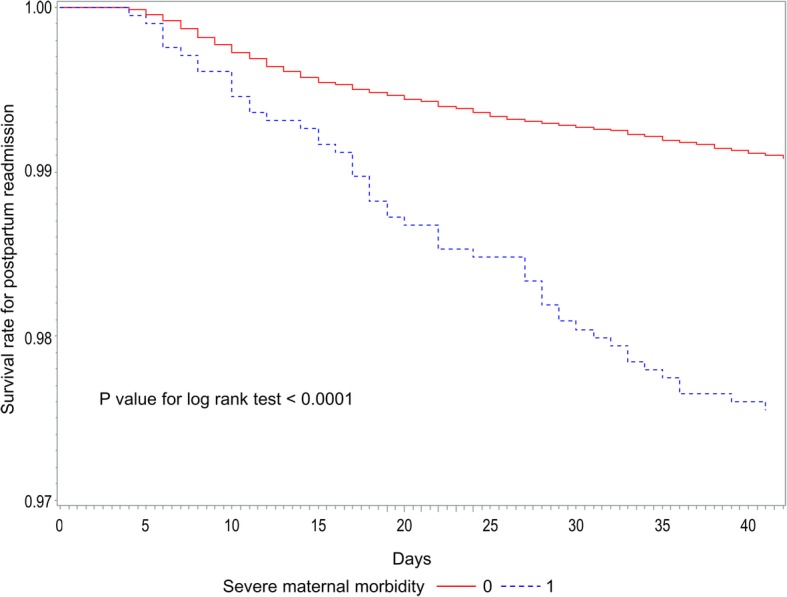
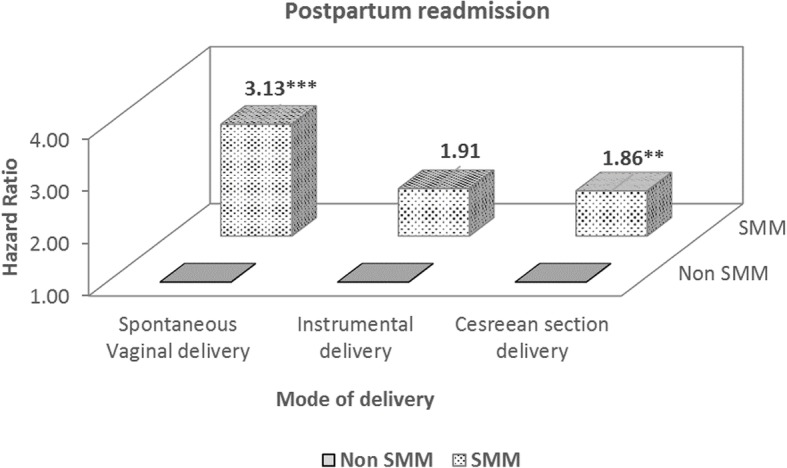
The overall incidence of postpartum readmission was 2041 cases (0.95%) of delivery. Women with severe maternal morbidity had an approximately 2.4 times higher risk of postpartum readmission than those without severe maternal morbidity (hazard ratio 2.36, 95% confidence interval 1.75-3.19). In addition, compared with reference group, women who were aged 20-30 years, nulliparous, and delivered in a tertiary hospital were at high risk of postpartum readmission.
Severe maternal morbidity was related to the risk of postpartum readmission. Policy makers should provide a quality indicator of postpartum maternal health care and improve the quality of intrapartum care.
随着剖宫产率的上升,严重产妇发病率持续上升。严重产妇发病率与高医疗费用、住院时间延长和长期康复有关。然而,目前尚无证据表明严重产妇发病率是否会影响产后再入院。因此,本研究旨在确定严重产妇发病率与产后再入院之间的关系。
本研究采用了韩国国家健康保险服务-国家抽样队列 2003 年 1 月至 2013 年 11 月期间的 90035 例分娩病例进行了全国性的基于人群的队列研究。因变量是产后 6 周内的再次入院。另一个感兴趣的变量是严重产妇发病率,这是使用疾病控制和预防中心的算法来确定的。在调整所有协变量后,使用 Cox 比例风险模型评估产后再入院与严重产妇发病率之间的关系。
总体产后再入院率为 2041 例(0.95%)。与无严重产妇发病率的产妇相比,患有严重产妇发病率的产妇产后再入院的风险约高 2.4 倍(风险比 2.36,95%置信区间 1.75-3.19)。此外,与参考组相比,年龄在 20-30 岁、初产妇和在三级医院分娩的产妇产后再入院的风险较高。
严重产妇发病率与产后再入院的风险相关。政策制定者应提供产后产妇保健质量指标,并提高分娩期护理质量。