Swinburne University of Technology, Mail Services Unit, H25, PO Box 218, Hawthorn, VIC, 3122, Australia.
Mind Australia, PO Box 592, Heidelberg, VIC, 3084, Australia.
BMC Health Serv Res. 2020 Mar 6;20(1):172. doi: 10.1186/s12913-020-4984-2.
This study presents a way for health services to improve service access for hardly reached people through an exploration of how staff can find and collaborate with citizens (referred to as connectors) who span socio-cultural boundaries in their community. The study explored the local socio-cultural contexts of connectors' boundary spanning activities and if they are health related; boundary spanning occurring between connectors and health professionals at the interface of health systems and community; and the opportunities and barriers to actively seeking out and collaborating with community connectors to access marginalised and hardly reached people.
We conducted a qualitative case comparison from rural Ireland and Australia. Following purposive snow-ball sampling techniques to recruit participants, semi-structured interviews were conducted with 34 community informants, 21 healthcare staff and 32 connectors. Transcripts were coded and analysed using an inductive approach to ascertain categories and overall themes.
We found a diverse sample of connectors relating to heterogenous, small and locally distinct groups of hardly reached people. Overall 26 connectors were active at the interface between health services and the community, with variation in how this occurred between cases. The majority (21) described one or more health related activities with hardly reached people. All connectors expressed a willingness to develop a relationship with local health services on issues they identified as relevant. Barriers to collaborations between connectors and health services related to bureaucracy, workload, and burnout.
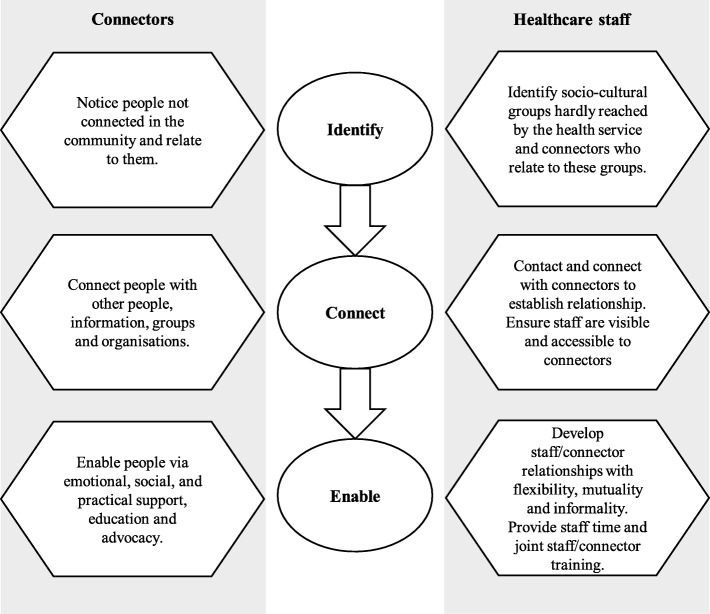
Collaborating with connectors has potential as one strategy to improve access to health services for hardly reached people. To enact this, health staff need to identify local socio-cultural boundaries and associated connectors, facilitate two-way connections at the boundary between health services and community and enable collaboration by attending to activities in the community, at the interface between health services and community, and within the health system.
本研究提出了一种通过探索工作人员如何找到并与跨越社区社会文化界限的公民(称为“连接器”)合作,为服务难以触及的人群改善服务获取途径的方法。本研究探讨了连接器跨越边界活动的当地社会文化背景,以及它们是否与健康相关;连接器在卫生系统和社区接口处与卫生专业人员之间发生的跨越边界活动;以及积极寻找和与社区连接器合作以接触边缘化和服务难以触及的人群的机会和障碍。
我们在爱尔兰和澳大利亚农村进行了一项定性案例比较。通过有针对性的滚雪球抽样技术招募参与者,对 34 名社区线人、21 名医疗保健人员和 32 名连接器进行了半结构化访谈。使用归纳方法对转录本进行编码和分析,以确定类别和总体主题。
我们发现连接器的样本多样,涉及难以触及的人群中异质、小规模和本地独特的群体。总体而言,有 26 名连接器在卫生服务和社区之间的接口处活跃,不同案例之间的活动方式存在差异。其中大多数(21 人)描述了与难以触及的人群开展一项或多项与健康相关的活动。所有连接器都表示愿意就他们认为相关的问题与当地卫生服务部门建立关系。连接器与卫生服务部门之间合作的障碍与官僚主义、工作量和倦怠有关。
与连接器合作作为改善服务难以触及的人群获得卫生服务的策略具有潜力。为此,卫生工作人员需要识别当地的社会文化界限和相关连接器,促进卫生服务和社区之间边界的双向连接,并通过关注社区内、卫生服务和社区之间接口以及卫生系统内的活动来促进合作。