Department of Neuroimmunology, Max Planck Institute of Neurobiology, Martinsried, Germany.
Faculty of Medicine, University of Freiburg, Freiburg, Germany.
J Neuroinflammation. 2020 Mar 6;17(1):79. doi: 10.1186/s12974-020-01766-9.
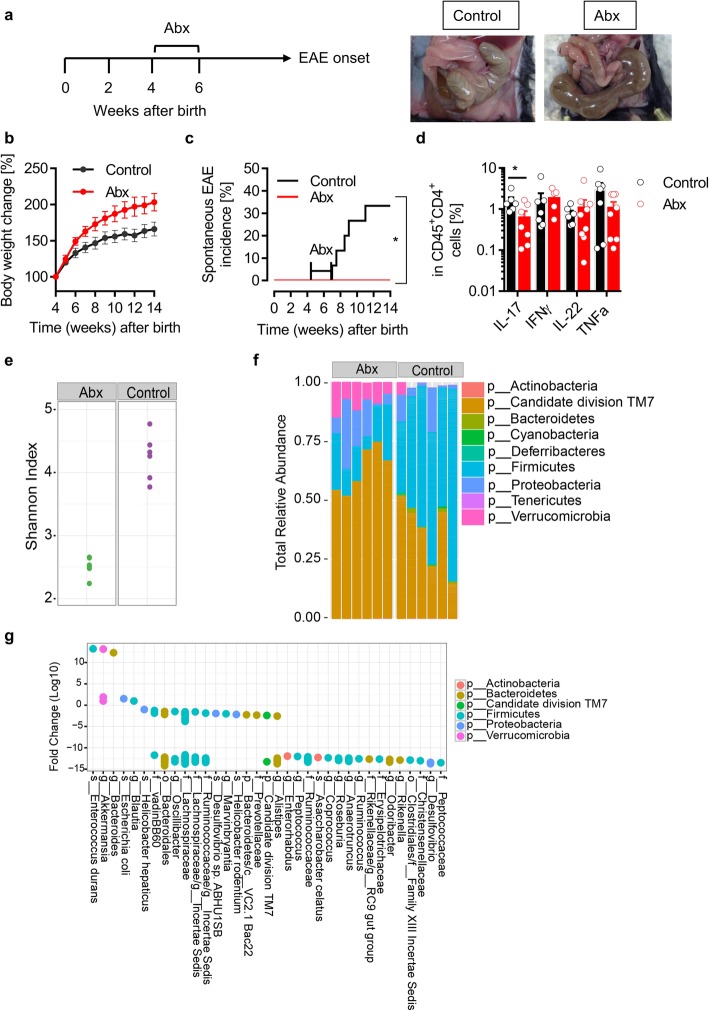
The gut microbiota regulates the host immune and nervous systems and plays an important role in the pathogenesis of autoimmune neurological disease multiple sclerosis (MS). There are considerable efforts currently being undertaken to develop therapies for MS based on the modulation of microbiota. Evidence from experimental models suggests that the manipulation of microbiota through diet or antibiotics prior to the disease development limits disease susceptibility. However, it is currently unclear if microbiota manipulation therapies would also have an impact on ongoing neurological disease. Here, we examined the effect of antibiotic-based microbiota modulation in spontaneous experimental autoimmune encephalomyelitis (EAE) mouse models of MS before and after the onset of autoimmune disease. Prophylactic antibiotic treatment led to a significant reduction of susceptibility to spontaneous EAE. In contrast, antibiotic treatment after the onset of spontaneous EAE did not show a significant amelioration. These results reveal that the perturbation of gut bacteria alters disease susceptibility but has minimal impact on the ongoing neurological disease.
肠道微生物群调节宿主的免疫和神经系统,在自身免疫性神经疾病多发性硬化症(MS)的发病机制中发挥重要作用。目前,人们正在努力开发基于微生物群调节的 MS 治疗方法。来自实验模型的证据表明,在疾病发展之前通过饮食或抗生素来操纵微生物群可以限制疾病易感性。然而,目前尚不清楚微生物群操纵疗法是否也会对正在进行的神经疾病产生影响。在这里,我们在 MS 的自发性实验性自身免疫性脑脊髓炎(EAE)小鼠模型中检查了发病前和发病后的基于抗生素的微生物群调节的效果。预防性抗生素治疗导致对自发性 EAE 的易感性显著降低。相比之下,在自发性 EAE 发病后进行抗生素治疗并没有显著改善。这些结果表明,肠道细菌的扰动会改变疾病的易感性,但对正在进行的神经疾病的影响很小。