Institut für Physikalische Chemie, Lehrstuhl für Molekulare Physikalische Chemie, Heinrich-Heine-Universität, Düsseldorf, Germany.
Department of Physics and Astronomy, Clemson University, Clemson, SC, USA.
Nat Commun. 2020 Mar 6;11(1):1231. doi: 10.1038/s41467-020-14886-w.
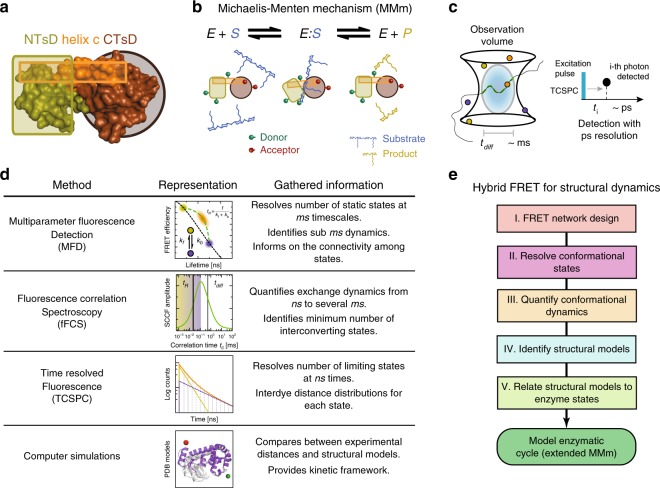
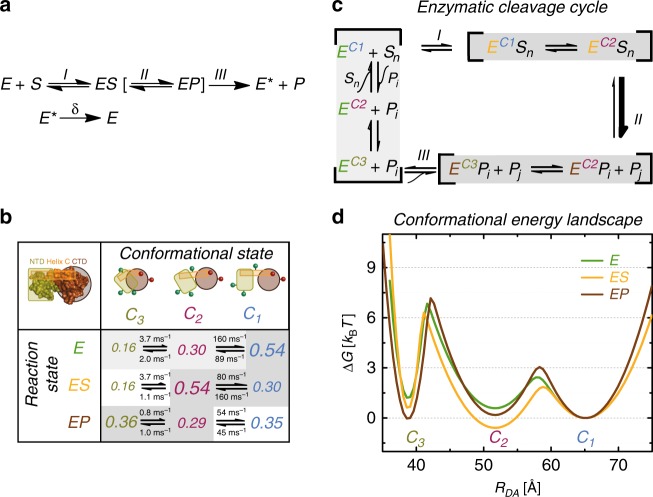
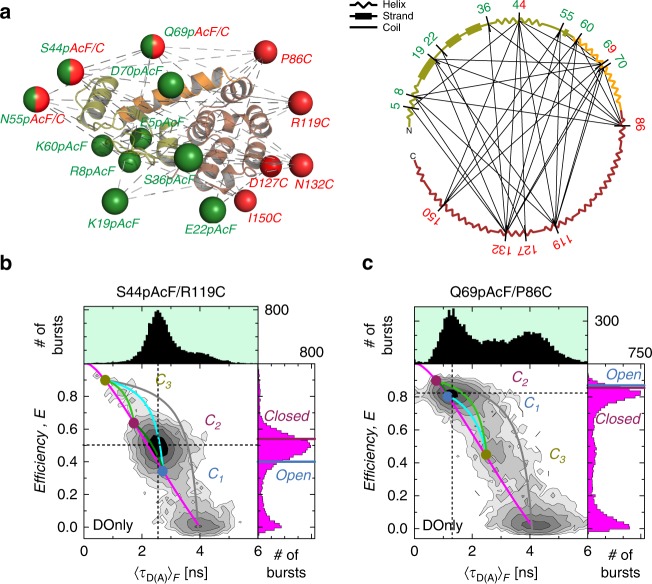
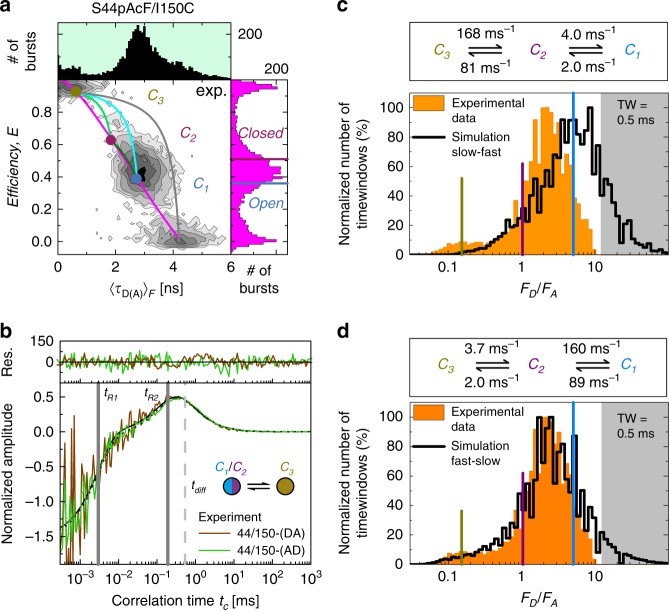
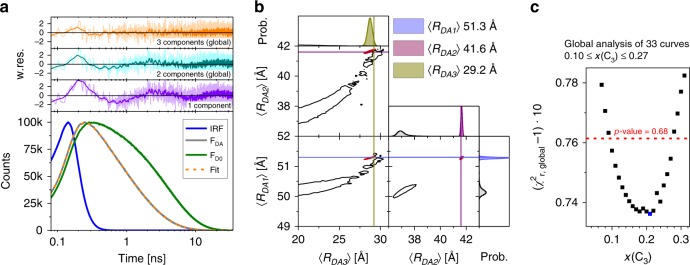
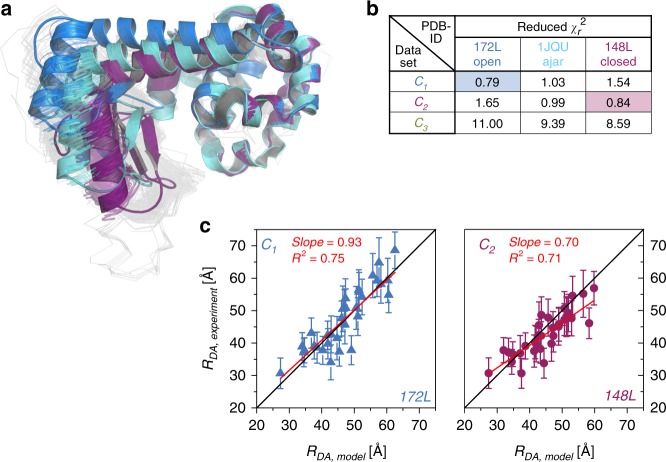
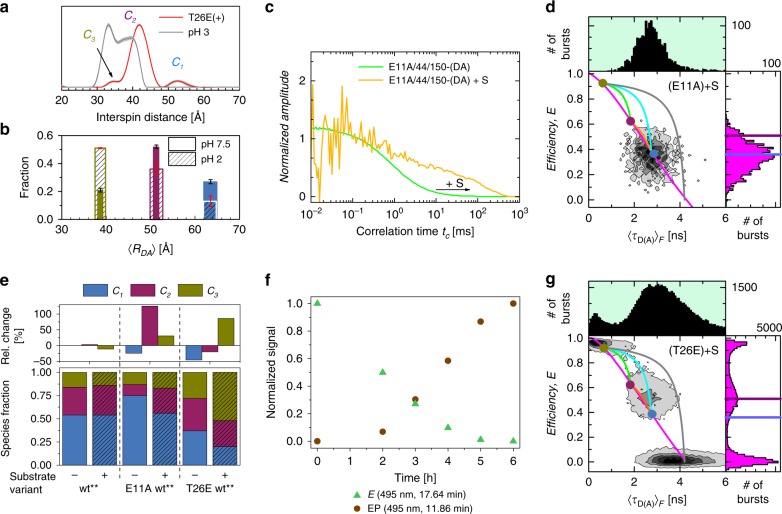
We use a hybrid fluorescence spectroscopic toolkit to monitor T4 Lysozyme (T4L) in action by unraveling the kinetic and dynamic interplay of the conformational states. In particular, by combining single-molecule and ensemble multiparameter fluorescence detection, EPR spectroscopy, mutagenesis, and FRET-positioning and screening, and other biochemical and biophysical tools, we characterize three short-lived conformational states over the ns-ms timescale. The use of 33 FRET-derived distance sets, to screen available T4L structures, reveal that T4L in solution mainly adopts the known open and closed states in exchange at 4 µs. A newly found minor state, undisclosed by, at present, more than 500 crystal structures of T4L and sampled at 230 µs, may be actively involved in the product release step in catalysis. The presented fluorescence spectroscopic toolkit will likely accelerate the development of dynamic structural biology by identifying transient conformational states that are highly abundant in biology and critical in enzymatic reactions.
我们使用混合荧光光谱工具包来监测 T4 溶菌酶 (T4L) 的作用,揭示构象状态的动力学和动态相互作用。具体来说,通过结合单分子和整体多参数荧光检测、EPR 光谱学、突变、FRET 定位和筛选以及其他生化和生物物理工具,我们在纳秒到毫秒的时间尺度上表征了三个短寿命构象状态。使用 33 个 FRET 衍生的距离集来筛选可用的 T4L 结构,表明 T4L 在溶液中主要以已知的开放和关闭状态在 4 µs 内进行交换。目前,通过 500 多个 T4L 晶体结构和 230 µs 的采样尚未揭示的新发现的次要状态可能在催化中的产物释放步骤中积极参与。所提出的荧光光谱工具包可能通过鉴定在生物学中高度丰富且在酶反应中至关重要的瞬态构象状态来加速动态结构生物学的发展。