Medical Department I , Centre for Translational Medicine, Marienhospital Herne, Universitätsklinikum Der Ruhr-Universität Bochum, Ruhr-Universität Bochum, Hölkeskampring 40, 44623, Herne, Germany.
Biodiversity, University of Duisburg-Essen, Essen, Germany.
J Nephrol. 2020 Aug;33(4):817-827. doi: 10.1007/s40620-019-00694-z. Epub 2020 Mar 6.
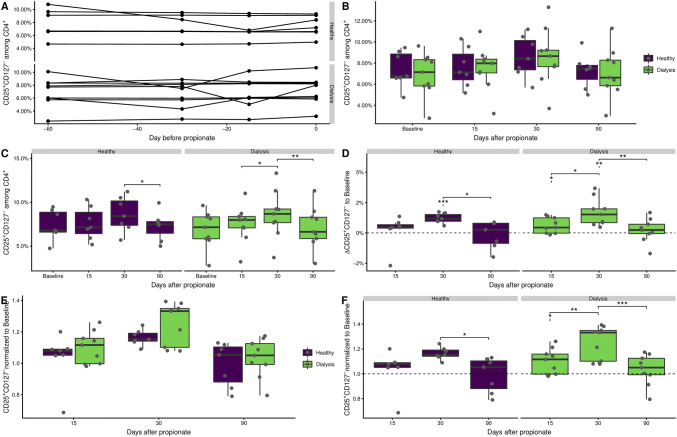
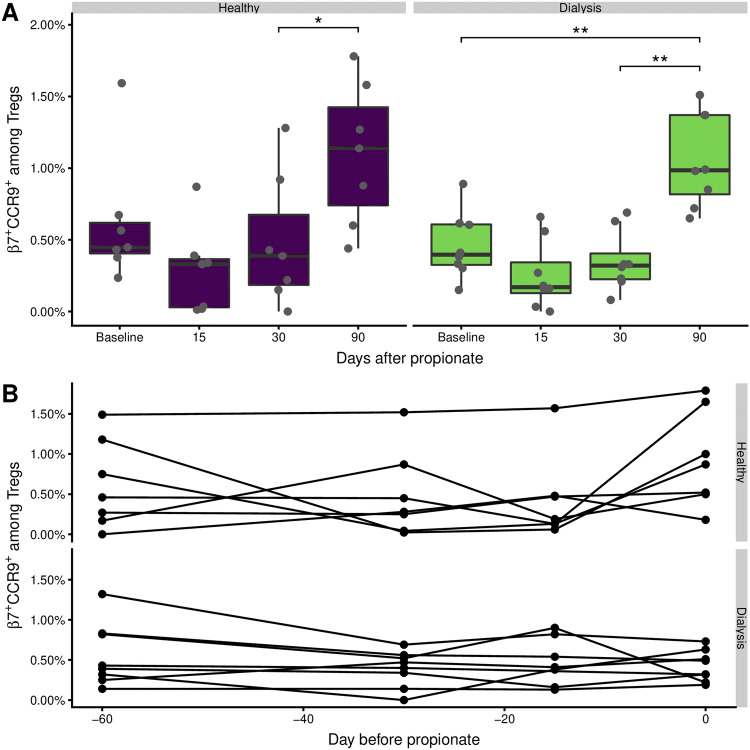
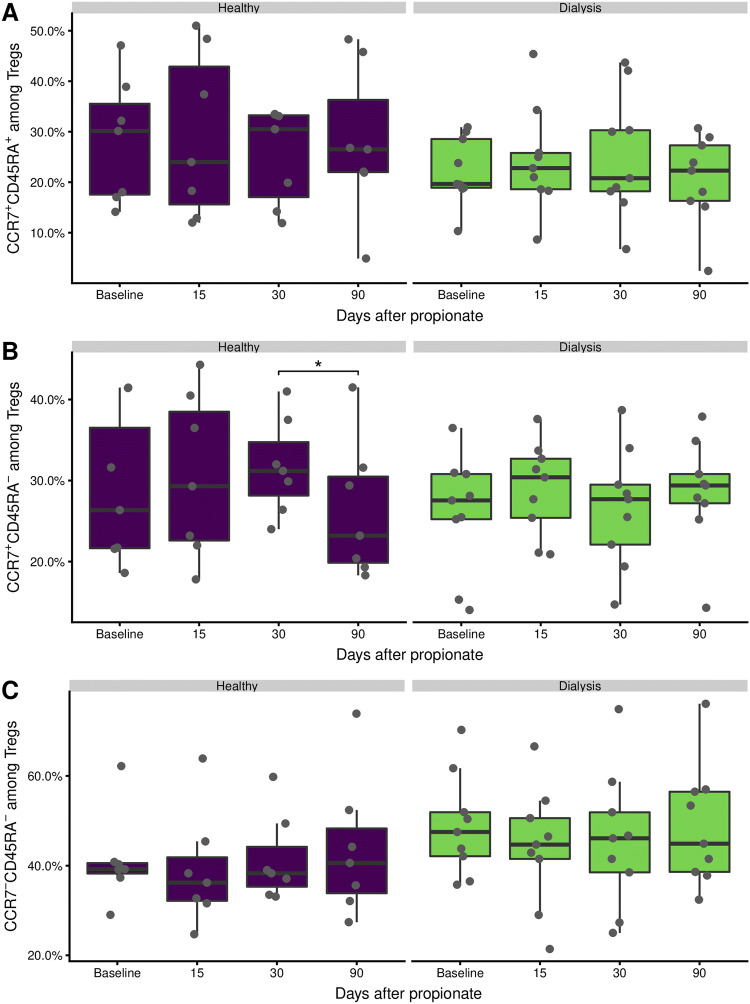
Patients with end-stage renal disease (ESRD) suffer from a progressively increasing low-grade systemic inflammation, which is associated with higher morbidity and mortality. Regulatory T cells (Tregs) play an important role in regulation of the inflammatory process. Previously, it has been demonstrated that short-chain fatty acids reduce inflammation in the central nervous system in a murine model of multiple sclerosis through an increase in tissue infiltrating Tregs. Here, we evaluated the effect of the short-chain fatty acid propionate on the chronic inflammatory state and T-cell composition in ESRD patients. Analyzing ESRD patients and healthy blood donors before, during, and 60 days after the propionate supplementation by multiparametric flow cytometry we observed a gradual and significant expansion in the frequencies of CD25CD127 Tregs in both groups. Phenotypic characterization suggests that polarization of naïve T cells towards Tregs is responsible for the observed expansion. In line with this, we observed a significant reduction of inflammatory marker CRP under propionate supplementation. Of interest, the observed anti-inflammatory surroundings did not affect the protective pathogen-specific immunity as demonstrated by the stable frequencies of effector/memory T cells specific for tetanus/diphtheria recall antigens. Collectively, our data suggest that dietary supplements with propionate have a beneficial effect on the elevated systemic inflammation of ESRD patients. The effect can be achieved through an expansion of circulating Tregs without affecting the protective pathogen-reactive immunity.
终末期肾病 (ESRD) 患者患有进行性增加的低度全身炎症,这与更高的发病率和死亡率有关。调节性 T 细胞 (Tregs) 在炎症过程的调节中起着重要作用。先前已经证明,短链脂肪酸通过增加组织浸润的 Tregs 来减少多发性硬化症的中枢神经系统中的炎症。在这里,我们评估了短链脂肪酸丙酸盐对 ESRD 患者慢性炎症状态和 T 细胞组成的影响。通过多参数流式细胞术分析 ESRD 患者和健康献血者在丙酸盐补充前后和 60 天后,我们观察到两组中 CD25CD127 Tregs 的频率逐渐显著增加。表型特征表明,幼稚 T 细胞向 Tregs 的极化是导致观察到的扩张的原因。与此一致,我们观察到丙酸盐补充下炎症标志物 CRP 的显著减少。有趣的是,观察到的抗炎环境并没有影响针对破伤风/白喉回忆抗原的保护性病原体特异性免疫,因为针对破伤风/白喉回忆抗原的效应/记忆 T 细胞的频率保持稳定。总的来说,我们的数据表明,丙酸盐的膳食补充剂对 ESRD 患者升高的全身炎症具有有益的影响。这种效果可以通过循环 Tregs 的扩张来实现,而不会影响保护性病原体反应性免疫。