Vanderbilt Memory & Alzheimer's Center, Department of Neurology, Vanderbilt University Medical Center, Nashville, TN, USA.
Department of Biostatistics, Vanderbilt University Medical Center, Nashville, TN, USA.
J Alzheimers Dis. 2020;74(3):965-974. doi: 10.3233/JAD-190813.
Subclinical cardiac dysfunction is associated with decreased cerebral blood flow, placing the aging brain at risk for Alzheimer's disease (AD) pathology and neurodegeneration.
This study investigates the association between subclinical cardiac dysfunction, measured by left ventricular ejection fraction (LVEF), and cerebrospinal fluid (CSF) biomarkers of AD and neurodegeneration.
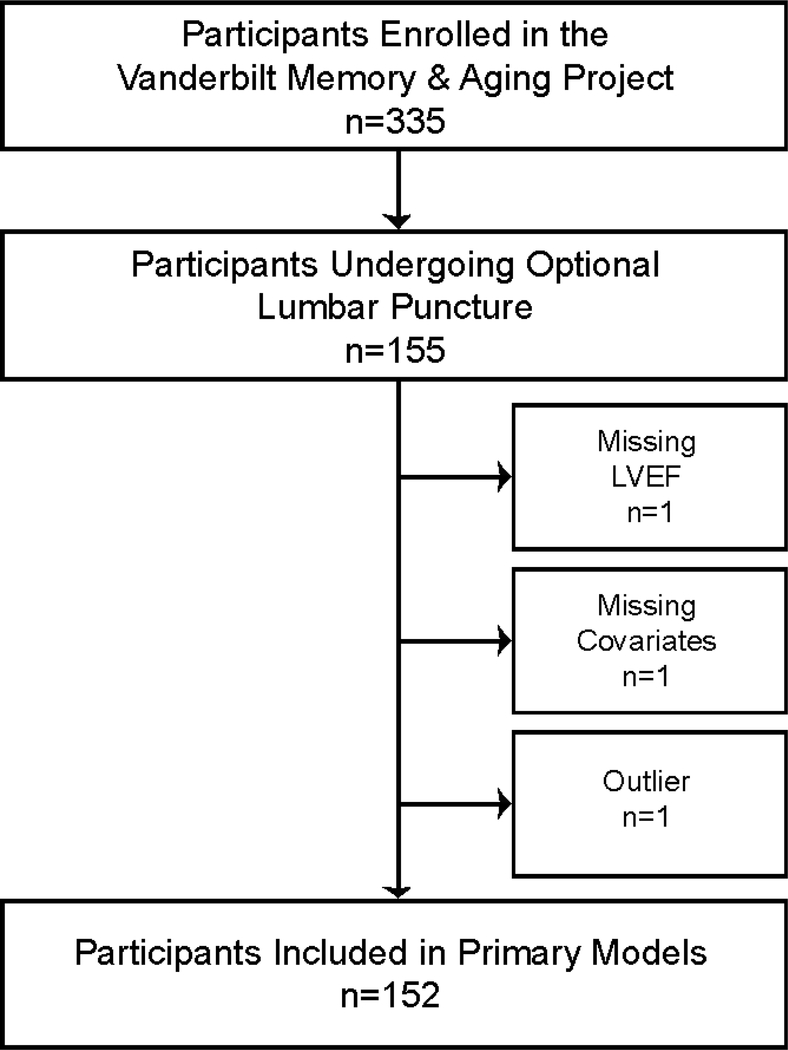
Vanderbilt Memory & Aging Project participants free of dementia, stroke, and heart failure (n = 152, 72±6 years, 68% male) underwent echocardiogram to quantify LVEF and lumbar puncture to measure CSF levels of amyloid-β42 (Aβ42), phosphorylated tau (p-tau), and total tau (t-tau). Linear regressions related LVEF to CSF biomarkers, adjusting for age, sex, race/ethnicity, education, Framingham Stroke Risk Profile, cognitive diagnosis, and apolipoprotein E ɛ4 status. Secondary models tested an LVEF x cognitive diagnosis interaction and then stratified by diagnosis (normal cognition (NC), mild cognitive impairment (MCI)).
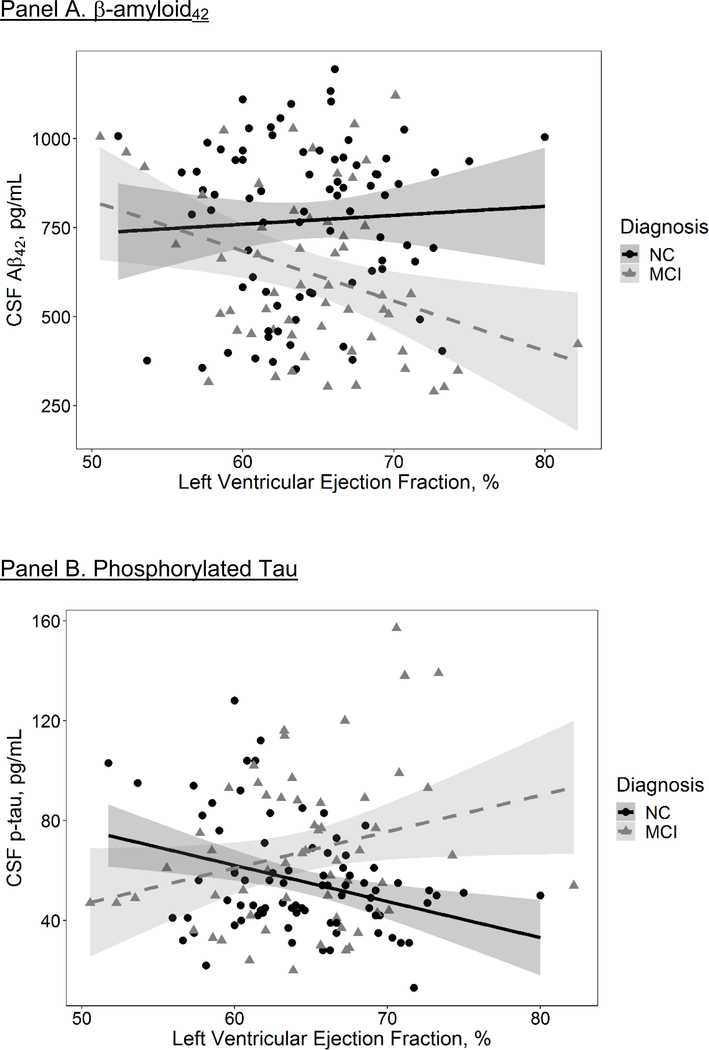
Higher LVEF related to decreased CSF Aβ42 levels (β= -6.50, p = 0.04) reflecting greater cerebral amyloid accumulation, but this counterintuitive result was attenuated after excluding participants with cardiovascular disease and atrial fibrillation (p = 0.07). We observed an interaction between LVEF and cognitive diagnosis on CSF t-tau (p = 0.004) and p-tau levels (p = 0.002), whereas lower LVEF was associated with increased CSF t-tau (β= -9.74, p = 0.01) and p-tau in the NC (β= -1.41, p = 0.003) but not MCI participants (p-values>0.13).
Among cognitively normal older adults, subclinically lower LVEF relates to greater molecular evidence of tau phosphorylation and neurodegeneration. Modest age-related changes in cardiovascular function may have implications for pathophysiological changes in the brain later in life.
亚临床心功能障碍与脑血流减少有关,使衰老的大脑容易受到阿尔茨海默病(AD)病理和神经退行性变的影响。
本研究旨在探讨左心室射血分数(LVEF)测量的亚临床心功能障碍与 AD 和神经退行性变的脑脊液(CSF)生物标志物之间的关系。
范德比尔特记忆与衰老项目的参与者无痴呆、中风和心力衰竭(n=152,72±6 岁,68%男性)接受超声心动图检查以量化 LVEF,并进行腰椎穿刺以测量 CSF 中淀粉样蛋白-β42(Aβ42)、磷酸化 tau(p-tau)和总 tau(t-tau)水平。线性回归将 LVEF 与 CSF 生物标志物相关联,并调整年龄、性别、种族/民族、教育程度、弗雷明汉中风风险评分、认知诊断和载脂蛋白 Eɛ4 状态。二级模型测试了 LVEF×认知诊断的相互作用,然后按诊断(正常认知(NC)、轻度认知障碍(MCI))进行分层。
较高的 LVEF 与 CSF Aβ42 水平降低(β=-6.50,p=0.04)相关,表明大脑淀粉样蛋白堆积更多,但这一与直觉相反的结果在排除心血管疾病和心房颤动患者后减弱(p=0.07)。我们观察到 LVEF 与 CSF t-tau(p=0.004)和 p-tau 水平(p=0.002)之间存在认知诊断的相互作用,而较低的 LVEF 与 CSF t-tau 增加相关(β=-9.74,p=0.01)和 NC 参与者的 p-tau(β=-1.41,p=0.003),但 MCI 参与者无此关联(p 值>0.13)。
在认知正常的老年人中,亚临床低 LVEF 与 tau 磷酸化和神经退行性变的更多分子证据相关。心血管功能的适度与年龄相关的变化可能对以后生活中大脑的病理生理变化有影响。