The Infectious Diseases Research Laboratory, Sheba Medical Center, Tel-Hashomer, Israel.
Sackler Faculty of Medicine, Tel Aviv University, Israel.
Genome Biol Evol. 2020 Mar 1;12(3):151-159. doi: 10.1093/gbe/evaa048.
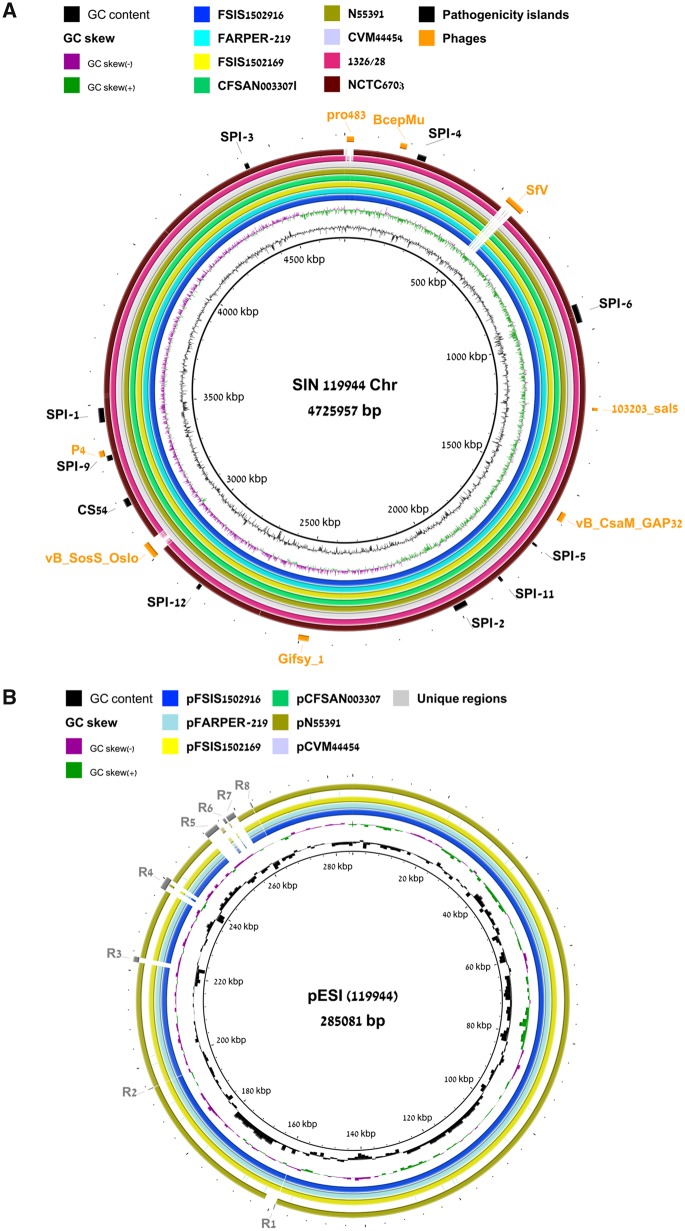
Salmonella enterica serovar Infantis (S. Infantis) is one of the dominant serovars of the bacterial pathogen S. enterica. In recent years, the number of human infections caused by S. Infantis has been increasing in many countries, and often the emerging population harbors a unique virulence-resistant megaplasmid called plasmid of emerging S. Infantis (pESI). Here, we report the complete gap-free genome sequence of the S. Infantis Israeli emerging clone and compare its chromosome and pESI sequences with other complete S. Infantis genomes. We show a conserved presence of the Salmonella pathogenicity islands 1-6, 9, 11, 12, and CS54 and a common integration of five bacteriophages in the S. Infantis chromosome. In contrast, we found variable presence of additionally three chromosomally integrated phages and eight modular regions in pESI, which contribute to the genetic and phenotypic diversity (including antimicrobial resistance) of this ubiquitous foodborne pathogen.
肠炎沙门氏菌血清型婴孩(S. Infantis)是沙门氏菌属细菌病原体的主要血清型之一。近年来,许多国家由肠炎沙门氏菌 Infantis 引起的人类感染数量不断增加,而新兴人群通常携带有一种独特的毒力抗性大型质粒,称为新兴肠炎沙门氏菌质粒(pESI)。在这里,我们报告了肠炎沙门氏菌婴孩以色列新兴克隆体的完整无间隙基因组序列,并将其染色体和 pESI 序列与其他完整的肠炎沙门氏菌基因组进行了比较。我们显示了沙门氏菌致病岛 1-6、9、11、12 和 CS54 的保守存在,以及五个噬菌体在肠炎沙门氏菌染色体中的共同整合。相比之下,我们发现 pESI 中另外三个染色体整合噬菌体和八个模块化区域的存在存在差异,这有助于这种普遍存在的食源性病原体的遗传和表型多样性(包括抗微生物药物耐药性)。