Department of Biochemistry, University of Nebraska Medical Center, Omaha, NE.
School of Interdisciplinary Informatics, University of Nebraska at Omaha, Omaha, NE.
Brain Pathol. 2020 Jul;30(4):732-745. doi: 10.1111/bpa.12829. Epub 2020 Mar 30.
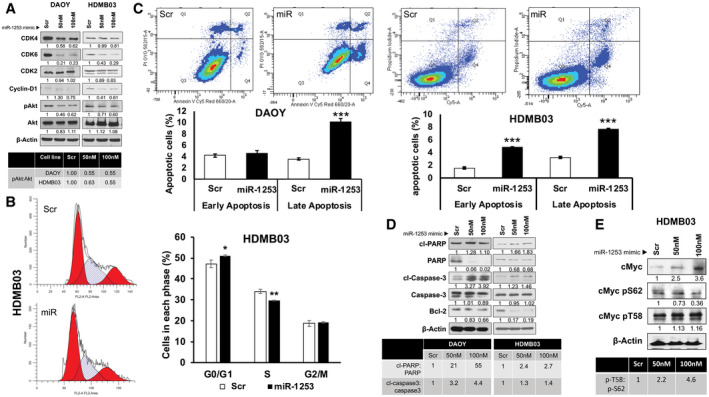
Of the four primary subgroups of medulloblastoma, the most frequent cytogenetic abnormality, i17q, distinguishes Groups 3 and 4 which carry the highest mortality; haploinsufficiency of 17p13.3 is a marker for particularly poor prognosis. At the terminal end of this locus lies miR-1253, a brain-enriched microRNA that regulates bone morphogenic proteins during cerebellar development. We hypothesized miR-1253 confers novel tumor-suppressive properties in medulloblastoma. Using two different cohorts of medulloblastoma samples, we first studied the expression and methylation profiles of miR-1253. We then explored the anti-tumorigenic properties of miR-1253, in parallel with a biochemical analysis of apoptosis and proliferation, and isolated oncogenic targets using high-throughput screening. Deregulation of miR-1253 expression was noted, both in medulloblastoma clinical samples and cell lines, by epigenetic silencing via hypermethylation; specific de-methylation of miR-1253 not only resulted in rapid recovery of expression but also a sharp decline in tumor cell proliferation and target gene expression. Expression restoration also led to a reduction in tumor cell virulence, concomitant with activation of apoptotic pathways, cell cycle arrest and reduction of markers of proliferation. We identified two oncogenic targets of miR-1253, CDK6 and CD276, whose silencing replicated the negative trophic effects of miR-1253. These data reveal novel tumor-suppressive properties for miR-1253, i.e., (i) loss of expression via epigenetic silencing; (ii) negative trophic effects on tumor aggressiveness; and (iii) downregulation of oncogenic targets.
在四个主要的髓母细胞瘤亚组中,最常见的细胞遗传学异常 i17q 区分了死亡率最高的第 3 组和第 4 组;17p13.3 的单倍体不足是预后特别差的标志物。在这个基因座的末端是 miR-1253,一种丰富的大脑microRNA,它在小脑发育过程中调节骨形态发生蛋白。我们假设 miR-1253 在髓母细胞瘤中赋予了新的肿瘤抑制特性。我们使用两个不同的髓母细胞瘤样本队列,首先研究了 miR-1253 的表达和甲基化谱。然后,我们通过生化分析细胞凋亡和增殖,以及使用高通量筛选分离致癌靶点,探索了 miR-1253 的抗肿瘤特性。通过超甲基化导致的表观遗传沉默,我们注意到 miR-1253 的表达失调,不仅在髓母细胞瘤临床样本中,而且在细胞系中也是如此;miR-1253 的特异性去甲基化不仅导致表达的快速恢复,而且导致肿瘤细胞增殖和靶基因表达的急剧下降。表达恢复也导致肿瘤细胞毒力降低,同时激活凋亡途径、细胞周期停滞和减少增殖标志物。我们鉴定了 miR-1253 的两个致癌靶标,CDK6 和 CD276,它们的沉默复制了 miR-1253 的负营养作用。这些数据揭示了 miR-1253 的新的肿瘤抑制特性,即:(i)通过表观遗传沉默导致表达缺失;(ii)对肿瘤侵袭性的负营养作用;(iii)下调致癌靶标。