Jang Hee Yeon, Lim Seung Mook, Lee Hyun Jung, Hong Joon-Seok, Kim Gi Jin
Department of Biomedical Science, CHA University, Seongnam, Korea.
Non-Clinical Evaluation Center, CHA Advanced Research Institute, Seongnam, Korea.
Clin Exp Reprod Med. 2020 Mar;47(1):42-53. doi: 10.5653/cerm.2019.03013. Epub 2020 Mar 1.
Recently, microRNA (miRNA) has been identified both as a powerful regulator involved in various biological processes through the regulation of numerous genes and as an effective biomarker for the prediction and diagnosis of various disease states. The objective of this study was to identify and validate miRNAs and their target genes involved in inflammation in placental tissue.
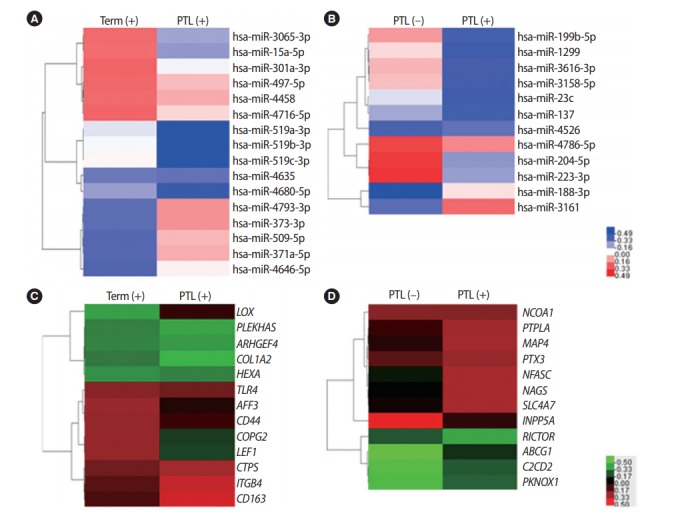
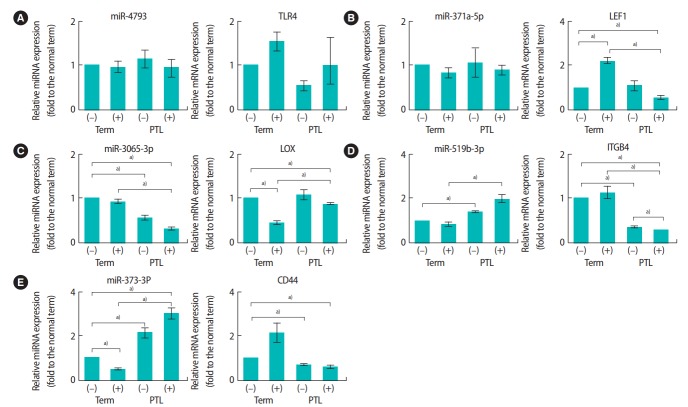
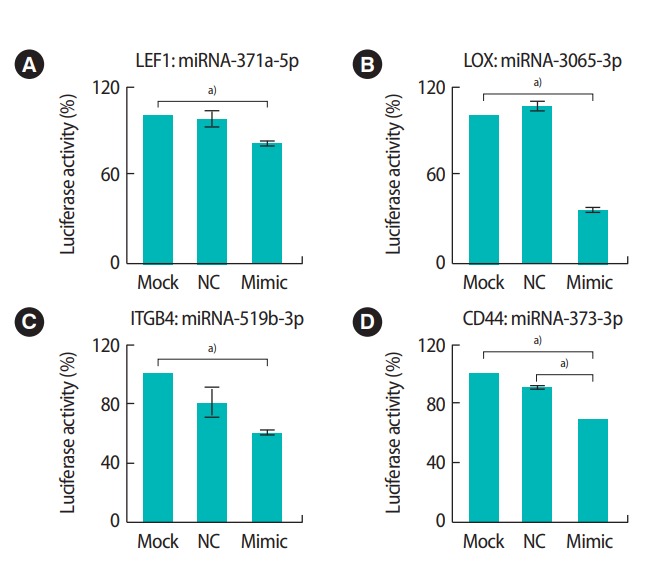
Microarrays were utilized to obtain miRNA and gene expression profiles from placentas with or without inflammation obtained from nine normal pregnant women and 10 preterm labor patients. Quantitative real-time polymerase chain reaction and Western blots were performed to validate the miRNAs and differentially-expressed genes in the placentas with inflammation. Correlations between miRNA and target gene expression were confirmed by luciferase assays in HTR-8/SVneo cells.
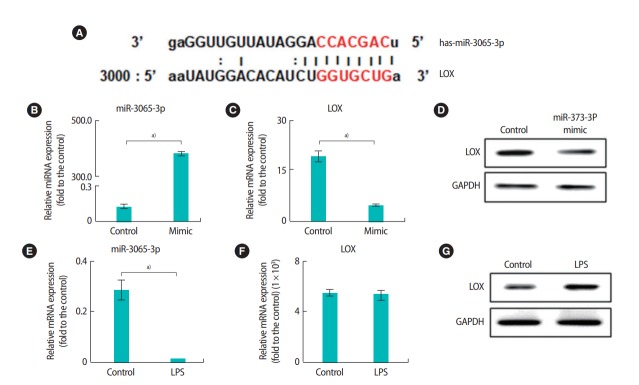
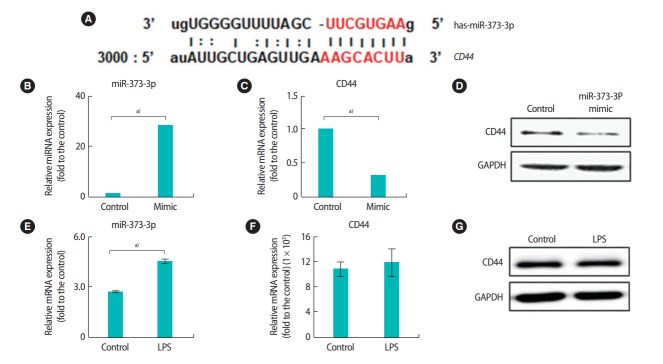
We identified and validated miRNAs and their target genes that were differentially expressed in placentas with inflammation. We also demonstrated that several miRNAs (miR-371a-5p, miR-3065-3p, miR-519b-3p, and miR-373-3p) directly targeted their target genes (LEF1, LOX, ITGB4, and CD44). However, some miRNAs and their direct target genes showed no correlation in tissue samples. Interestingly, miR-373-3p and miR-3065-3p were markedly regulated by lipopolysaccharide (LPS) treatment, although the expression of their direct targets CD44 and LOX was not altered by LPS treatment.
These results provide candidate miRNAs and their target genes that could be used as placental biomarkers of inflammation. These candidates may be useful for further miRNA-based biomarker development.
最近,微小RNA(miRNA)已被确定为通过调控众多基因参与各种生物学过程的强大调节因子,以及用于预测和诊断各种疾病状态的有效生物标志物。本研究的目的是鉴定和验证胎盘组织中参与炎症的miRNA及其靶基因。
利用微阵列技术从9名正常孕妇和10名早产患者的有或无炎症的胎盘中获取miRNA和基因表达谱。进行定量实时聚合酶链反应和蛋白质免疫印迹以验证炎症胎盘组织中的miRNA和差异表达基因。通过在HTR-8/SVneo细胞中进行荧光素酶测定来确认miRNA与靶基因表达之间的相关性。
我们鉴定并验证了在炎症胎盘中差异表达的miRNA及其靶基因。我们还证明了几种miRNA(miR-371a-5p、miR-3065-3p、miR-519b-3p和miR-373-3p)直接靶向其靶基因(LEF1、LOX、ITGB4和CD44)。然而,一些miRNA及其直接靶基因在组织样本中未显示出相关性。有趣的是,尽管脂多糖(LPS)处理未改变其直接靶标CD44和LOX的表达,但miR-373-3p和miR-3065-3p受LPS处理的显著调控。
这些结果提供了可作为胎盘炎症生物标志物的候选miRNA及其靶基因。这些候选物可能有助于进一步基于miRNA的生物标志物开发。