Hogquist Kristin, Georgiev Hristo
Center for Immunology, University of Minnesota, Minneapolis, MN, 55455, USA.
F1000Res. 2020 Feb 20;9. doi: 10.12688/f1000research.21378.1. eCollection 2020.
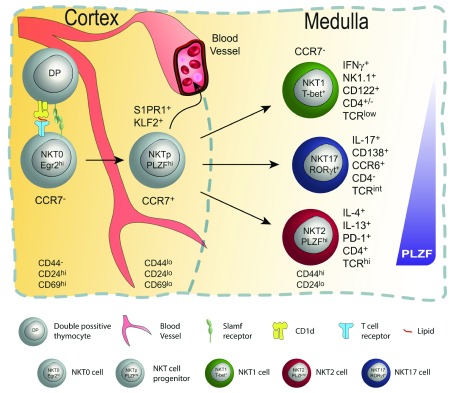
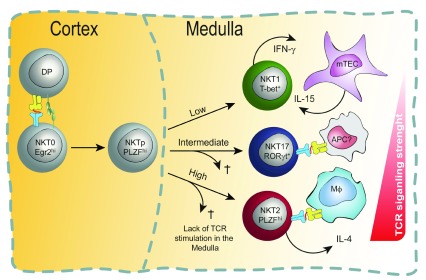
Recent studies suggest that murine invariant natural killer T (iNKT) cell development culminates in three terminally differentiated iNKT cell subsets denoted as NKT1, 2, and 17 cells. Although these studies corroborate the significance of the subset division model, less is known about the factors driving subset commitment in iNKT cell progenitors. In this review, we discuss the latest findings in iNKT cell development, focusing in particular on how T-cell receptor signal strength steers iNKT cell progenitors toward specific subsets and how early progenitor cells can be identified. In addition, we will discuss the essential factors for their sustenance and functionality. A picture is emerging wherein the majority of thymic iNKT cells are mature effector cells retained in the organ rather than developing precursors.
最近的研究表明,小鼠不变自然杀伤T(iNKT)细胞的发育最终形成三个终末分化的iNKT细胞亚群,分别称为NKT1、NKT2和NKT17细胞。尽管这些研究证实了亚群划分模型的重要性,但对于驱动iNKT细胞祖细胞亚群定向分化的因素了解较少。在这篇综述中,我们讨论了iNKT细胞发育的最新发现,特别关注T细胞受体信号强度如何引导iNKT细胞祖细胞分化为特定亚群,以及如何识别早期祖细胞。此外,我们还将讨论维持其生存和功能的关键因素。一幅图景正在浮现,即大多数胸腺iNKT细胞是保留在器官中的成熟效应细胞,而非正在发育的前体细胞。