Sun Yat-sen University Cancer Center, State Key Laboratory of Oncology in South China, Collaborative Innovation Center for Cancer Medicine Guangdong Key Laboratory of Nasopharyngeal Carcinoma Diagnosis and Therapy, Guangzhou 510060, China.
Zhongshan School of Medical, Sun Yat-sen University, Guangzhou, Guangdong 510080, China.
Biomed Res Int. 2020 Feb 21;2020:8068913. doi: 10.1155/2020/8068913. eCollection 2020.
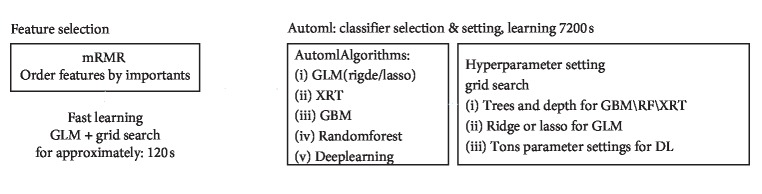
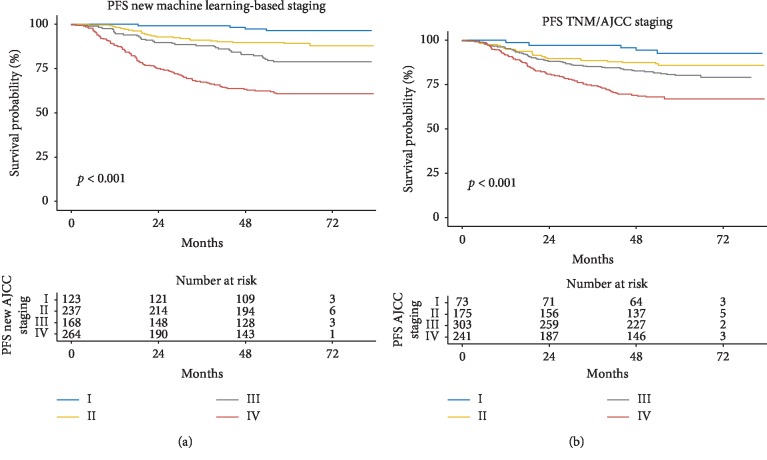
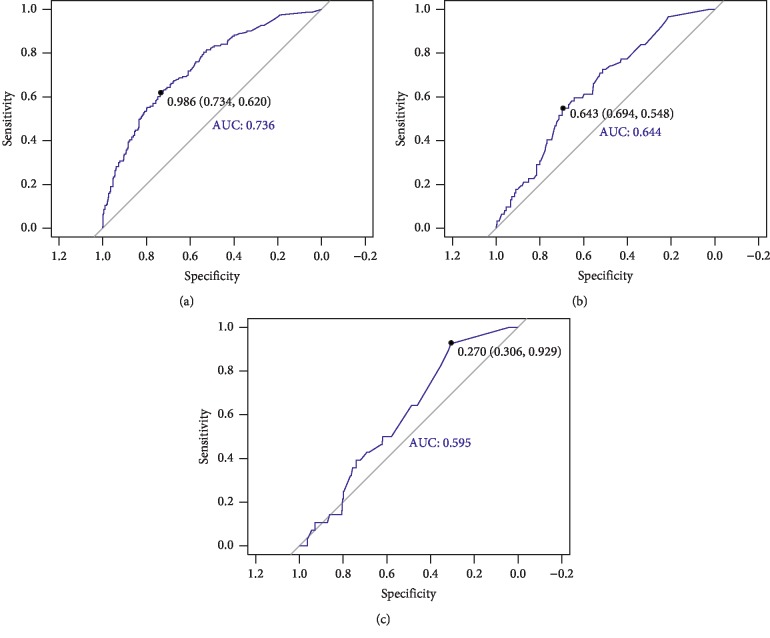
We aimed to assess the use of automatic machine learning (AutoML) algorithm based on magnetic resonance (MR) image data to assign prediction scores to patients with nasopharyngeal carcinoma (NPC). We also aimed to develop a 4-group classification system for NPC, superior to the current clinical staging system. Between January 2010 and January 2013, 792 patients with recent diagnosis of NPC, who had MR image data, were enrolled in the study. The AutoML algorithm was used and all statistical analyses were based on the 10-fold test. Primary endpoints included the probabilities of overall survival (OS), distant metastasis-free survival (DMFS), and local-region relapse-free survival (LRFS), and their sum was recorded as the final voting score, representative of progression-free survival (PFS) for each patient. The area under the receiver operating characteristic (ROC) curve generated from the MR image data-based model compared with the tumor, node, and metastasis (TNM) system-based model was 0.796 (=0.008) for OS, 0.752 (=0.053) for DMFS, and 0.721 (=0.025) for LRFS. The Kaplan-Meier (KM) test values for II/I, III/II, IV/III groups in our new machine learning-based scoring system were 0.011, 0.010, and <0.001, respectively, whereas those for II/I, III/II, IV/III groups in the TNM/American Joint Committee on Cancer (AJCC) system were 0.118, 0.121, and <0.001, respectively. Significant differences were observed in the new machine learning-based scoring system analysis of each curve ( < 0.05), whereas the values of curves obtained from the TNM/AJCC system, between II/I and III/II, were 0.118 and 0.121, respectively, without a significant difference. In conclusion, the AutoML algorithm demonstrated better prognostic performance than the TNM/AJCC system for NPC. The algorithm showed a good potential for clinical application and may aid in improving counseling and facilitate the personalized management of patients with NPC. The clinical application of our new scoring and staging system may significantly improve precision medicine.
我们旨在评估基于磁共振(MR)图像数据的自动机器学习(AutoML)算法在为鼻咽癌(NPC)患者分配预测评分方面的应用。我们还旨在开发一种 NPC 的 4 组分类系统,优于当前的临床分期系统。2010 年 1 月至 2013 年 1 月期间,纳入了 792 名最近诊断为 NPC 的患者,这些患者具有 MR 图像数据。使用 AutoML 算法,所有统计分析均基于 10 倍测试。主要终点包括总生存率(OS)、远处转移无复发生存率(DMFS)和局部区域无复发生存率(LRFS)的概率,它们的总和被记录为每位患者的无进展生存率(PFS)的最终投票得分。基于 MR 图像数据的模型生成的接收器工作特征(ROC)曲线下面积与基于肿瘤、淋巴结和转移(TNM)系统的模型相比,OS 为 0.796(=0.008),DMFS 为 0.752(=0.053),LRFS 为 0.721(=0.025)。我们新的基于机器学习的评分系统中 II/I、III/II 和 IV/III 组的 Kaplan-Meier(KM)测试值分别为 0.011、0.010 和 <0.001,而 TNM/美国癌症联合委员会(AJCC)系统中 II/I、III/II 和 IV/III 组的相应值分别为 0.118、0.121 和 <0.001。在新的基于机器学习的评分系统分析中,每个曲线的差异均有统计学意义(<0.05),而 TNM/AJCC 系统中 II/I 和 III/II 之间的曲线值分别为 0.118 和 0.121,无统计学差异。总之,AutoML 算法在 NPC 预后方面的表现优于 TNM/AJCC 系统。该算法具有良好的临床应用潜力,可能有助于改善咨询并促进 NPC 患者的个性化管理。我们新的评分和分期系统的临床应用可能会显著提高精准医学的水平。