Su Xiaodi, Sutarlie Laura, Loh Xian Jun
Institute of Materials Research and Engineering, Agency for Science, Technology and Research, 2 Fusionopolis Way. Innovis #08-03, Singapore 138634.
Department of Chemistry, National University of Singapore, Block S8, Level 3, 3 Science Drive 3, Singapore 117543.
Research (Wash D C). 2020 Feb 17;2020:8272705. doi: 10.34133/2020/8272705. eCollection 2020.
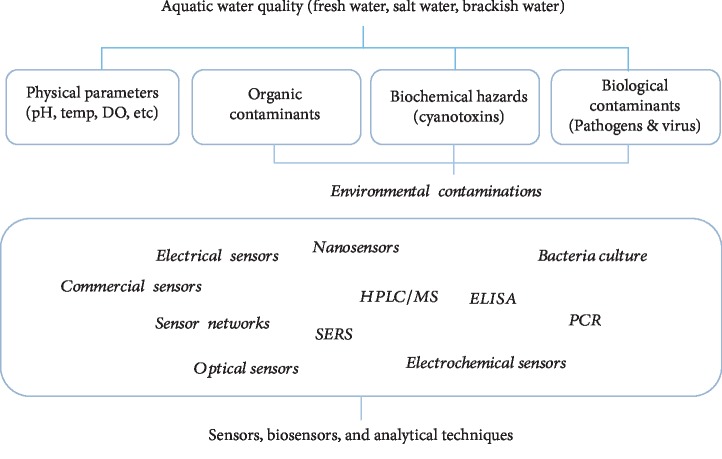
In aquaculture industry, fish, shellfish, and aquatic plants are cultivated in fresh, salt, or brackish waters. The increasing demand of aquatic products has stimulated the rapid growth of aquaculture industries. How to effectively monitor and control water quality is one of the key concerns for aquaculture industry to ensure high productivity and high quality. There are four major categories of water quality concerns that affect aquaculture cultivations, namely, (1) physical parameters, e.g., pH, temperature, dissolved oxygen, and salinity, (2) organic contaminants, (3) biochemical hazards, e.g., cyanotoxins, and (4) biological contaminants, i.e., pathogens. While the physical parameters are affected by climate changes, the latter three are considered as environmental factors. In this review, we provide a comprehensive summary of sensors, biosensors, and analytical technologies available for monitoring aquaculture water quality. They include low-cost commercial sensors and sensor network setups for physical parameters. They also include chromatography, mass spectrometry, biochemistry, and molecular methods (e.g., immunoassays and polymerase chain reaction assays), culture-based method, and biophysical technologies (e.g., biosensors and nanosensors) for environmental contamination factors. According to the different levels of sophistication of various analytical techniques and the information they can provide (either fine fingerprint, highly accurate quantification, semiquantification, qualitative detection, or fast screening), we will comment on how they may be used as complementary tools, as well as their potential and gaps toward current demand of real-time, online, and/or onsite detection.
在水产养殖业中,鱼类、贝类和水生植物在淡水、咸水或半咸水中养殖。对水产品日益增长的需求刺激了水产养殖业的快速发展。如何有效监测和控制水质是水产养殖业确保高产量和高质量的关键问题之一。影响水产养殖的水质问题主要有四大类,即:(1)物理参数,如pH值、温度、溶解氧和盐度;(2)有机污染物;(3)生化危害,如蓝藻毒素;(4)生物污染物,即病原体。虽然物理参数受气候变化影响,但后三类被视为环境因素。在本综述中,我们全面总结了可用于监测水产养殖水质的传感器、生物传感器和分析技术。它们包括用于物理参数的低成本商业传感器和传感器网络设置。还包括用于环境污染因素的色谱法、质谱法、生物化学和分子方法(如免疫测定和聚合酶链反应测定)、基于培养的方法以及生物物理技术(如生物传感器和纳米传感器)。根据各种分析技术的复杂程度及其所能提供的信息(无论是精细指纹图谱、高精度定量、半定量、定性检测还是快速筛选),我们将评论它们如何作为互补工具使用,以及它们在满足实时、在线和/或现场检测当前需求方面的潜力和差距。