.
Invest Ophthalmol Vis Sci. 2020 Mar 9;61(3):5. doi: 10.1167/iovs.61.3.5.
Activating the cell survival modulator sigma 1 receptor (Sig1R) delays cone photoreceptor cell loss in Pde6βrd10/J (rd10) mice, a model of retinitis pigmentosa. Beneficial effects are abrogated in rd10 mice lacking NRF2, implicating NRF2 as essential to Sig1R-mediated cone neuroprotection. Here we asked whether activation of NRF2 alone is sufficient to rescue cones in rd10 mice.
Expression of antioxidant genes was evaluated in 661W cells and in mouse retinas after treatment with monomethylfumarate (MMF), a potent NRF2 activator. Rd10 mice were administered MMF (50 mg/kg) or the Sig1R ligand (+)-pentazocine (PTZ; 0.5 mg/kg) intraperitoneally (every other day, P14-42). Mice were evaluated for visual acuity (optokinetic tracking response), retinal function (electroretinography) and architecture (SD-OCT); histologic retinal sections were evaluated morphometrically.
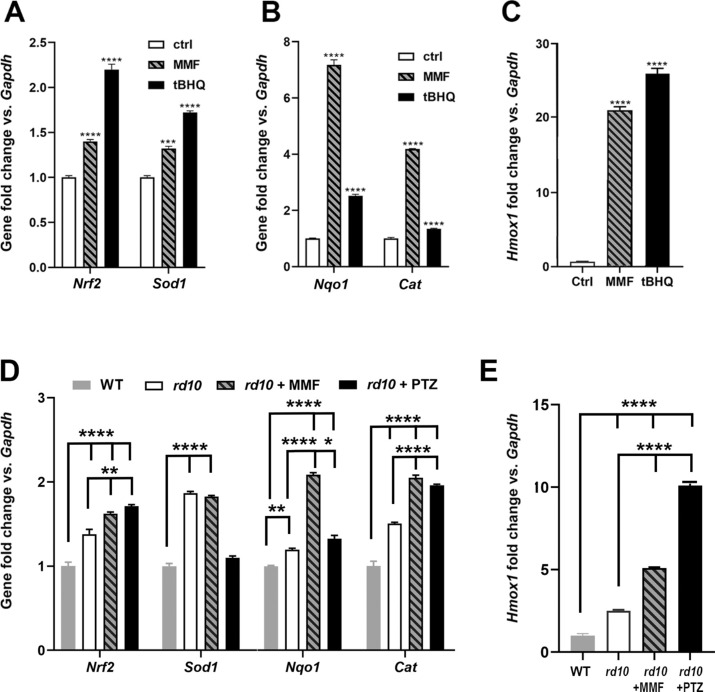
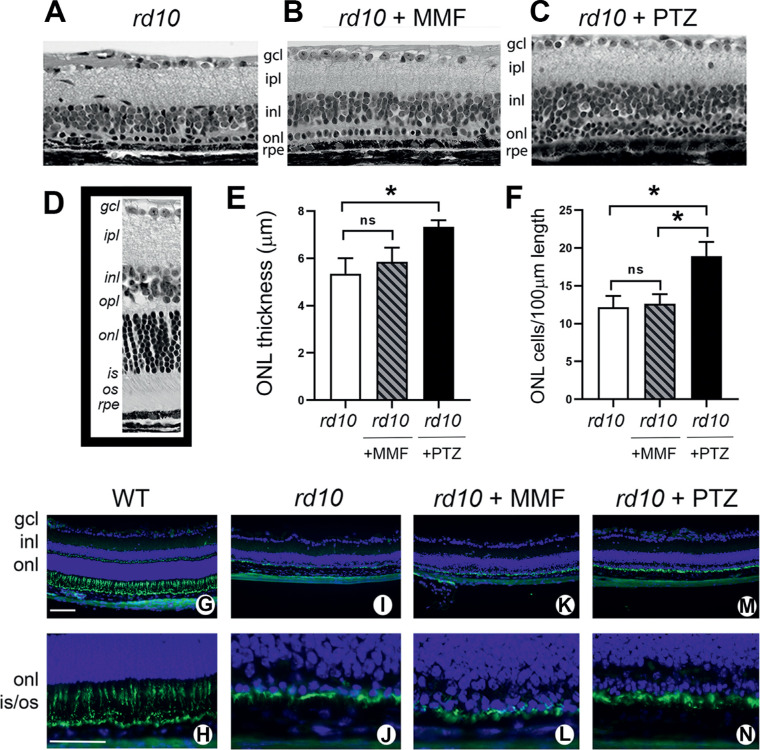
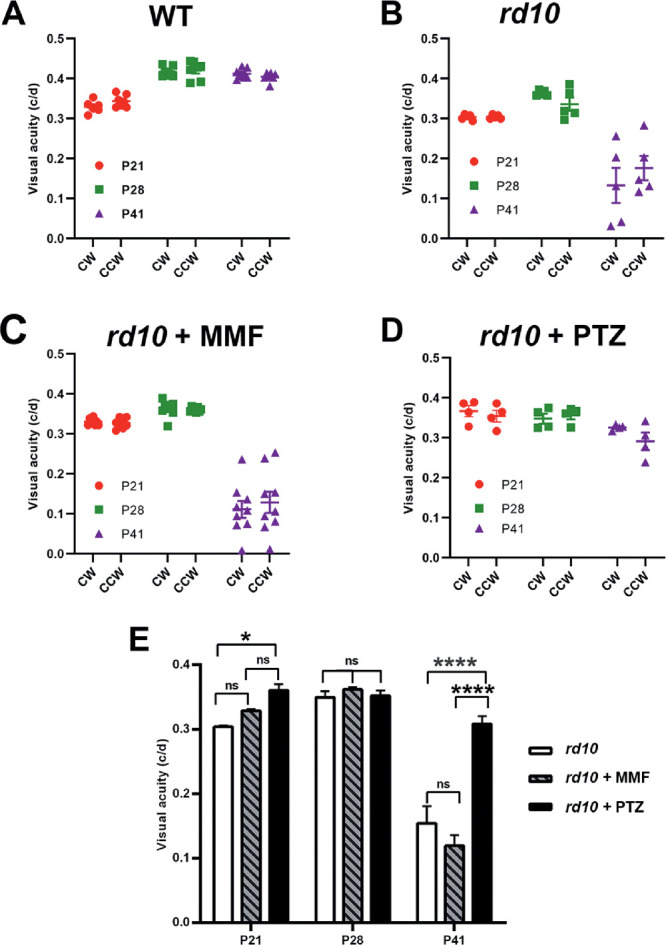
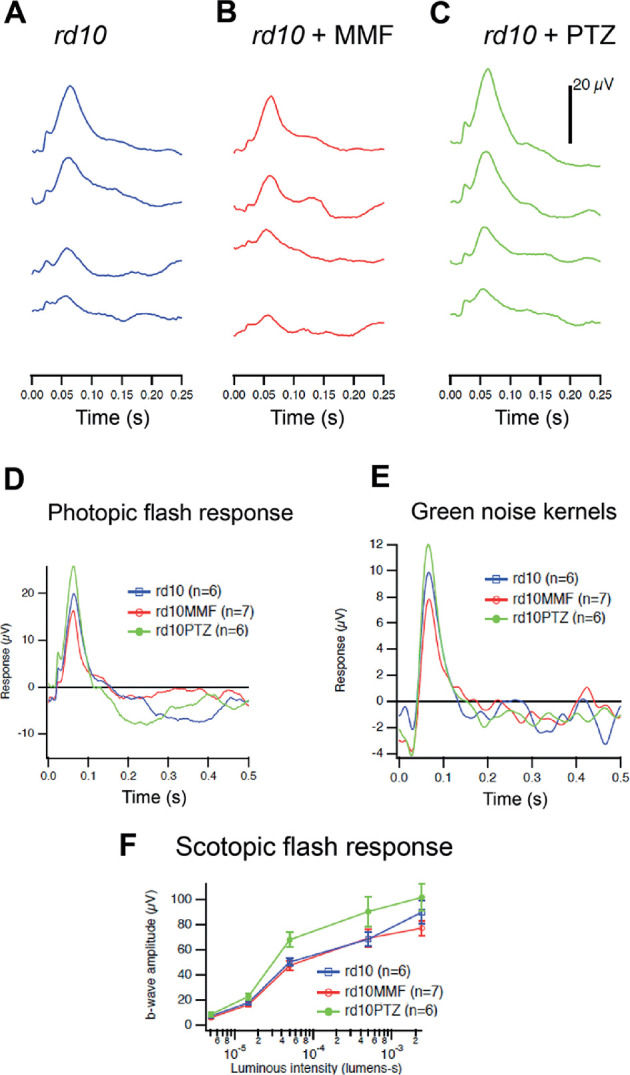
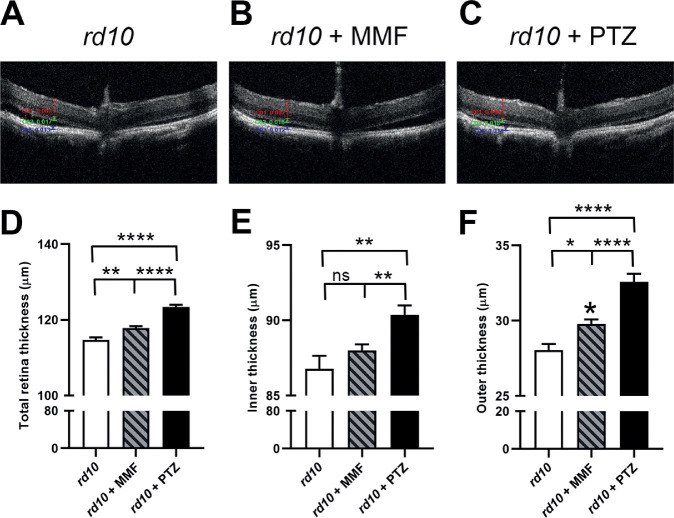
MMF treatment increased Nrf2, Nqo1, Cat, Sod1, and Hmox1 expression in vitro and in vivo. Visual acuity of (+)-PTZ-treated rd10 mice was similar to wild-type mice; however, MMF treatment did not alter acuity compared with nontreated rd10 mice. Cone electroretinography b-wave amplitudes were greater in PTZ-treated than nontreated or MMF-treated rd10 mice. SD-OCT assessment of retinal thickness was greater in (+)-PTZ-treated mice versus nontreated or MMF-treated rd10 mice. Morphometric assessment of the outer nuclear layer revealed approximately 18 cells/100 µm retinal length in (+)-PTZ-treated rd10 mice, but only approximately 10 to 12 cells/100 µm in MMF-treated and nontreated rd10 retinas.
Activation of NRF2 using MMF, at least at our dosing regimen, is insufficient to attenuate catastrophic photoreceptor damage characteristic of rd10 mice. The data prompt investigation of additional mechanisms involved in Sig1R-mediated retinal neuroprotection.
激活细胞存活调节剂 sigma 1 受体(Sig1R)可延迟 Pde6βrd10/J(rd10)小鼠(一种视网膜色素变性模型)中的视锥细胞丧失。在缺乏 NRF2 的 rd10 小鼠中,有益作用被阻断,这表明 NRF2 对 Sig1R 介导的视锥神经保护至关重要。在这里,我们想知道单独激活 NRF2 是否足以挽救 rd10 小鼠的视锥细胞。
用单甲基富马酸(MMF)处理 661W 细胞和小鼠视网膜后,评估抗氧化基因的表达,MMF 是一种有效的 NRF2 激活剂。用 MMF(50mg/kg)或 Sig1R 配体(+)-戊噻嗪(PTZ;0.5mg/kg)腹腔内注射 rd10 小鼠(每隔一天,P14-42)。通过视动跟踪反应评估小鼠的视力(视力)、视网膜功能(视网膜电图)和结构(SD-OCT);对组织学视网膜切片进行形态计量学评估。
MMF 治疗在体外和体内均增加了 Nrf2、Nqo1、Cat、Sod1 和 Hmox1 的表达。(+)-PTZ 处理的 rd10 小鼠的视力与野生型小鼠相似;然而,与未治疗的 rd10 小鼠相比,MMF 治疗并未改变视力。与未治疗或 MMF 治疗的 rd10 小鼠相比,PTZ 处理的视锥细胞视网膜电图 b 波幅度更大。与未治疗或 MMF 治疗的 rd10 小鼠相比,(+)-PTZ 处理的小鼠的视网膜厚度 SD-OCT 评估更大。在外核层的形态计量评估中,在(+)-PTZ 处理的 rd10 小鼠中发现大约 18 个细胞/100µm 视网膜长度,但在 MMF 处理和未处理的 rd10 视网膜中仅发现大约 10 到 12 个细胞/100µm。
至少在我们的给药方案中,使用 MMF 激活 NRF2 不足以减轻 rd10 小鼠特征性的灾难性光感受器损伤。这些数据提示我们需要进一步研究 Sig1R 介导的视网膜神经保护作用涉及的其他机制。