Laboratorio de Procesado de Imagen (LPI), Universidad de Valladolid, Spain.
Cardiff University Brain Research Imaging Center (CUBRIC), School of Psychology, University of Cardiff, UK.
PLoS One. 2020 Mar 9;15(3):e0229526. doi: 10.1371/journal.pone.0229526. eCollection 2020.
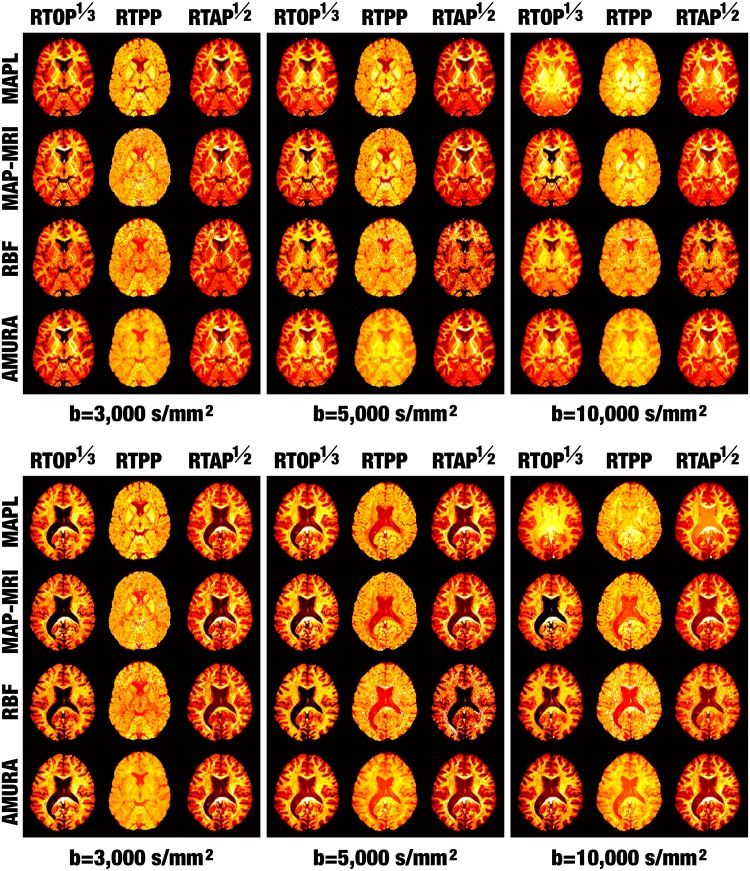
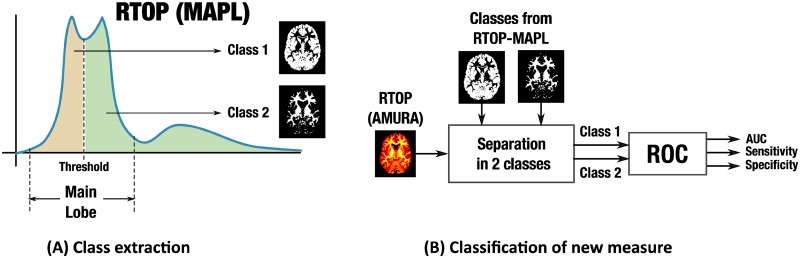
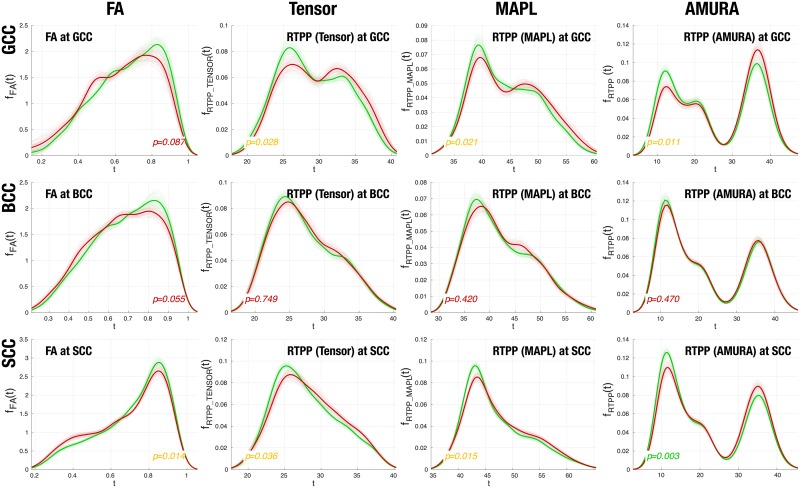
In diffusion MRI, the Ensemble Average diffusion Propagator (EAP) provides relevant micro-structural information and meaningful descriptive maps of the white matter previously obscured by traditional techniques like Diffusion Tensor Imaging (DTI). The direct estimation of the EAP, however, requires a dense sampling of the Cartesian q-space involving a huge amount of samples (diffusion gradients) for proper reconstruction. A collection of more efficient techniques have been proposed in the last decade based on parametric representations of the EAP, but they still imply acquiring a large number of diffusion gradients with different b-values (shells). Paradoxically, this has come together with an effort to find scalar measures gathering all the q-space micro-structural information probed in one single index or set of indices. Among them, the return-to-origin (RTOP), return-to-plane (RTPP), and return-to-axis (RTAP) probabilities have rapidly gained popularity. In this work, we propose the so-called "Apparent Measures Using Reduced Acquisitions" (AMURA) aimed at computing scalar indices that can mimic the sensitivity of state of the art EAP-based measures to micro-structural changes. AMURA drastically reduces both the number of samples needed and the computational complexity of the estimation of diffusion properties by assuming the diffusion anisotropy is roughly independent from the radial direction. This simplification allows us to compute closed-form expressions from single-shell information, so that AMURA remains compatible with standard acquisition protocols commonly used even in clinical practice. Additionally, the analytical form of AMURA-based measures, as opposed to the iterative, non-linear reconstruction ubiquitous to full EAP techniques, turns the newly introduced apparent RTOP, RTPP, and RTAP both robust and efficient to compute.
在扩散磁共振成像中,整体平均扩散传播算子(EAP)提供了有关白质的微观结构信息和有意义的描述性图谱,这些信息和图谱以前被传统技术(如扩散张量成像(DTI))所掩盖。然而,EAP 的直接估计需要对笛卡尔 q 空间进行密集采样,这需要大量的样本(扩散梯度)进行适当的重建。在过去的十年中,已经提出了一系列更有效的技术,这些技术基于 EAP 的参数表示,但它们仍然需要获取具有不同 b 值(壳)的大量扩散梯度。矛盾的是,这与寻找能够在一个单一指数或一组指数中收集所有 q 空间微观结构信息的标量测量方法的努力结合在一起。其中,返回原点(RTOP)、返回平面(RTPP)和返回轴(RTAP)概率迅速流行起来。在这项工作中,我们提出了所谓的“使用减少采集的表观测量”(AMURA),旨在计算可以模拟基于 EAP 的最新技术对微观结构变化的敏感性的标量指数。AMURA 通过假设扩散各向异性大致独立于径向方向,大大减少了所需样本的数量和扩散特性估计的计算复杂度。这种简化允许我们从单壳信息中计算出闭式表达式,因此 AMURA 仍然与标准采集协议兼容,即使在临床实践中也经常使用。此外,与全 EAP 技术中普遍存在的迭代、非线性重建相反,基于 AMURA 的测量的解析形式使新引入的表观 RTOP、RTPP 和 RTAP 既稳健又高效。