Department of Engineering for Innovation MedicineUniversity of Verona Verona 37134 Italy.
Department of Computer ScienceUniversity of Verona Verona 37134 Italy.
IEEE J Transl Eng Health Med. 2024 Jul 17;12:569-579. doi: 10.1109/JTEHM.2024.3430035. eCollection 2024.
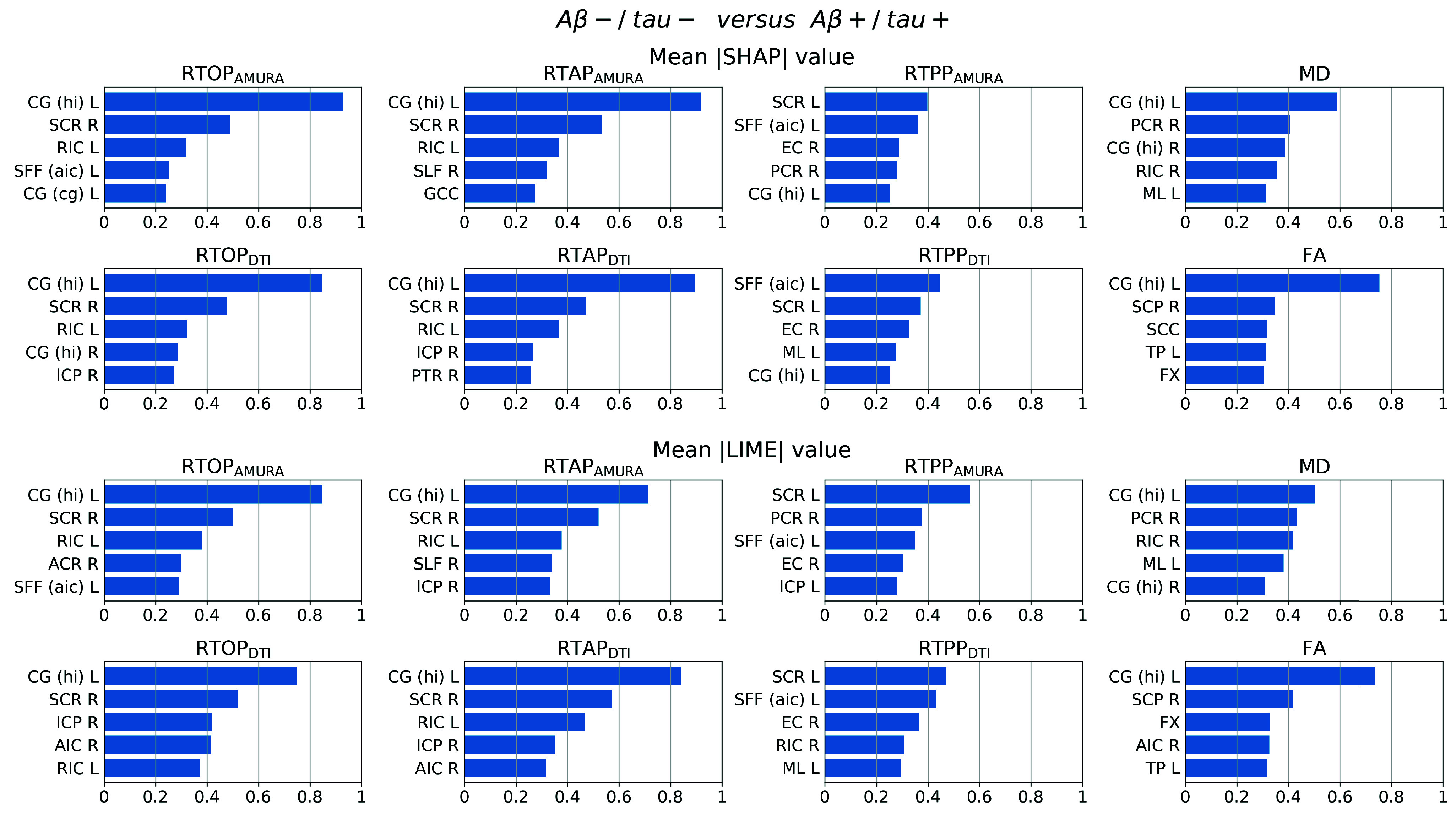
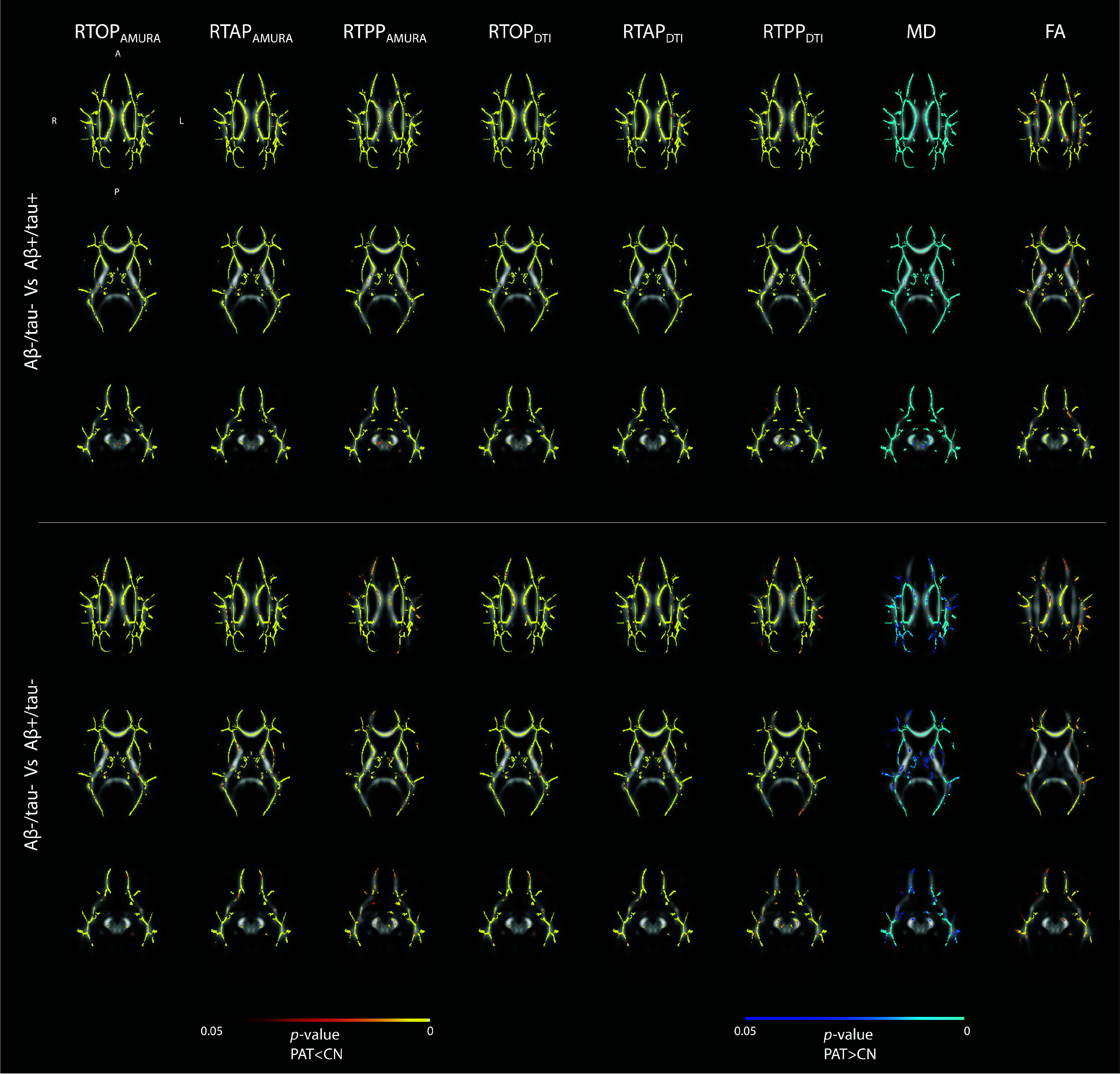
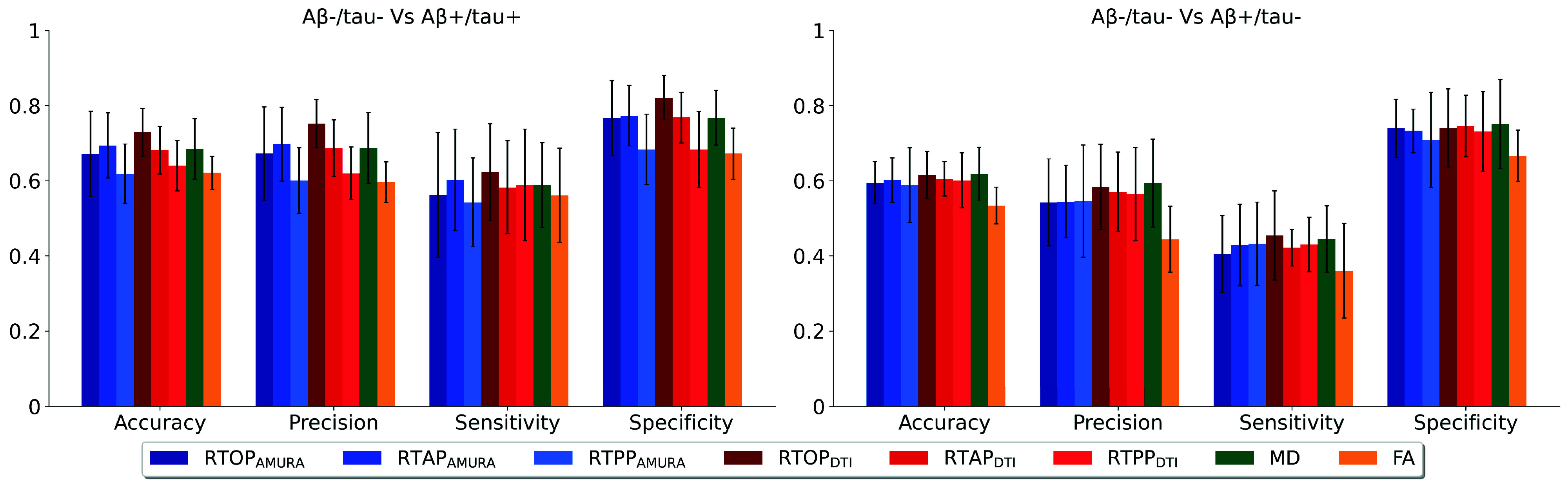
Brain microstructural changes already occur in the earliest phases of Alzheimer's disease (AD) as evidenced in diffusion magnetic resonance imaging (dMRI) literature. This study investigates the potential of the novel dMRI Apparent Measures Using Reduced Acquisitions (AMURA) as imaging markers for capturing such tissue modifications.Tract-based spatial statistics (TBSS) and support vector machines (SVMs) based on different measures were exploited to distinguish between amyloid-beta/tau negative (A[Formula: see text]-/tau-) and A[Formula: see text]+/tau+ or A[Formula: see text]+/tau- subjects. Moreover, eXplainable Artificial Intelligence (XAI) was used to highlight the most influential features in the SVMs classifications and to validate the results by seeing the explanations' recurrence across different methods.TBSS analysis revealed significant differences between A[Formula: see text]-/tau- and other groups in line with the literature. The best SVM classification performance reached an accuracy of 0.73 by using advanced measures compared to more standard ones. Moreover, the explainability analysis suggested the results' stability and the central role of the cingulum to show early sign of AD.By relying on SVM classification and XAI interpretation of the outcomes, AMURA indices can be considered viable markers for amyloid and tau pathology. Clinical impact: This pre-clinical research revealed AMURA indices as viable imaging markers for timely AD diagnosis by acquiring clinically feasible dMR images, with advantages compared to more invasive methods employed nowadays.
脑微观结构的改变早在阿尔茨海默病(AD)的早期阶段就已经发生,这在扩散磁共振成像(dMRI)文献中得到了证明。本研究旨在探索新型 dMRI 表观测量使用简化采集(AMURA)作为捕获这种组织变化的成像标志物的潜力。基于不同测量方法的基于束流的空间统计学(TBSS)和支持向量机(SVM)被用于区分淀粉样蛋白-β/tau 阴性(A[Formula: see text]-/tau-)和 A[Formula: see text]+/tau+或 A[Formula: see text]+/tau-患者。此外,可解释人工智能(XAI)被用于突出 SVM 分类中最具影响力的特征,并通过观察不同方法中解释的重现性来验证结果。TBSS 分析显示,与文献一致,A[Formula: see text]-/tau-和其他组之间存在显著差异。与更标准的测量方法相比,使用高级测量方法的最佳 SVM 分类性能达到了 0.73 的准确率。此外,可解释性分析表明结果的稳定性以及扣带在显示 AD 早期迹象中的核心作用。通过依赖 SVM 分类和 XAI 对结果的解释,AMURA 指数可以被认为是淀粉样蛋白和 tau 病理学的可行成像标志物。临床影响:这项临床前研究通过获取临床可行的 dMRI 图像,揭示了 AMURA 指数作为 AD 及时诊断的可行成像标志物的潜力,与目前使用的更具侵入性的方法相比具有优势。