Section of Preventive and Public Health Dentistry, Division of Oral Health, Growth and Development, Faculty of Dental Science, Kyushu University, Fukuoka, Japan.
Section of Geriatric Dentistry and Perioperative Medicine in Dentistry, Faculty of Dental Science, Kyushu University, Fukuoka, Japan.
PLoS Pathog. 2020 Mar 9;16(3):e1008348. doi: 10.1371/journal.ppat.1008348. eCollection 2020 Mar.
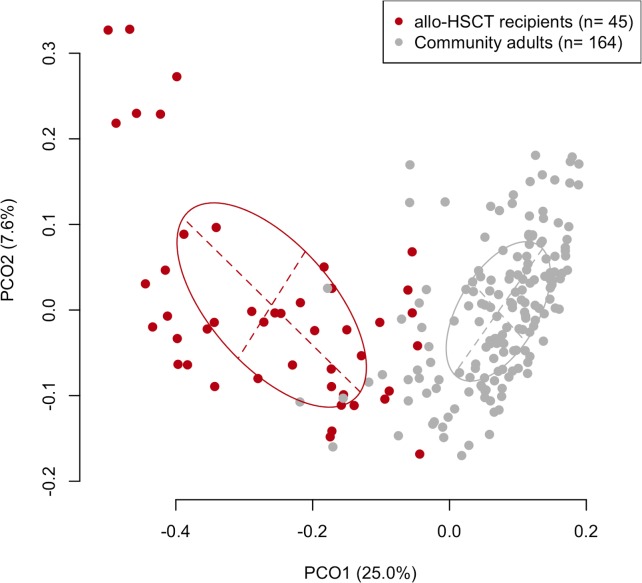
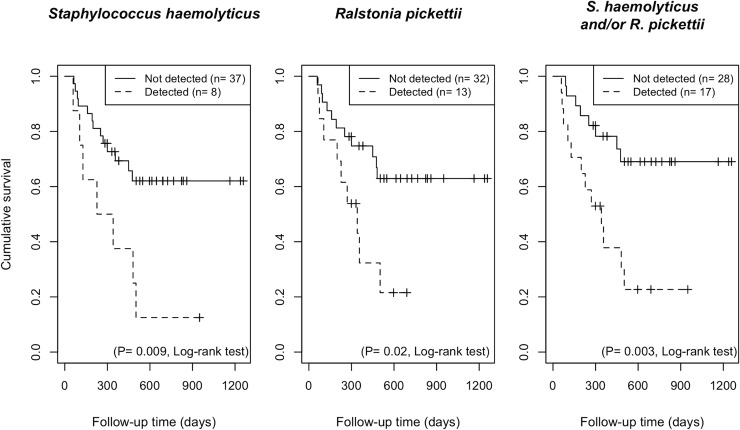
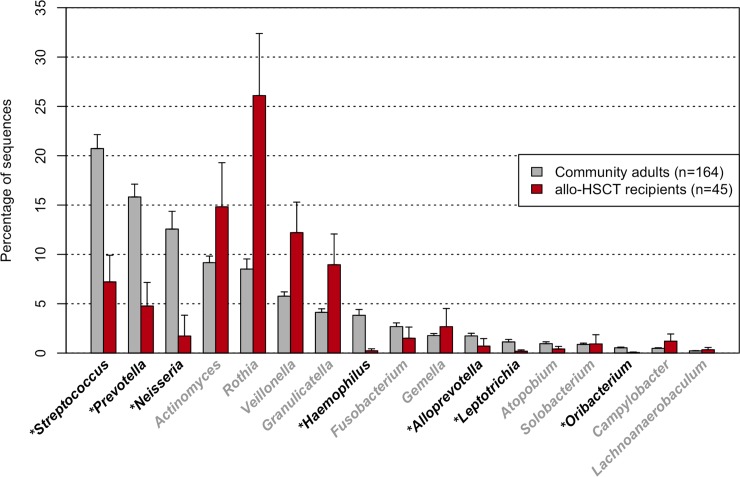
Disruption of the intestinal microbiota caused by intensive chemotherapy, irradiation and antibiotics can result in development of severe gut graft-versus-host disease and infectious complications, leading to poorer outcomes among allogeneic hematopoietic stem cell transplantation (allo-HSCT) recipients. Although the oral cavity is also densely colonized by indigenous microorganisms, the bacterial composition in allo-HSCT recipients remains unclear. We determined the tongue microbiota composition of 45 patients with hematological disorders on the day of transplantation and compared them to 164 community-dwelling adults. The V1-V2 regions of the 16S rRNA gene sequences demonstrated that the allo-HSCT recipients had less diverse and distinct microbiota from that of community-dwelling adults. The full-length 16S rRNA gene sequences identified 146 bacterial taxa in the microbiota of allo-HSCT recipients, of which 34 bacterial taxa did not correspond to bacteria primarily inhabiting the oral cavity deposited in the expanded Human Oral Microbiome Database. Notably, the detection of Staphylococcus haemolyticus and/or Ralstonia pickettii was significantly associated with a higher risk of mortality during the follow-up period. These results demonstrate that the oral cavity of allo-HSCT recipients is colonized by a disrupted microbiota on the day of transplantation and suggest that detection of specific nonindigenous taxa could be a predictor of transplant outcome.
强烈的化疗、放疗和抗生素会破坏肠道微生物群,导致严重的肠道移植物抗宿主病和感染并发症,从而使异基因造血干细胞移植(allo-HSCT)受者的预后更差。尽管口腔也被土著微生物高度定植,但 allo-HSCT 受者口腔中的细菌组成仍不清楚。我们在移植当天确定了 45 名血液系统疾病患者的舌微生物群组成,并将其与 164 名社区居住的成年人进行了比较。16S rRNA 基因 V1-V2 区的序列表明,allo-HSCT 受者的微生物群与社区居住的成年人的多样性和特征明显不同。全长 16S rRNA 基因序列在 allo-HSCT 受者的微生物群中鉴定出 146 个细菌分类群,其中 34 个细菌分类群与主要定植于口腔的细菌不同,这些细菌没有储存在扩展的人类口腔微生物组数据库中。值得注意的是,检测到溶血葡萄球菌和/或罗尔斯顿氏菌与随访期间更高的死亡率显著相关。这些结果表明,allo-HSCT 受者的口腔在移植当天就被破坏的微生物群定植,并表明检测特定的非土著分类群可能是移植结果的预测因子。