Belozersky Institute of Physico-Chemical Biology, Lomonosov Moscow State University, 119992 Moscow, Russia.
Faculty of Bioengineering and Bioinformatics, Lomonosov Moscow State University, 119234 Moscow, Russia.
Int J Mol Sci. 2020 Mar 5;21(5):1780. doi: 10.3390/ijms21051780.
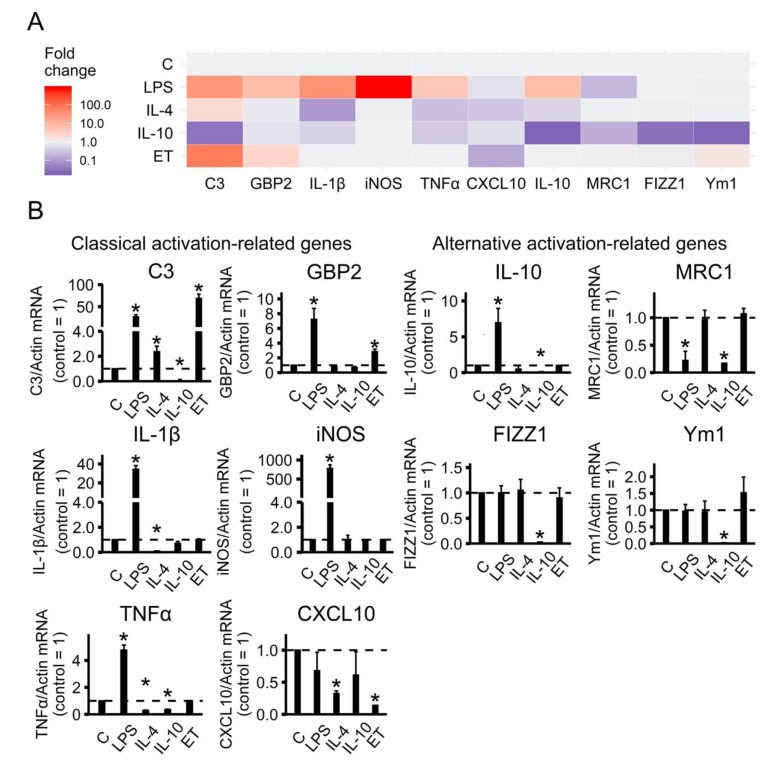
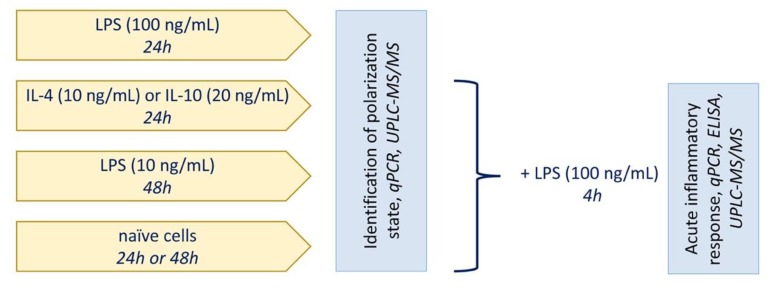
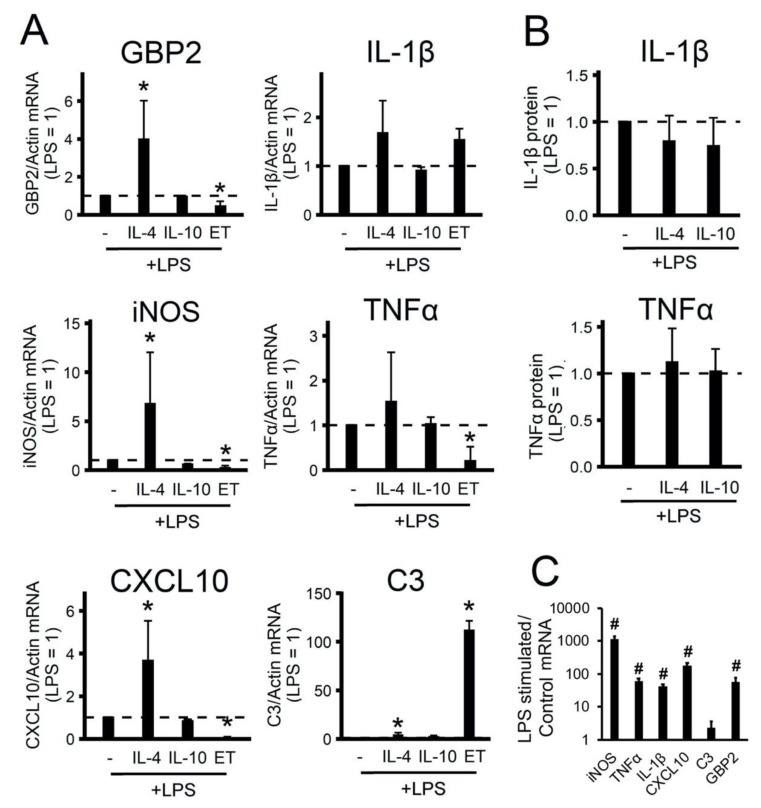
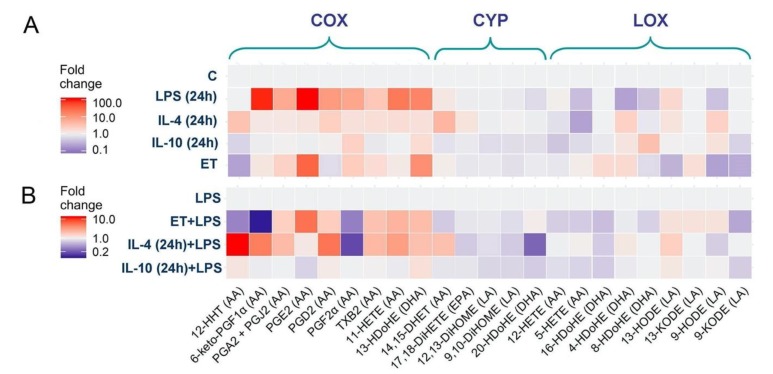
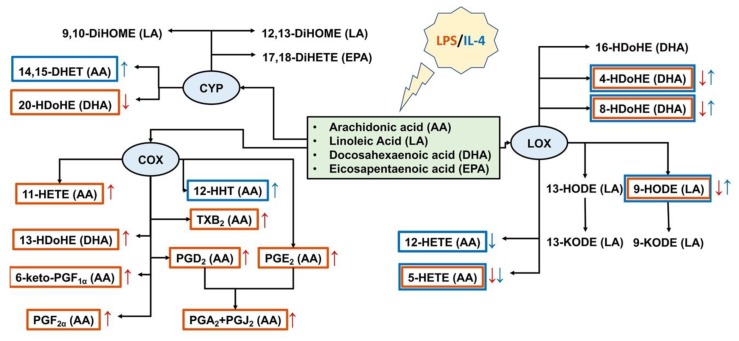
Functional phenotypes, which cells can acquire depending on the microenvironment, are currently the focus of investigations into new anti-inflammatory therapeutic approaches. Glial cells, microglia, and astrocytes are major participants in neuroinflammation, but their roles differ, as microglia are cells of mesodermal origin, while astrocytes are cells of ectodermal origin. The inflammatory phenotype of cells can be modulated by ω-6- and ω-3-polyunsaturated fatty acid-derived oxylipins, although data on changes in oxylipin profiles in different cell adaptations to pro- and anti-inflammatory stimuli are scarce. Our study aimed to compare UPLC-MS/MS-measured oxylipin profiles in various rat astrocyte adaptation states. We used cells treated for 24 h with lipopolysaccharide (LPS) for classical pro-inflammatory adaptation and with interleukin 4 (IL-4) or 10 (IL-10) for alternative anti-inflammatory adaptation, with the resulting phenotypes characterized by quantitative real-time PCR (RT-PCR). We also tested long-term, low-concentration LPS treatment (endotoxin treatment) as a model of astrocyte adaptations. The functional response of astrocytes was estimated by acute (4 h) LPS-induced cell reactivity, measured by gene expression markers and oxylipin synthesis. We discovered that, as well as gene markers, oxylipin profiles can serve as markers of pro- (A1-like) or anti-inflammatory (A2-like) adaptations. We observed predominant involvement of ω-6 polyunsaturated fatty acid (PUFA) and the cyclooxygenase branch for classical (LPS) pro-inflammatory adaptations and ω-3 PUFA and the lipoxygenase branch for alternative (IL-4) anti-inflammatory adaptations. Treatment with IL-4, but not IL-10, primes the ability of astrocytes to activate the innate immunity signaling pathways in response to LPS. Endotoxin-treated astrocytes provide an alternative anti-inflammatory adaptation, which makes cells less sensitive to acute LPS stimulation than the IL-4 induced adaptation. Taken together, the data reveal that oxylipin profiles associate with different states of polarization to generate a pro-inflammatory or anti-inflammatory phenotype. This association manifests itself both in native cells and in their responses to a pro-inflammatory stimulus.
功能表型是指细胞根据微环境而获得的表型,目前是研究新的抗炎治疗方法的重点。神经胶质细胞、小胶质细胞和星形胶质细胞是神经炎症的主要参与者,但它们的作用不同,因为小胶质细胞起源于中胚层,而星形胶质细胞起源于外胚层。细胞的炎症表型可以通过 ω-6 和 ω-3 多不饱和脂肪酸衍生的氧化脂类调节,尽管关于不同细胞对促炎和抗炎刺激的适应过程中氧化脂类谱的变化的数据很少。我们的研究旨在比较不同大鼠星形胶质细胞适应状态下 UPLC-MS/MS 测定的氧化脂类谱。我们使用脂多糖 (LPS) 处理 24 小时的细胞进行经典的促炎适应,用白细胞介素 4 (IL-4) 或 10 (IL-10) 进行替代的抗炎适应,用定量实时 PCR (RT-PCR) 来描述这些表型。我们还测试了长期低浓度 LPS 处理 (内毒素处理) 作为星形胶质细胞适应的模型。星形胶质细胞的功能反应通过急性 (4 小时) LPS 诱导的细胞反应来估计,通过基因表达标志物和氧化脂类的合成来测量。我们发现,除了基因标志物外,氧化脂类谱还可以作为促炎 (A1 样) 或抗炎 (A2 样) 适应的标志物。我们观察到,经典 (LPS) 促炎适应中主要涉及 ω-6 多不饱和脂肪酸 (PUFA) 和环氧化酶分支,替代 (IL-4) 抗炎适应中主要涉及 ω-3 PUFA 和脂氧合酶分支。IL-4 处理而不是 IL-10 处理可使星形胶质细胞能够激活先天免疫信号通路,以响应 LPS。内毒素处理的星形胶质细胞提供了一种替代的抗炎适应,使细胞对急性 LPS 刺激的敏感性低于 IL-4 诱导的适应。总的来说,这些数据表明氧化脂类谱与极化的不同状态相关,从而产生促炎或抗炎表型。这种关联既存在于天然细胞中,也存在于它们对促炎刺激的反应中。