Sutton Preston, Airoldi Martino, Porcarelli Luca, Olmedo-Martínez Jorge L, Mugemana Clément, Bruns Nico, Mecerreyes David, Steiner Ullrich, Gunkel Ilja
Adolphe Merkle Institute, University of Fribourg, Chemin des Verdiers 4, 1700 Fribourg, Switzerland.
POLYMAT, University of the Basque Country UPV/EHU, Avda. Tolosa 72, 20018 Donostia-San Sebastian, Spain.
Polymers (Basel). 2020 Mar 5;12(3):595. doi: 10.3390/polym12030595.
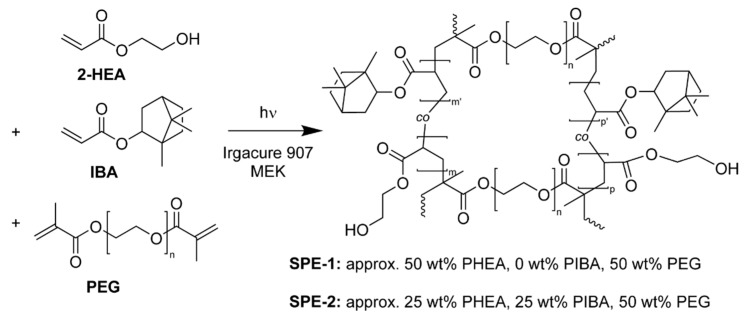
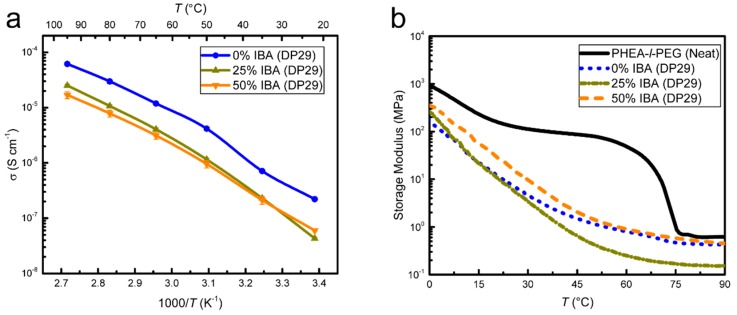
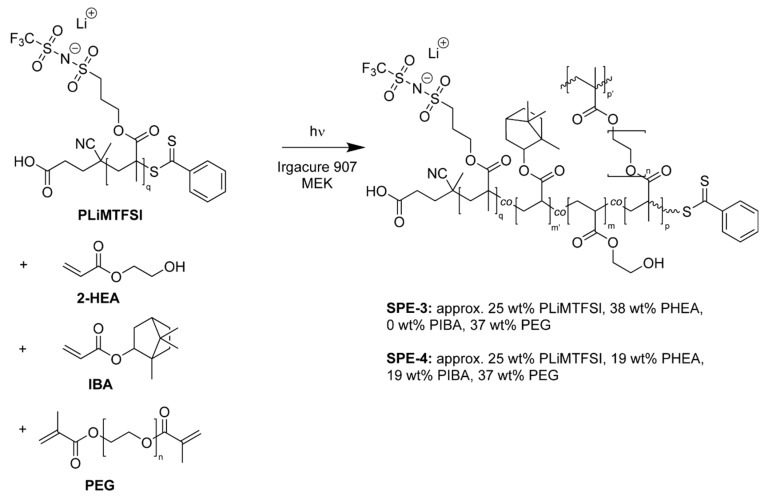
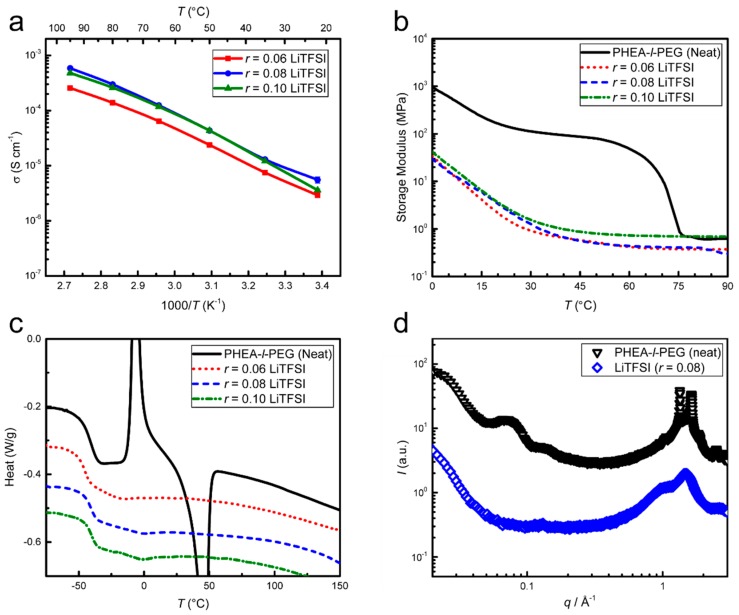
Lithium metal anodes have been pursued for decades as a way to significantly increase the energy density of lithium-ion batteries. However, safety risks caused by flammable liquid electrolytes and short circuits due to lithium dendrite formation during cell cycling have so far prevented the use of lithium metal in commercial batteries. Solid polymer electrolytes (SPEs) offer a potential solution if their mechanical properties and ionic conductivity can be simultaneously engineered. Here, we introduce a family of SPEs that are scalable and easy to prepare with a photopolymerization process, synthesized from amphiphilic acrylic polymer conetworks based on poly(ethylene glycol), 2-hydroxy-ethylacrylate, norbornyl acrylate, and either lithium bis (trifluoromethanesulfonyl) imide (LiTFSI) or a single-ion polymethacrylate as lithium-ion source. Several conetworks were synthesized and cycled, and their ionic conductivity, mechanical properties, and lithium transference number were characterized. A single-ion-conducting polymer electrolyte shows the best compromise between the different properties and extends the calendar life of the cell.
几十年来,锂金属负极一直被视为大幅提高锂离子电池能量密度的一种途径。然而,易燃液体电解质带来的安全风险以及电池循环过程中锂枝晶形成导致的短路,至今阻碍了锂金属在商用电池中的应用。如果能同时设计出固态聚合物电解质(SPEs)的机械性能和离子电导率,那么它将提供一种潜在的解决方案。在此,我们介绍一类可扩展且易于通过光聚合过程制备的SPEs,它们由基于聚乙二醇、丙烯酸2-羟乙酯、丙烯酸降冰片酯以及双(三氟甲烷磺酰)亚胺锂(LiTFSI)或单离子聚甲基丙烯酸酯作为锂离子源的两亲性丙烯酸聚合物互穿网络合成。合成并循环了几种互穿网络,对其离子电导率、机械性能和锂迁移数进行了表征。一种单离子导电聚合物电解质在不同性能之间表现出最佳的折衷,并延长了电池的日历寿命。