Katakami N, Harada T, Murata T, Shinozaki K, Tsutsumi M, Yokota T, Arai M, Tada Y, Narabayashi M, Boku N
Kobe City Medical Center General Hospital, Kobe, Japan.
Center for Respiratory Diseases, JCHO Hokkaido Hospital, Sapporo, Japan.
Ann Oncol. 2018 Jun;29(6):1461-1467. doi: 10.1093/annonc/mdy118. Epub 2019 Dec 4.
The efficacy and safety of naldemedine (a peripherally acting µ-opioid receptor antagonist) for opioid-induced constipation (OIC) in subjects with cancer was demonstrated in the primary report of a phase III, double-blind study (COMPOSE-4) and its open-label extension (COMPOSE-5). The primary end point, the proportion of spontaneous bowel movement (SBM) responders, was met. Here, we report results from secondary end points, including quality of life (QOL) assessments from these studies.
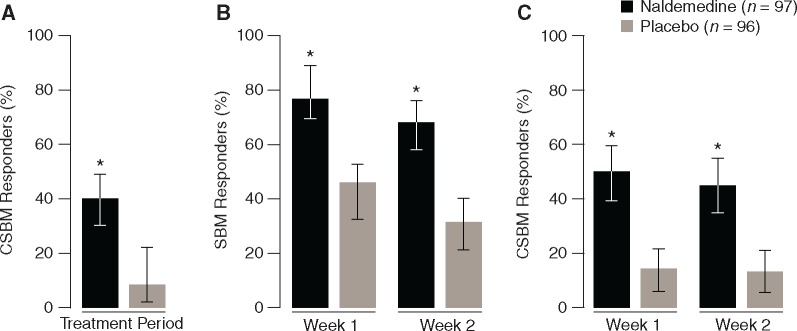
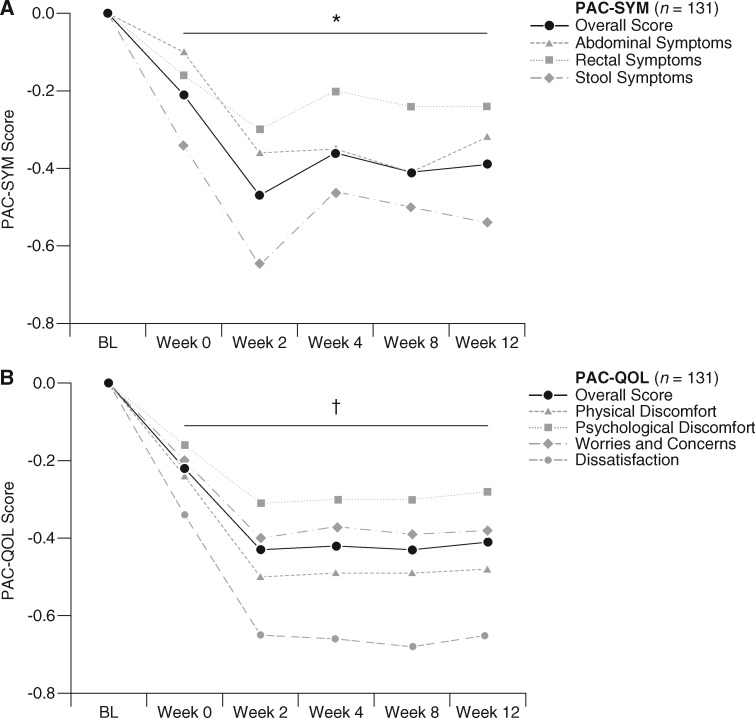
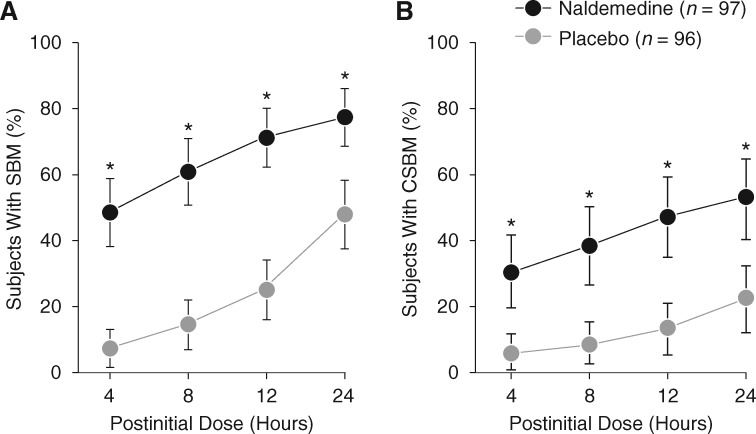
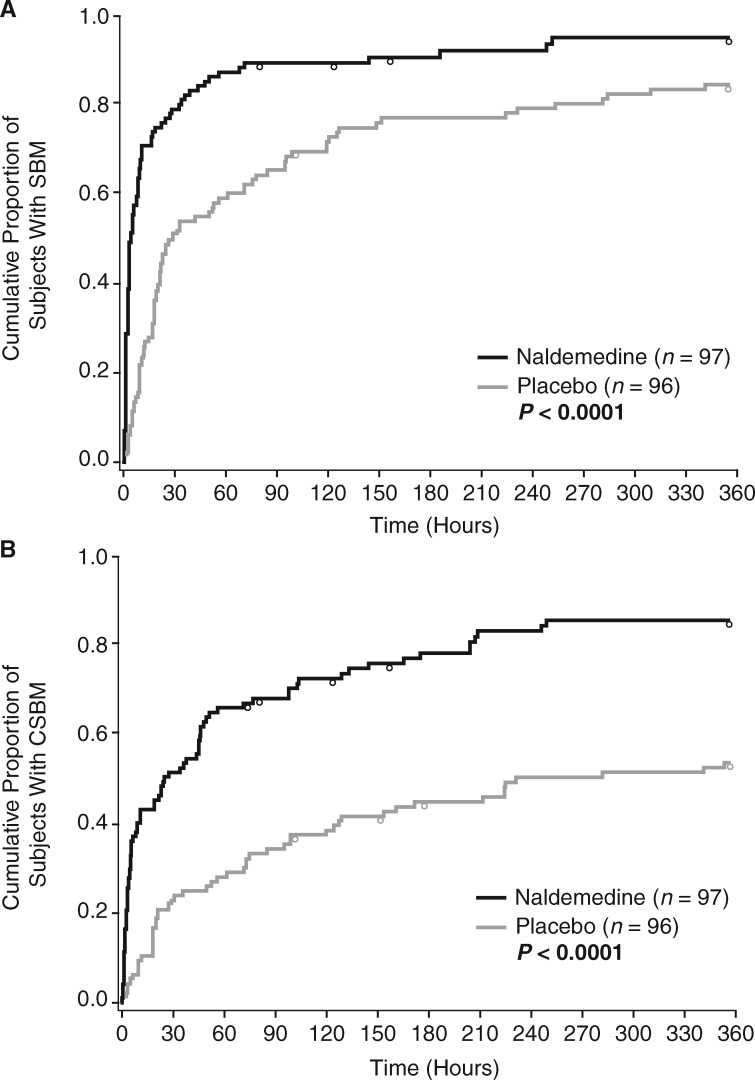
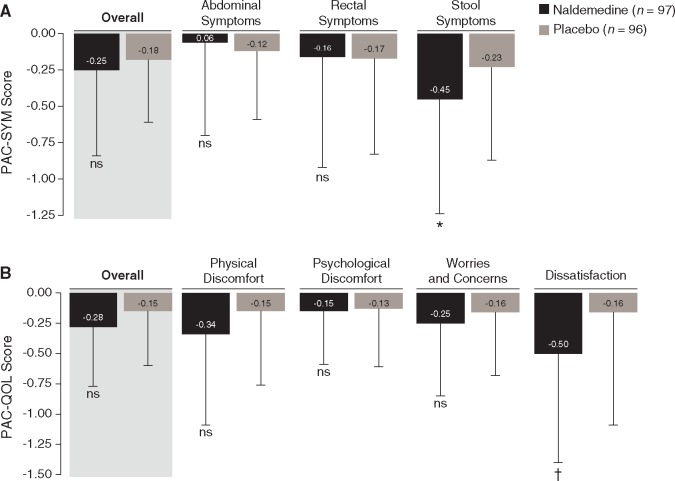
In COMPOSE-4, eligible adults with OIC and cancer were randomly assigned 1:1 to receive once-daily oral naldemedine 0.2 mg (n = 97) or placebo (n = 96) for 2 weeks, and those who continued on to COMPOSE-5 received naldemedine for 12 weeks (n = 131). Secondary assessments in COMPOSE-4 included the proportion of complete SBM (CSBM) responders, SBM or CSBM responders by week, and subjects with ≥1 SBM or CSBM within 24 h postinitial dose. Changes from baseline in the frequency of SBMs or CSBMs per week were assessed at weeks 1 and 2. Time to the first SBM or CSBM postinitial dose was also evaluated. In both studies, QOL impact was evaluated by Patient Assessment of Constipation-Symptoms (PAC-SYM) and PAC-QOL questionnaires.
Naldemedine improved bowel function for all secondary efficacy assessments versus placebo (all P ≤ 0.0002). The timely onset of naldemedine activity versus placebo was evidenced by median time to the first SBM (4.7 h versus 26.6 h) and CSBM (24.0 h versus 218.5 h) postinitial dose (all P < 0.0001). In COMPOSE-4, significant differences between groups were observed with the PAC-SYM stool domain (P = 0.045) and PAC-QOL dissatisfaction domain (P = 0.015). In COMPOSE-5, significant improvements from baseline were observed for overall and individual domain scores of PAC-SYM and PAC-QOL.
Naldemedine provided effective and timely symptomatic relief from OIC and improved the QOL of subjects with OIC and cancer. TRIAL REGISTRATION ID: www.ClinicalTrials.jp: JAPIC-CTI-132340 (COMPOSE-4) and JAPIC-CTI-132342 (COMPOSE-5).
在一项III期双盲研究(COMPOSE - 4)及其开放标签扩展研究(COMPOSE - 5)的初步报告中,已证实纳地美定(一种外周作用的μ - 阿片受体拮抗剂)对癌症患者阿片类药物引起的便秘(OIC)的疗效和安全性。达到了主要终点,即自发排便(SBM)反应者的比例。在此,我们报告这些研究中次要终点的结果,包括生活质量(QOL)评估。
在COMPOSE - 4中,符合条件的患有OIC和癌症的成年人被随机1:1分配,接受每日一次口服0.2毫克纳地美定(n = 97)或安慰剂(n = 96),为期2周,继续参加COMPOSE - 5的患者接受纳地美定治疗12周(n = 131)。COMPOSE - 4中的次要评估包括完全SBM(CSBM)反应者的比例、按周计算的SBM或CSBM反应者,以及初始剂量后24小时内有≥1次SBM或CSBM的受试者。在第1周和第2周评估每周SBM或CSBM频率相对于基线的变化。还评估了初始剂量后至首次SBM或CSBM的时间。在两项研究中,通过患者便秘症状评估(PAC - SYM)和PAC - QOL问卷评估生活质量影响。
与安慰剂相比,纳地美定在所有次要疗效评估中均改善了肠道功能(所有P≤0.0002)。初始剂量后首次SBM(4.7小时对26.6小时)和CSBM(24.0小时对218.5小时)的中位时间证明了纳地美定相对于安慰剂的活性起效及时(所有P < 0.0001)。在COMPOSE - 4中,在PAC - SYM粪便领域(P = 0.045)和PAC - QOL不满意领域(P = 0.015)观察到组间存在显著差异。在COMPOSE - 5中,观察到PAC - SYM和PAC - QOL的总体和各个领域得分相对于基线有显著改善。
纳地美定为OIC提供了有效且及时的症状缓解,并改善了患有OIC和癌症患者的生活质量。试验注册号:www.ClinicalTrials.jp:JAPIC - CTI - 132340(COMPOSE - 4)和JAPIC - CTI - 132342(COMPOSE - 5)。