International Observatory on End of Life Care, Lancaster University Faculty of Health and Medicine, Lancaster, Lancashire, UK
International Observatory on End of Life Care, Lancaster University Faculty of Health and Medicine, Lancaster, Lancashire, UK.
BMJ Open. 2020 Mar 8;10(3):e033881. doi: 10.1136/bmjopen-2019-033881.
This paper aims to investigate resident, facility and country characteristics associated with length of stay in long-term care facilities (LTCFs) across six European countries.
Data from a cross-sectional study of deceased residents, conducted in LTCFs in Belgium, England, Finland, Italy, the Netherlands and Poland.
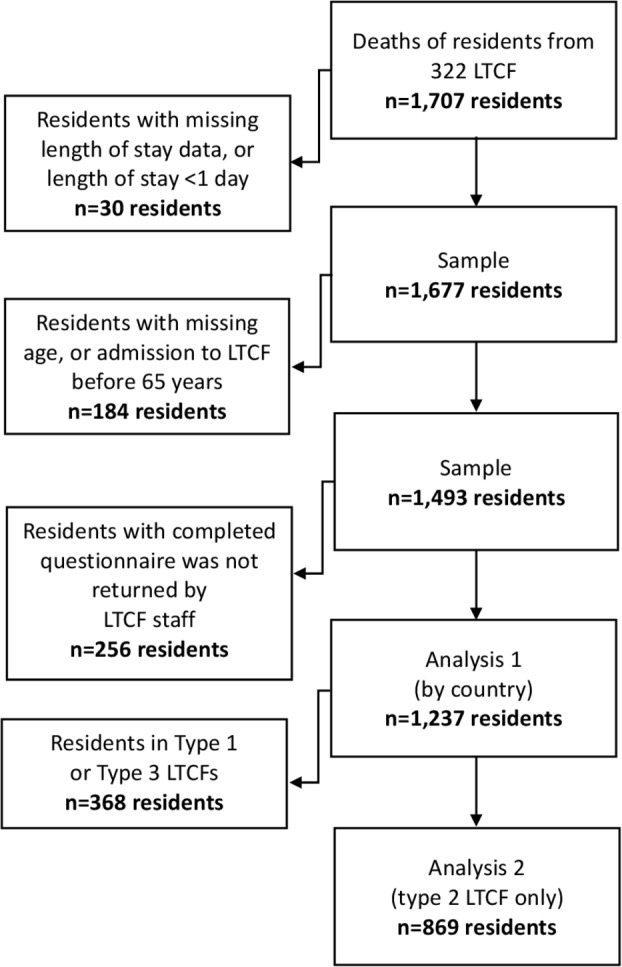
All residents aged 65 years and older at admission who died in a 3-month period residing in a proportional random sample of LTCFs were included.
The primary outcome was length of stay in days, calculated from date of admission and date of death. Resident, facility and country characteristics were included in a proportional hazards model.
The proportion of deaths within 1 year of admission was 42% (range 32%-63%). Older age at admission (HR 1.04, 95% CI 1.03 to 1.06), being married/in a civil partnership at time of death (HR 1.47, 95% CI 1.13 to 1.89), having cancer at time of death (HR 1.60, 95% CI 1.22 to 2.10) and admission from a hospital (HR 1.84, 95% CI 1.43 to 2.37) or another LTCF (HR 1.81, 95% CI 1.37 to 2.40) were associated with shorter lengths of stay across all countries. Being female (HR 0.72, 95% CI 0.57 to 0.90) was associated with longer lengths of stay.
Length of stay varied significantly between countries. Factors prior to LTCF admission, in particular the availability of resources that allow an older adult to remain living in the community, appear to influence length of stay. Further research is needed to explore the availability of long-term care in the community prior to admission and its influence on the trajectories of LTCF residents in Europe.
本文旨在研究六个欧洲国家的居民、设施和国家特征与长期护理机构(LTCF)中居民的住院时间之间的关系。
这项研究的数据来自比利时、英国、芬兰、意大利、荷兰和波兰六个欧洲国家的 LTCF 中进行的一项死亡居民的横断面研究。
所有在 3 个月内入住 LTCF 并死亡的年龄在 65 岁及以上的居民都被纳入了研究。
主要结果是住院时间,从入院日期和死亡日期计算。居民、设施和国家特征被纳入比例风险模型。
在入院后 1 年内死亡的比例为 42%(范围为 32%-63%)。入院时年龄较大(HR 1.04,95%CI 1.03-1.06)、在死亡时已婚/处于民事伴侣关系(HR 1.47,95%CI 1.13-1.89)、在死亡时患有癌症(HR 1.60,95%CI 1.22-2.10)、从医院(HR 1.84,95%CI 1.43-2.37)或其他 LTCF(HR 1.81,95%CI 1.37-2.40)入院与所有国家的住院时间较短相关。女性(HR 0.72,95%CI 0.57-0.90)与较长的住院时间相关。
住院时间在国家之间差异显著。LTCF 入院前的因素,特别是允许老年人继续在社区生活的资源的可用性,似乎会影响住院时间。需要进一步研究,以探讨入院前社区长期护理的可用性及其对欧洲 LTCF 居民轨迹的影响。