Department of Oncology, Renmin Hospital, Hubei University of Medicine, Shiyan, Hubei, China.
Cancer Center of Union Hospital, Tongji Medical College, Huazhong University of Science and Technology, Wuhan, Hubei, China.
J Immunother Cancer. 2020 Mar;8(1). doi: 10.1136/jitc-2019-000111.
Interferon-α (IFN-α) plays a pivotal role in host antitumor immunity, and the evasion of IFN-α signaling pathway can lead to IFN-α resistance during the treatment of cancer. Although the interplay between IFN-α and tumor cells has been extensively investigated in differentiated tumor cells, much less attention has been directed to tumor-repopulating cells (TRCs).
Three-dimentional soft fibrin matrix was used to select and grow highly malignant and tumorigenic melanoma TRCs. The regulation of integrin β3 (ITGB3)-c-SRC-STAT signaling pathway in melanoma TRCs was investigated both in vitro and in vivo. The relevant mRNA and protein expression levels were analyzed by qRT-PCR and western blot analysis. Immunoprecipitation and chromatin immunoprecipitation (ChIP) followed by qPCR (ChIP-qPCR) assays were performed to detect protein-protein and protein-DNA interactions. The clinical impacts of retinoic acid inducible gene-I (RIG-I) were assessed in melanoma datasets obtained from The Cancer Genome Atlas and Gene Expression Omnibus profiles.
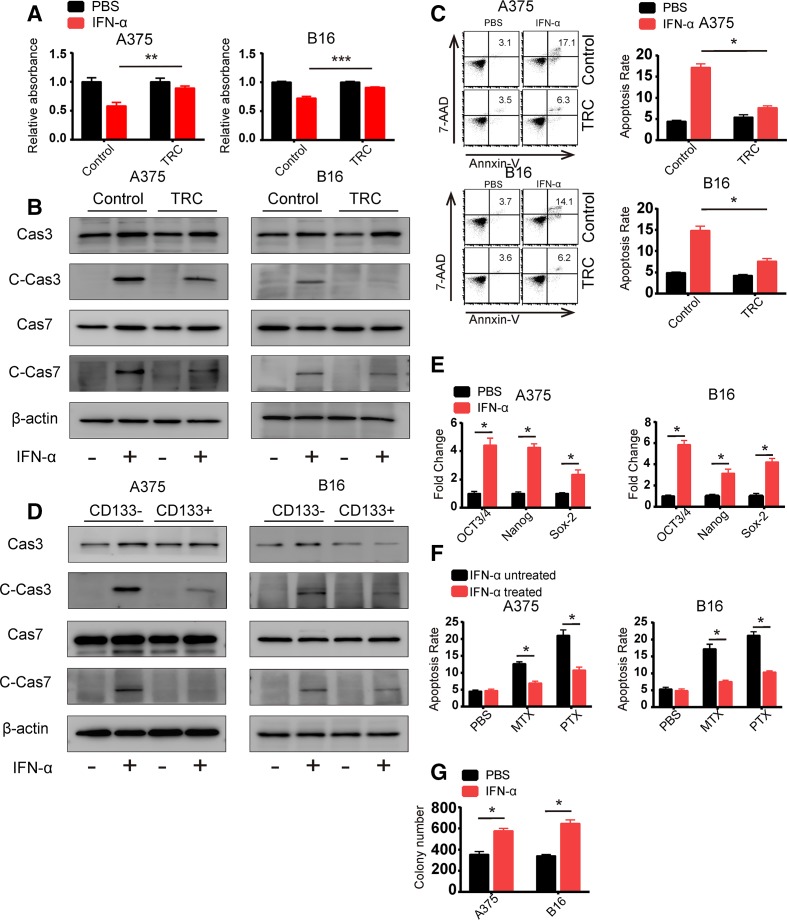
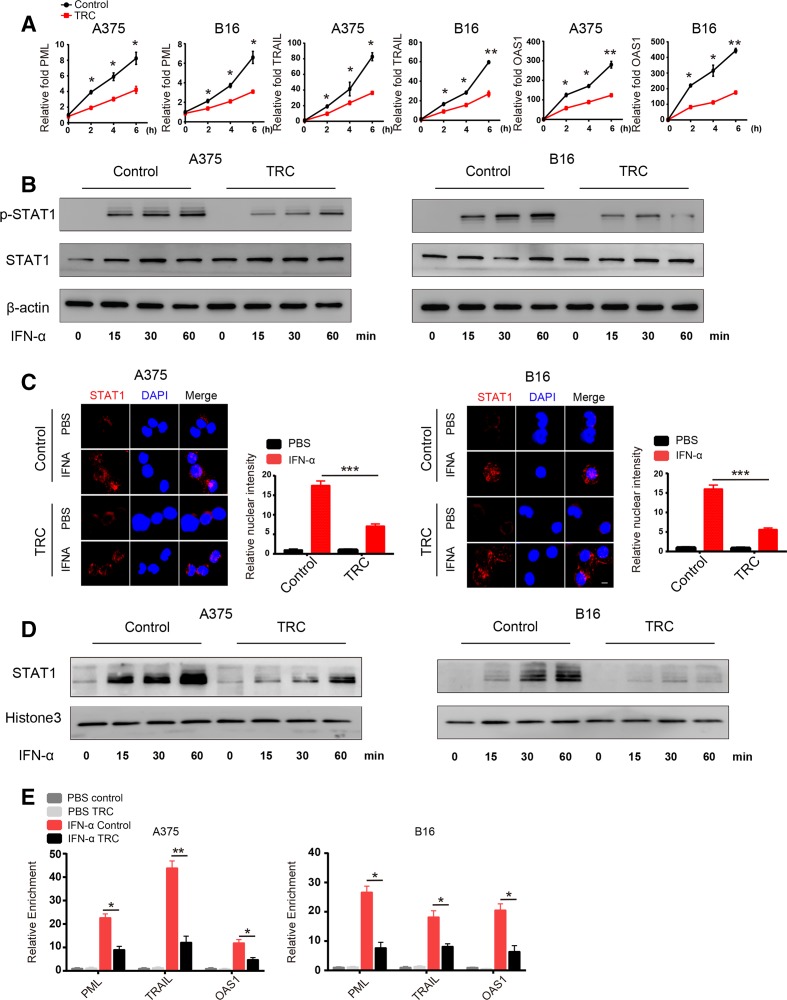
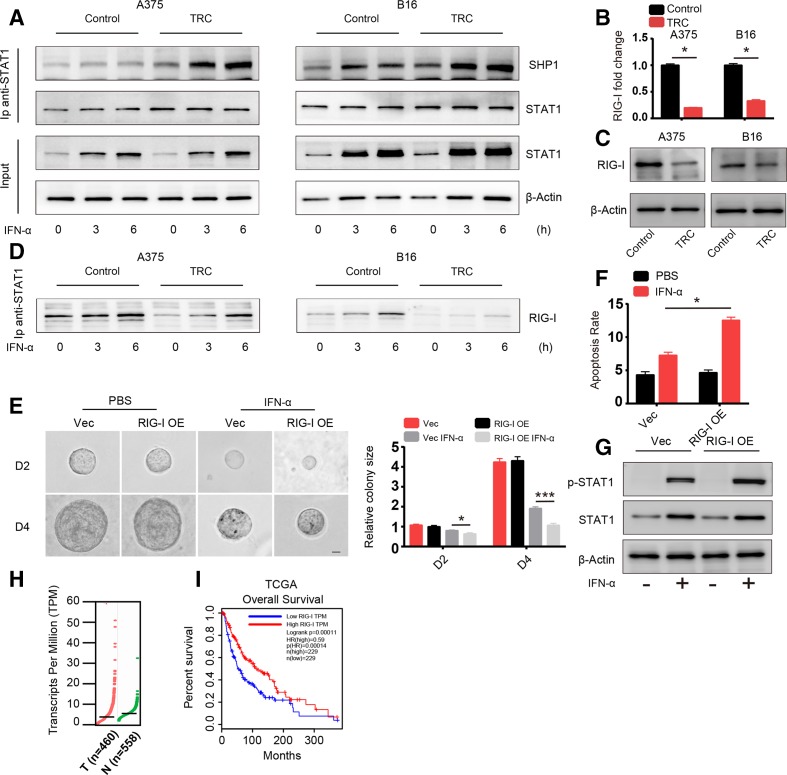
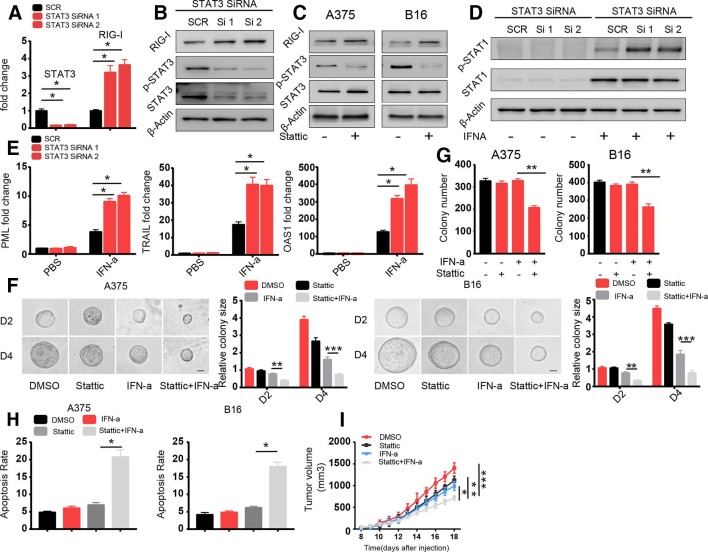
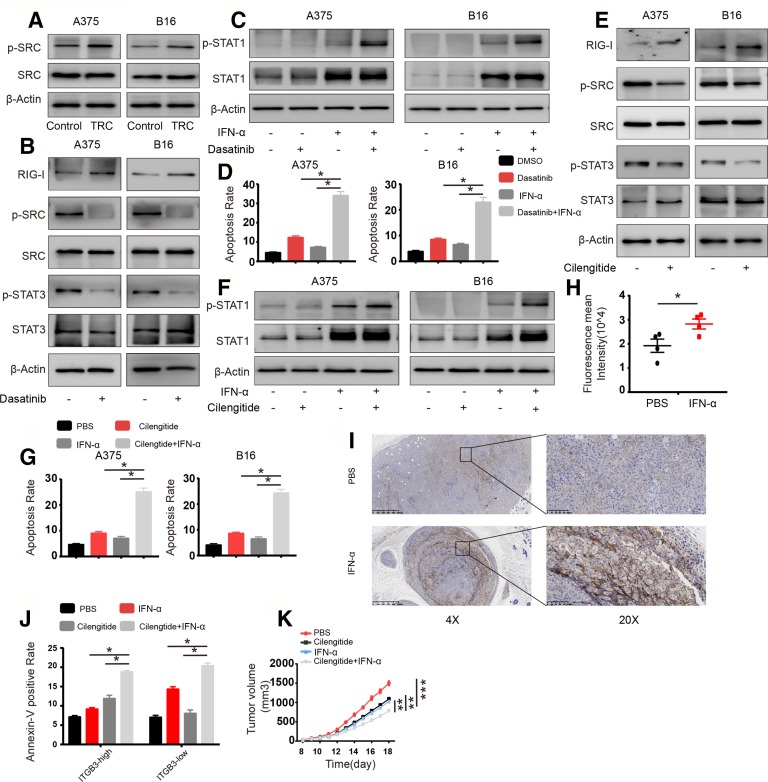
IFN-α-induced apoptosis was decreased in melanoma TRCs. Compared with conventional flask-cultured cells, IFN-α-mediated STAT1 activation was diminished in melanoma TRCs. Decreased expression of RIG-I in melanoma TRCs led to diminished activation of STAT1 via enhancing the interaction between Src homology region 2 domain-containing phosphatase-1 and STAT1. In addition, low expression levels of RIG-I correlated with poor prognosis in patients with melanoma. STAT3 was highly phosphorylated in TRCs and knockdown of STAT3 reversed the downregulation of RIG-I in TRCs. Knockdown of STAT3 resulted in STAT1 activation and increased expression of the pro-apoptosis genes in IFN-α-treated TRCs. Combined treatment of STAT3 inhibitor and IFN-α increased the apoptosis rate of TRCs. Disruption of ITGB3/c-SRC/STAT3 signaling pathway significantly elevated the efficiency of IFN-α-induced apoptosis of TRCs.
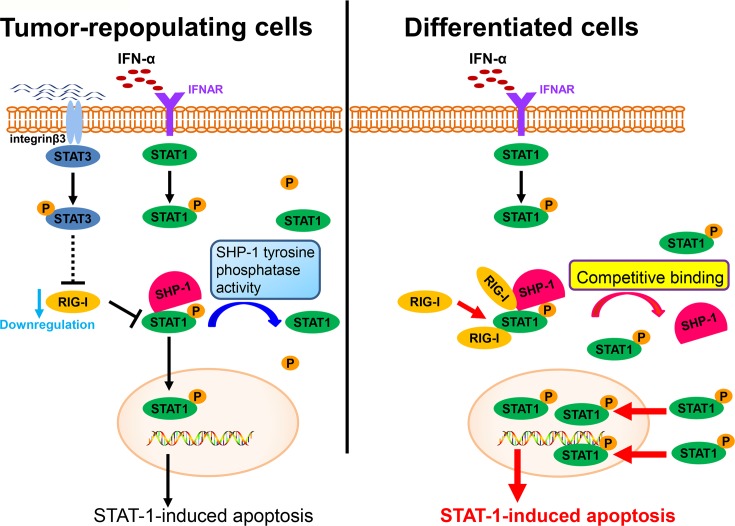
In melanoma TRCs, ITGB3-c-SRC-STAT3 pathway caused RIG-I repression and then affect STAT1 activation to cause resistance to IFN-α-induced apoptosis. RIG-I is a prognostic marker in patients with melanoma. Combination of STAT3 inhibitor and IFN-α could enhance the efficacy of melanoma treatment. Our findings may provide a new concept of combinatorial treatment for future immunotherapy.
干扰素-α(IFN-α)在宿主抗肿瘤免疫中发挥关键作用,而肿瘤细胞对 IFN-α信号通路的逃逸可导致癌症治疗过程中出现 IFN-α耐药。尽管 IFN-α与分化肿瘤细胞之间的相互作用已在分化肿瘤细胞中得到广泛研究,但对肿瘤再生细胞(TRCs)的关注却较少。
采用三维软纤维蛋白基质选择和培养高度恶性和致瘤性黑色素瘤 TRCs。在体外和体内研究了整合素β3(ITGB3)-c-SRC-STAT 信号通路在黑色素瘤 TRCs 中的调节作用。通过 qRT-PCR 和 Western blot 分析检测相关 mRNA 和蛋白表达水平。进行免疫沉淀和染色质免疫沉淀(ChIP)后 qPCR(ChIP-qPCR)检测以检测蛋白-蛋白和蛋白-DNA 相互作用。通过从癌症基因组图谱和基因表达 Omnibus 谱中获得的黑色素瘤数据集评估视黄酸诱导基因-I(RIG-I)的临床影响。
IFN-α诱导的黑色素瘤 TRCs 凋亡减少。与传统的瓶培养细胞相比,IFN-α介导的 STAT1 激活在黑色素瘤 TRCs 中减弱。黑色素瘤 TRCs 中 RIG-I 的表达降低导致 Src 同源结构域 2 区磷酸酶-1 和 STAT1 之间的相互作用增强,从而减弱了 STAT1 的激活。此外,RIG-I 的低表达与黑色素瘤患者的预后不良相关。TRCs 中 STAT3 高度磷酸化,STAT3 敲低可逆转 TRCs 中 RIG-I 的下调。STAT3 敲低导致 IFN-α处理的 TRCs 中 STAT1 激活和促凋亡基因表达增加。STAT3 抑制剂和 IFN-α的联合治疗增加了 TRCs 的凋亡率。破坏 ITGB3/c-SRC/STAT3 信号通路可显著提高 IFN-α诱导的 TRCs 凋亡效率。
在黑色素瘤 TRCs 中,ITGB3-c-SRC-STAT3 通路导致 RIG-I 抑制,进而影响 STAT1 激活,导致对 IFN-α诱导的凋亡产生耐药性。RIG-I 是黑色素瘤患者的预后标志物。STAT3 抑制剂和 IFN-α 的联合应用可增强黑色素瘤治疗的疗效。我们的研究结果可能为未来的免疫治疗提供联合治疗的新概念。