Craniofacial Anomalies and Regeneration Section, National Institute of Dental and Craniofacial Research, Bethesda, Maryland, USA.
Food Allergy Research Unit, National Institute of Allergy and Infectious Diseases, Bethesda, Maryland, USA.
J Med Genet. 2020 Oct;57(10):699-707. doi: 10.1136/jmedgenet-2019-106678. Epub 2020 Mar 8.
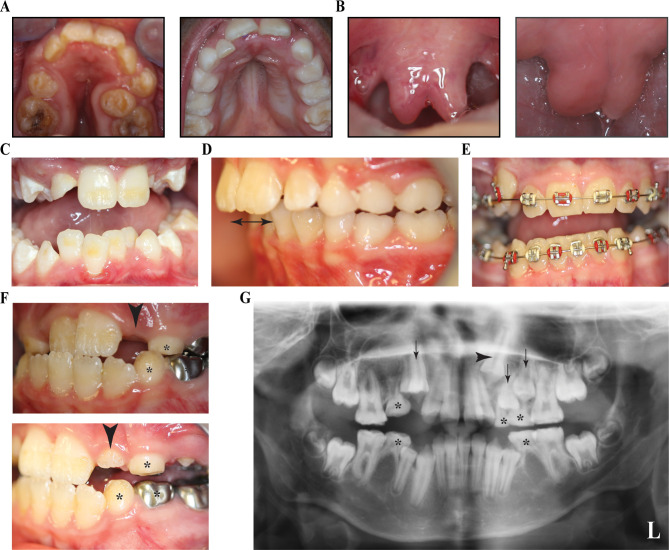
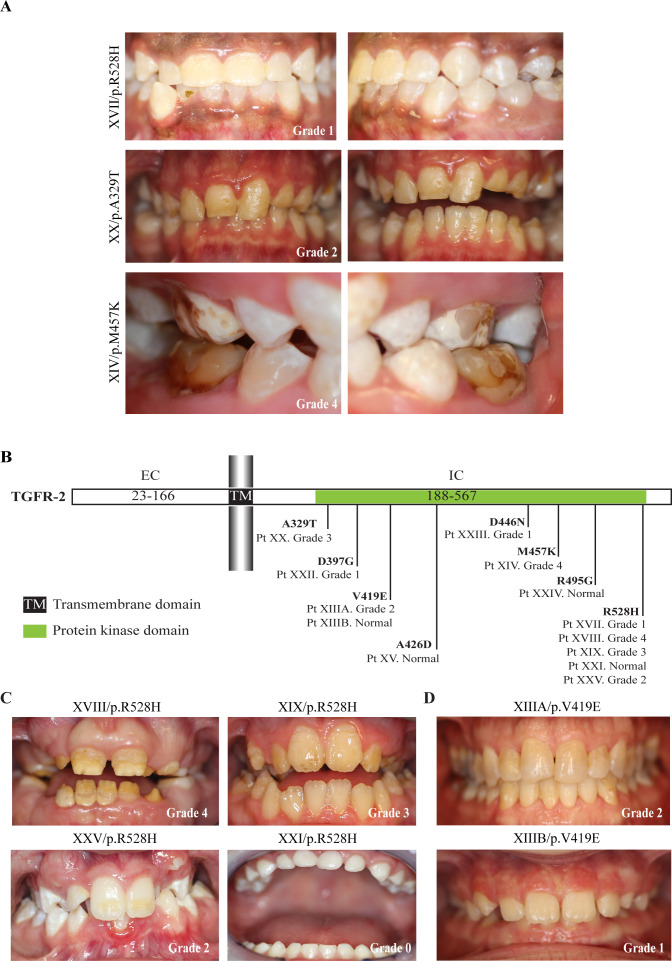
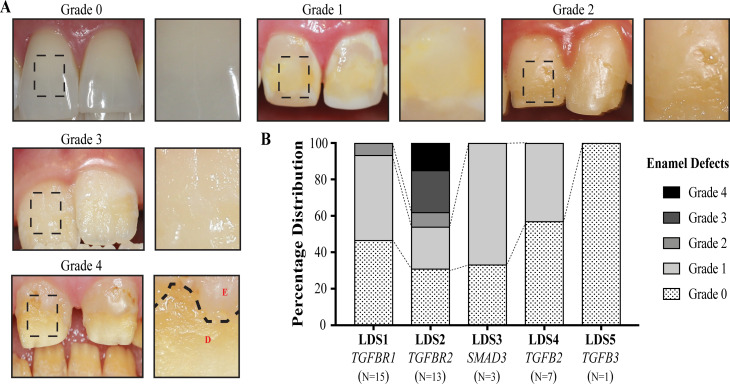
Loeys-Dietz syndrome (LDS), an autosomal dominant rare connective tissue disorder, has multisystemic manifestations, characterised by vascular tortuosity, aneurysms and craniofacial manifestations. Based on the associated gene mutations along the transforming growth factor-beta (TGF-β) pathway, LDS is presently classified into six subtypes. We present the oro-dental features of a cohort of 40 patients with LDS from five subtypes. The most common oro-dental manifestations were the presence of a high-arched and narrow palate, and enamel defects. Other common characteristics included bifid uvula, submucous cleft palate, malocclusion, dental crowding and delayed eruption of permanent teeth. Both deciduous and permanent teeth had enamel defects in some individuals. We established a grading system to measure the severity of enamel defects, and we determined that the severity of the enamel anomalies in LDS is subtype-dependent. In specific, patients with TGF-β receptor II mutations (LDS2) presented with the most severe enamel defects, followed by patients with TGF-β receptor I mutations (LDS1). LDS2 patients had higher frequency of oro-dental deformities in general. Across all five subtypes, as well as within each subtype, enamel defects exhibited incomplete penetrance and variable expression, which is not associated with the location of the gene mutations. This study describes, in detail, the oro-dental manifestations in a cohort of LDS, and we conclude that LDS2 has the most severely affected phenotype. This extensive characterisation, as well as some identified distinguishing features can significantly aid dental and medical care providers in the diagnosis and clinical management of patients with this rare connective tissue disorder.
洛伊氏迪茨综合征(LDS)是一种常染色体显性遗传的罕见结缔组织疾病,具有多系统表现,其特征为血管迂曲、动脉瘤和颅面表现。根据相关基因在转化生长因子-β(TGF-β)通路中的突变,LDS 目前分为六个亚型。我们报告了五个亚型的 40 例 LDS 患者的口腔牙科特征。最常见的口腔牙科表现是高拱形和狭窄的腭,以及牙釉质缺陷。其他常见特征包括悬雍垂分叉、黏膜下腭裂、错牙合、牙齿拥挤和恒牙迟萌。在一些个体中,乳牙和恒牙都有牙釉质缺陷。我们建立了一个分级系统来衡量牙釉质缺陷的严重程度,我们确定 LDS 中牙釉质异常的严重程度与亚型有关。具体来说,TGF-β受体 II 突变(LDS2)患者的牙釉质缺陷最严重,其次是 TGF-β受体 I 突变(LDS1)患者。LDS2 患者的口腔牙科畸形总体上更为常见。在所有五个亚型中,以及在每个亚型内,牙釉质缺陷表现出不完全外显和可变表达,与基因突变的位置无关。本研究详细描述了 LDS 患者的口腔牙科表现,我们得出结论,LDS2 具有最严重的表型。这种广泛的特征描述以及一些确定的鉴别特征可以显著帮助口腔和医疗保健提供者诊断和临床管理这种罕见的结缔组织疾病。