Zhang Yichen, Wu Jing, Chen Yingyao, Shi Lizheng
Department of Health Policy and Management, Tulane University, New Orleans, LA, 70112, USA.
School of Pharmaceutical Science and Technology, Tianjin University, 300072, Tianjin, China.
Diabetes Ther. 2020 Apr;11(4):939-950. doi: 10.1007/s13300-020-00788-z. Epub 2020 Mar 9.
Patients with type 2 diabetes have lower quality of life, which is further impaired by diabetes complications and comorbidities. This study aims to evaluate the impact of diabetes complications and comorbidities on EuroQol Five-Dimension Three-Level (EQ-5D-3L) scores among patients with type 2 diabetes with ongoing oral drug treatments in China.
This retrospective cross-sectional analysis included 9570 patients with type 2 diabetes on oral drug treatments, who were enrolled from 75 hospitals in nine cities in China. Patient characteristics, including demographic data, health conditions, oral treatment history, and health insurance coverage, were collected through self-reported questionnaires. Health utility was measured by the EQ-5D-3L scale in the questionnaire and a Chinese version of the EQ-5D-3L scoring weights was applied in the analysis. The associations between complications and health utility were assessed using linear regression.
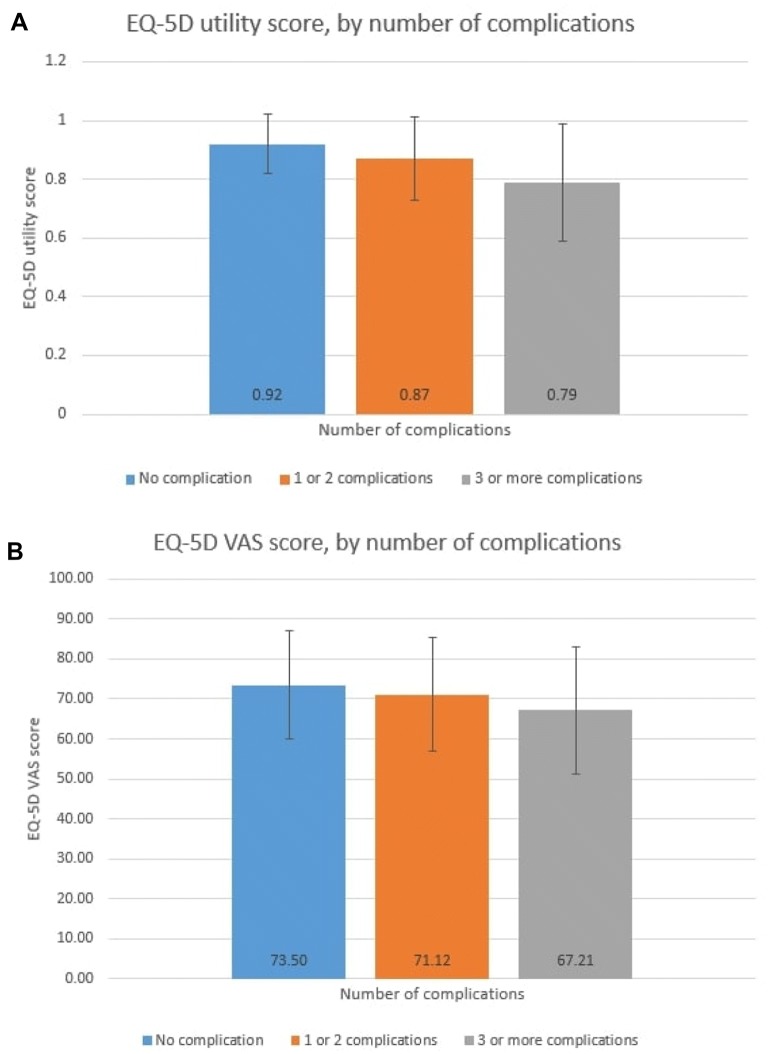
A total of 7081 patients with complete survey data were included in the analytic sample; 3479 (49.13%) patients were female. The mean age was 59.6 years old, with a standard deviation (SD) of 12.64. The average duration with type 2 diabetes was 7.91 (SD = 6.22) years. A total of 5189 (73.28%) patients reported complications. Hypertension (51.25%) and hyperlipidemia (28.90%) were the most common complications. Other complications reported by patients included cardiovascular disease, stroke, retinopathy, nephropathy, diabetic foot, and hypoglycemia. On average, each patient had 1.54 complications. All complications and comorbidities decreased the EQ-5D-3L score. Among patients with complications, the worst effect on EQ-5D-3L score was caused by diabetic foot, decreasing by 0.118 (p < 0.001), followed by stroke (decreasing by 0.101, p < 0.001) and nephropathy (decreasing by 0.058, p < 0.001).
The diabetes complications and comorbidities among patients with type 2 diabetes were associated with poor health utility scores, especially for those with diabetic foot, stroke, and nephropathy.
2型糖尿病患者的生活质量较低,而糖尿病并发症和合并症会进一步损害其生活质量。本研究旨在评估在中国接受口服药物治疗的2型糖尿病患者中,糖尿病并发症和合并症对欧洲五维度健康量表三级(EQ-5D-3L)评分的影响。
本回顾性横断面分析纳入了9570例接受口服药物治疗的2型糖尿病患者,这些患者来自中国9个城市的75家医院。通过自填问卷收集患者的特征,包括人口统计学数据、健康状况、口服治疗史和医疗保险覆盖情况。在问卷中使用EQ-5D-3L量表测量健康效用,并在分析中应用中文版的EQ-5D-3L评分权重。使用线性回归评估并发症与健康效用之间的关联。
分析样本中纳入了7081例具有完整调查数据的患者;3479例(49.13%)患者为女性。平均年龄为59.6岁,标准差为12.64。2型糖尿病的平均病程为(7.91)(标准差 = 6.22)年。共有5189例(73.28%)患者报告有并发症。高血压(51.25%)和高脂血症(28.90%)是最常见的并发症。患者报告的其他并发症包括心血管疾病、中风、视网膜病变、肾病、糖尿病足和低血糖。平均而言,每位患者有1.54种并发症。所有并发症和合并症均降低了EQ-5D-3L评分。在有并发症的患者中,对EQ-5D-3L评分影响最严重的是糖尿病足,降低了0.118((p < 0.001)),其次是中风(降低0.101,(p < 0.001))和肾病(降低0.058,(p < 0.001))。
2型糖尿病患者的糖尿病并发症和合并症与健康效用评分较低相关,尤其是糖尿病足、中风和肾病患者。