Liu Yong, Yang Kun, Hu Xinhua, Xiao Chaoyong, Rao Jiang, Li Zonghong, Liu Dongming, Zou Yuanjie, Chen Jiu, Liu Hongyi
Department of Neurosurgery, The Affiliated Brain Hospital of Nanjing Medical University, Nanjing, China.
Institute of Brain Functional Imaging, Nanjing Medical University, Nanjing, China.
Front Hum Neurosci. 2020 Feb 21;14:23. doi: 10.3389/fnhum.2020.00023. eCollection 2020.
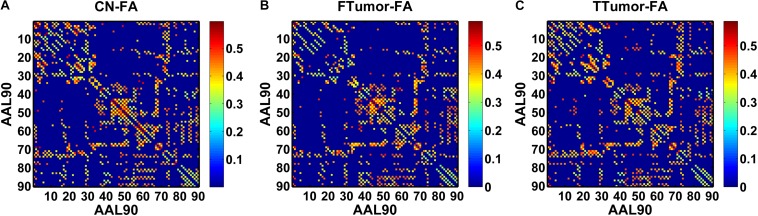
Gliomas are widely considered to be related to the altered topological organization of functional networks before operations. Tumors are usually thought to cause multimodal cognitive impairments. The structure is thought to form the basics of function, and the aim of this study was to reveal the rich-club organization and topological patterns of white matter (WM) structural networks associated with cognitive impairments in patients with frontal and temporal gliomas.
Graph theory approaches were utilized to reveal the global and regional topological organization and rich-club organization of WM structural networks of 14 controls (CN), 13 frontal tumors (FTumor), and 18 temporal tumors (TTumor). Linear regression was used to assess the relationship between cognitive performances and altered topological parameters.
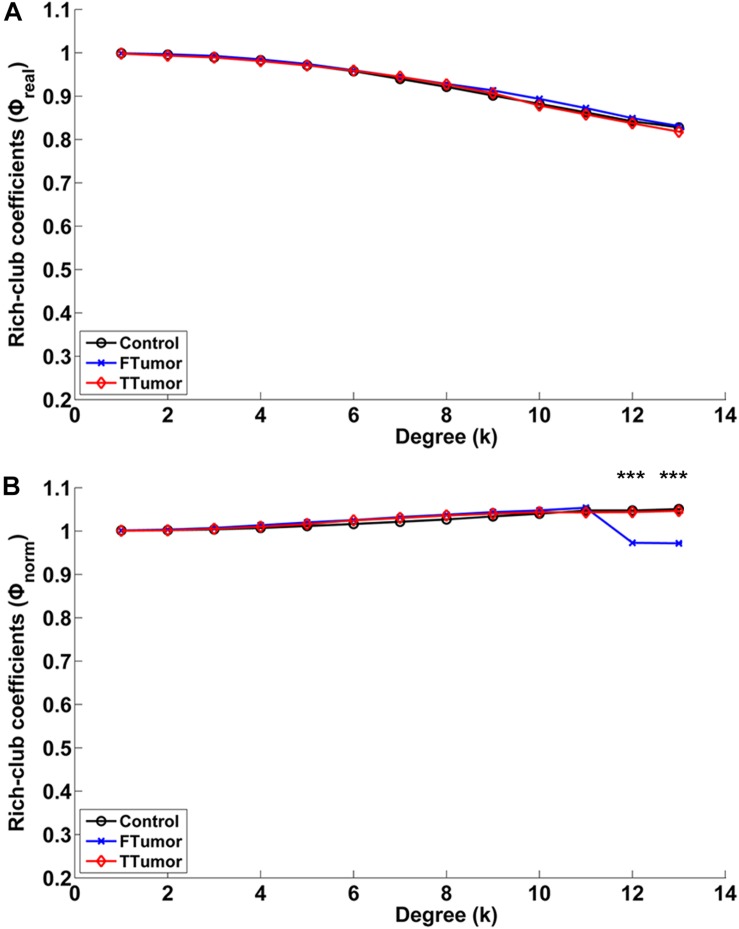
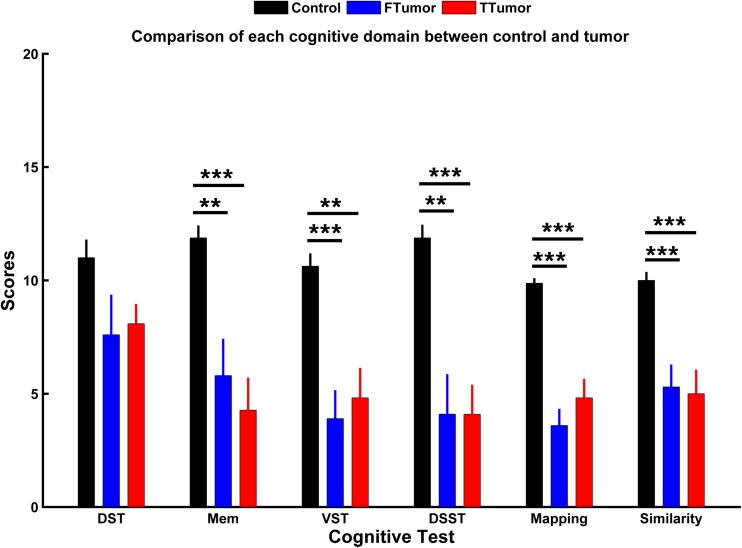
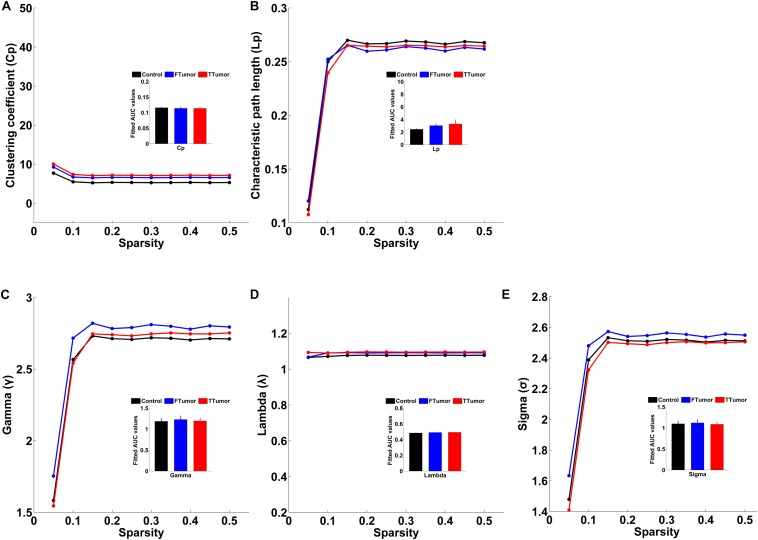
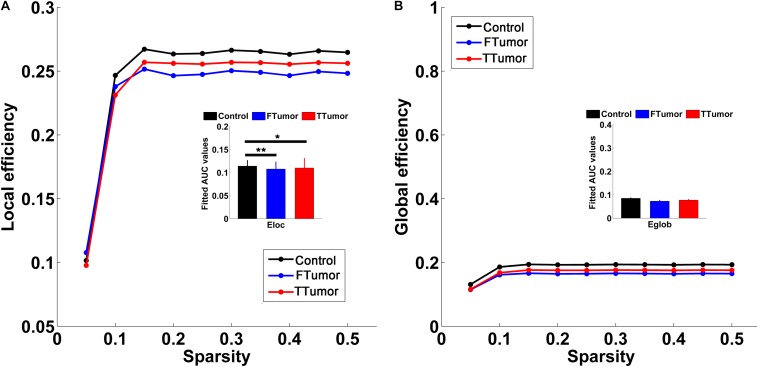
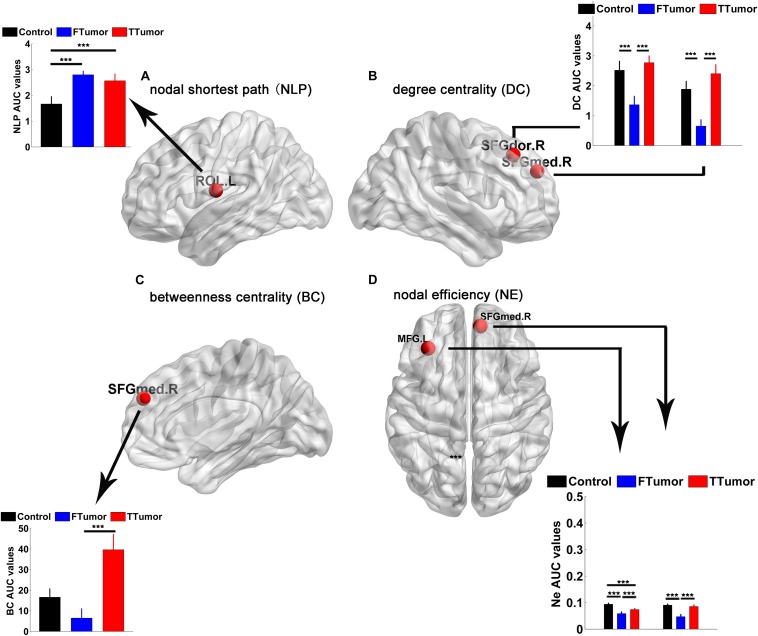
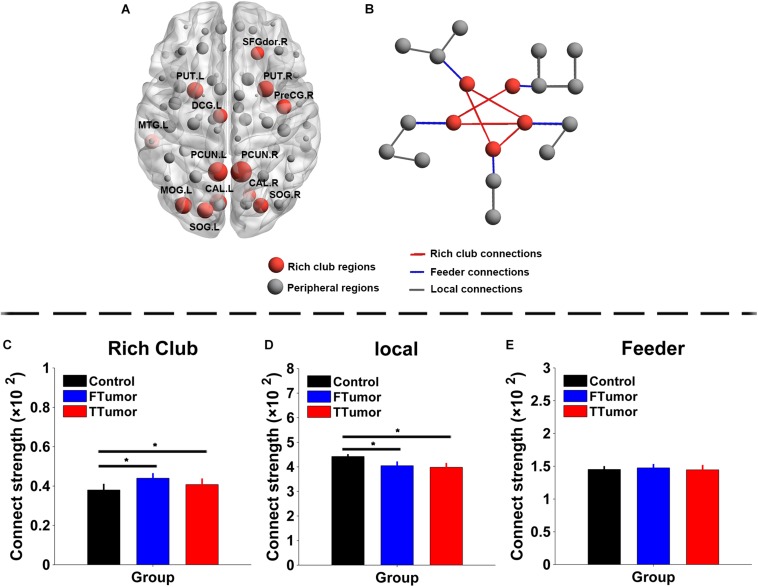
When compared with CN, both FTumor and TTumor showed no alterations in small-world properties and global network efficiency, but instead showed altered local network efficiency. Second, FTumor and TTumor patients showed similar deficits in the nodal shortest path in the left rolandic operculum and degree centrality (DC) of the right dorsolateral and medial superior frontal gyrus (SFGmed). Third, compared to FTumor patients, TTumor patients showed a significantly higher DC in the right dorsolateral and SFGmed, a higher level of betweenness in the right SFGmed, and higher nodal efficiency in the left middle frontal gyrus and right SFGmed. Finally, rich-club organization was disrupted, with increased structural connectivity among rich-club nodes and reduced structural connectivity among peripheral nodes in FTumor and TTumor patients. Altered local efficiency in TTumor correlated with memory function, while altered local efficiency in FTumor correlated with the information processing speed.
Both FTumor and TTumor presented an intact global topology and altered regional topology related to cognitive impairment and may also share the convergent and divergent regional topological organization of WM structural networks. This suggested that a compensatory mechanism plays a key role in global topology formation in both FTumor and TTumor patients, and as such, development of a structural connectome for patients with brain tumors would be an invaluable medical resource and allow clinicians to make comprehensive preoperative planning.
胶质瘤被广泛认为与手术前功能网络拓扑结构的改变有关。肿瘤通常被认为会导致多模式认知障碍。结构被认为是功能的基础,本研究的目的是揭示额叶和颞叶胶质瘤患者与认知障碍相关的白质(WM)结构网络的富俱乐部组织和拓扑模式。
采用图论方法揭示14名对照者(CN)、13名额叶肿瘤患者(FTumor)和18名颞叶肿瘤患者(TTumor)的WM结构网络的全局和区域拓扑组织以及富俱乐部组织。使用线性回归评估认知表现与改变的拓扑参数之间的关系。
与CN相比,FTumor和TTumor在小世界属性和全局网络效率方面均无改变,但局部网络效率发生了改变。其次,FTumor和TTumor患者在左侧罗兰岛盖的节点最短路径以及右侧背外侧和额上回内侧(SFGmed)的度中心性(DC)方面表现出相似的缺陷。第三,与FTumor患者相比,TTumor患者在右侧背外侧和SFGmed的DC显著更高,在右侧SFGmed的介数水平更高,在左侧额中回和右侧SFGmed的节点效率更高。最后,富俱乐部组织被破坏,FTumor和TTumor患者的富俱乐部节点之间的结构连通性增加,而外围节点之间的结构连通性降低。TTumor中局部效率的改变与记忆功能相关,而FTumor中局部效率的改变与信息处理速度相关。
FTumor和TTumor均呈现完整的全局拓扑结构以及与认知障碍相关的区域拓扑结构改变,并且可能还共享WM结构网络的趋同和趋异区域拓扑组织。这表明补偿机制在FTumor和TTumor患者的全局拓扑结构形成中起关键作用,因此,为脑肿瘤患者开发结构连接组将是一种宝贵的医学资源,并使临床医生能够进行全面的术前规划。