Machner Björn, Lencer Marie C, Möller Lisa, von der Gablentz Janina, Heide Wolfgang, Helmchen Christoph, Sprenger Andreas
Department of Neurology, University of Lübeck, Lübeck, Germany.
Department of Psychology II, University of Lübeck, Lübeck, Germany.
Front Hum Neurosci. 2020 Feb 20;14:41. doi: 10.3389/fnhum.2020.00041. eCollection 2020.
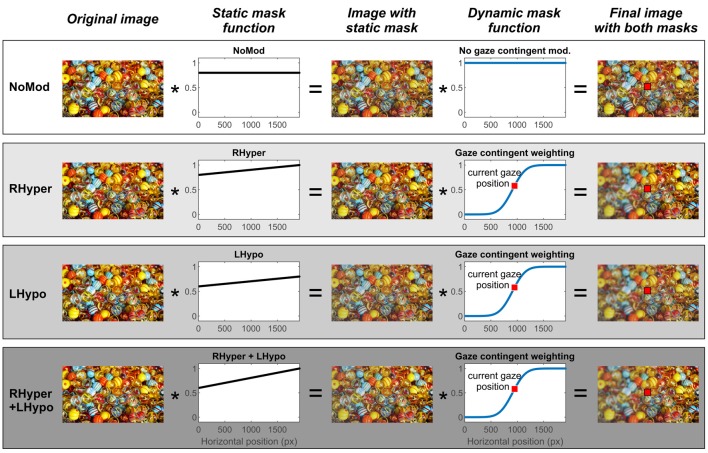
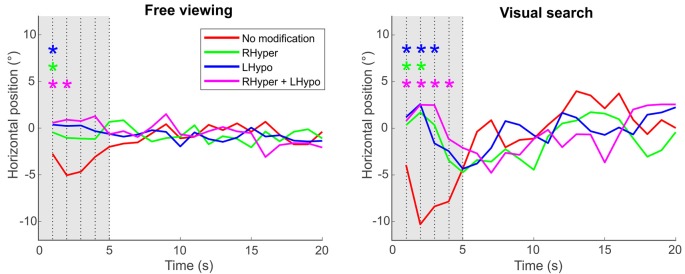
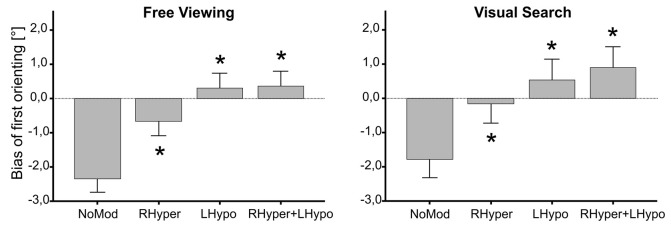
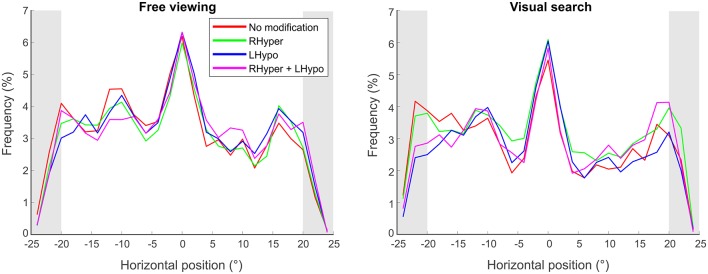
Selective spatial attention is a crucial cognitive process that guides us to the behaviorally relevant objects in a complex visual world by using exploratory eye movements. The spatial location of objects, their (bottom-up) saliency and (top-down) relevance is assumed to be encoded in one "attentional priority map" in the brain, using different egocentric (eye-, head- and trunk-centered) spatial reference frames. In patients with hemispatial neglect, this map is supposed to be imbalanced, leading to a spatially biased exploration of the visual environment. As a proof of concept, we altered the visual saliency (and thereby attentional priority) of objects in a naturalistic scene along a left-right spatial gradient and investigated whether this can induce a bias in the exploratory eye movements of healthy humans ( = 28; all right-handed; mean age: 23 years, range 19-48). We developed a computerized mask, using high-end "gaze-contingent display (GCD)" technology, that immediately and continuously reduced the saliency of objects on the left-"left" with respect to the head (body-centered) and the current position on the retina (eye-centered). In both experimental conditions, task-free viewing and goal-driven visual search, this modification induced a mild but significant bias in visual exploration similar to hemispatial neglect. Accordingly, global eye movement parameters changed (reduced number and increased duration of fixations) and the spatial distribution of fixations indicated an attentional bias towards the right (rightward shift of first orienting, fixations favoring the scene's outmost right over left). Our results support the concept of an attentional priority map in the brain as an interface between perception and behavior and as one pathophysiological ground of hemispatial neglect.
选择性空间注意是一种关键的认知过程,它通过探索性眼动引导我们在复杂的视觉世界中关注与行为相关的物体。物体的空间位置、它们的(自下而上的)显著性和(自上而下的)相关性被假定在大脑中的一个“注意优先级地图”中进行编码,使用不同的以自我为中心(以眼睛、头部和躯干为中心)的空间参考框架。在半侧空间忽视患者中,这个地图被认为是不平衡的,导致对视觉环境的空间偏向性探索。作为概念验证,我们沿着左右空间梯度改变了自然场景中物体的视觉显著性(从而改变了注意优先级),并研究了这是否会在健康人类(n = 28;均为右利手;平均年龄:23岁,范围19 - 48岁)的探索性眼动中诱发偏向。我们使用高端的“注视相关显示(GCD)”技术开发了一种计算机化掩模,它能立即并持续降低相对于头部(以身体为中心)和视网膜上当前位置(以眼睛为中心)左侧物体的显著性。在两种实验条件下,即无任务观看和目标驱动的视觉搜索,这种改变诱发了一种类似于半侧空间忽视的轻微但显著的视觉探索偏向。相应地,全局眼动参数发生了变化(注视次数减少,注视持续时间增加),注视的空间分布表明存在向右的注意偏向(首次定向的向右偏移,注视更倾向于场景最右侧而非左侧)。我们的结果支持了大脑中注意优先级地图这一概念,它是感知与行为之间的接口,也是半侧空间忽视的一种病理生理基础。