Reding Kerryn W, Brubaker Peter, D'Agostino Ralph, Kitzman Dalane W, Nicklas Barbara, Langford Dale, Grodesky Michael, Hundley W Gregory
1Department of Biobehavioral Nursing and Health Informatics, University of Washington School of Nursing, Seattle, WA USA.
9Department of Cancer Prevention, Public Health Sciences, Fred Hutch Cancer Research Center, Seattle, WA USA.
Cardiooncology. 2019 May 3;5:3. doi: 10.1186/s40959-019-0038-5. eCollection 2019.
Cancer survivors experience on average a 20% reduction in peak exercise capacity (VO) post-cancer treatment. Intermuscular fat (IMF) is a strong predictor of reduced exercise capacity in heart failure (HF) patients; however it is unknown whether increased IMF is related to reduced VO in cancer survivors.
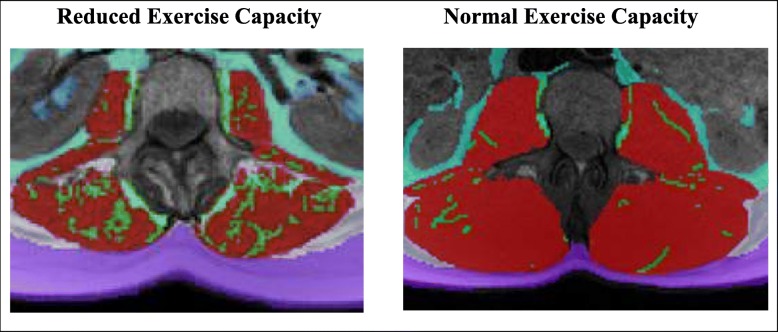
Twenty eight individuals: 14 cancer survivors > 12-months post-cancer treatment and 14 individuals without cancer were matched on age, gender, and body mass index (BMI). Participants underwent magnetic resonance imaging (MRI) assessments of IMF within the paraspinal muscles, VO and exercise-associated measures of left ventricular ejection fraction (LVEF). Blinded analyses were performed. Associations between the ratio of IMF to skeletal muscle (SM) were estimated using Pearson's partial correlation coefficients. Individuals with cancer and non-cancer comparators were of similar age (54 ± 17 versus 54 ± 15 years; = 1.0), gender (5 men and 9 women, both groups), and BMI (27 ± 4 versus 26 ± 4; = 0.57). Peak VO was 22% lower in cancer survivors versus non-cancer comparators (26.9 vs 34.3 ml/kg/min; = 0.005), and was correlated with IMF:SM in both cancer survivors and non-cancer individuals after accounting for exercise-associated LVEF, resting LVEF, BMI, other body fat depots, and cardiovascular disease (CVD) co-morbidities ( < 0.001 to 0.08 for all adjusted correlations).
Among cancer survivors that previously received anthracyclines, increased intermuscular fat is associated with reduced VO even after accounting for exercise-associated cardiac function. This suggests IMF is important in the development of exercise intolerance, an outcome experienced by a large number of cancer survivors.
癌症幸存者在癌症治疗后,其峰值运动能力(VO)平均下降20%。肌间脂肪(IMF)是心力衰竭(HF)患者运动能力下降的有力预测指标;然而,目前尚不清楚癌症幸存者中IMF增加是否与VO降低有关。
选取28名个体:14名癌症幸存者,在癌症治疗后超过12个月,以及14名无癌症个体,根据年龄、性别和体重指数(BMI)进行匹配。参与者接受了脊柱旁肌肉内IMF的磁共振成像(MRI)评估、VO以及左心室射血分数(LVEF)的运动相关测量。进行了盲法分析。使用Pearson偏相关系数估计IMF与骨骼肌(SM)的比例之间的关联。癌症患者和非癌症对照者在年龄(54±17岁与54±15岁;P = 1.0)、性别(两组均为5名男性和9名女性)和BMI(27±4与26±4;P = 0.57)方面相似。癌症幸存者的峰值VO比非癌症对照者低22%(26.9对34.3 ml/kg/min;P = 0.005),并且在考虑运动相关的LVEF、静息LVEF、BMI、其他体脂储存和心血管疾病(CVD)合并症后,癌症幸存者和非癌症个体的VO均与IMF:SM相关(所有调整后的相关性P < 0.001至0.08)。
在先前接受过蒽环类药物治疗的癌症幸存者中,即使考虑了运动相关的心脏功能,肌间脂肪增加仍与VO降低有关。这表明IMF在运动不耐受的发生中起重要作用,而运动不耐受是大量癌症幸存者所经历的结果。