Reding Kerryn W, O'Connell Nathaniel S, D'Agostino Ralph B, Hundley William, Lucas Alexander R, Ladd Amy C, Jordan Jennifer H, Heiston Emily M, Ge Yaorong, Hundley W Gregory
Biobehavioral Nursing and Health Informatics, University of Washington School of Nursing, Seattle, USA.
Fred Hutchinson Cancer Research Center Division of Public Health Sciences, Seattle, USA.
Cardiooncology. 2021 May 8;7(1):16. doi: 10.1186/s40959-021-00102-1.
Approximately 20% of cancer survivors treated with chemotherapy experience worsening heart failure (HF) symptoms post-cancer treatment. While research has predominantly investigated the role of cardiotoxic treatments, much less attention has focused on other risk factors, such as adiposity. However, emerging data in cancer survivors indicates that adiposity may also impact a variety of cardiovascular outcomes.
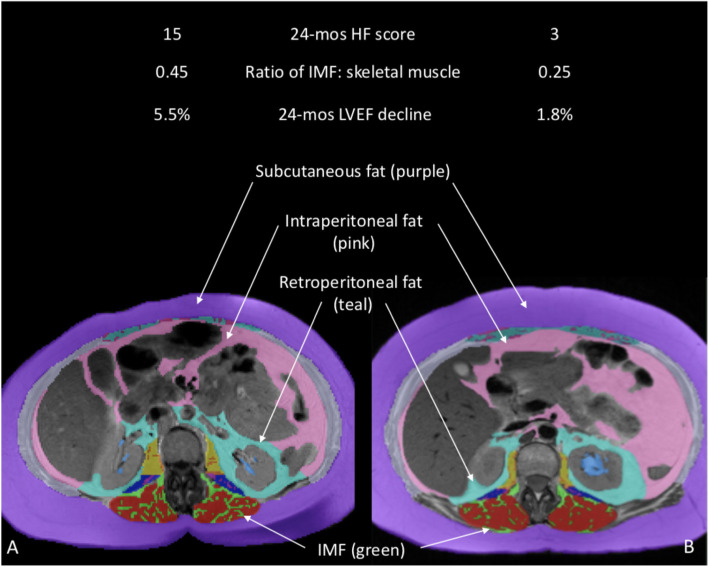
In a prospective study of 62 patients diagnosed with cancer followed for 24 months from cancer diagnosis through to survivorship (post-cancer treatment), we ascertained baseline fat depots including intermuscular fat (IMF) of the erector spinae muscles; and pre- and post-cancer treatment left ventricular ejection fraction (LVEF) and HF symptoms at baseline and 24-months, respectively. Linear regression was used to model independent variables in relation to HF symptoms at 24-months.
Baseline IMF and LVEF change over 24-months significantly interacted to predict HF score at 24-months. The highest HF symptom score was observed for participants who experienced high IMF at baseline and a high decline in LVEF over 24-months (HF score = 11.0) versus all other categories of baseline IMF and LVEF change.
Together IMF and LVEF decline may play an important role in the worsening of HF symptoms in cancer survivors. The finding that IMF at cancer diagnosis led to elevated HF scores post-treatment suggests that IMF may be a potential target for intervention studies.
接受化疗的癌症幸存者中,约20%在癌症治疗后出现心力衰竭(HF)症状恶化。虽然研究主要调查了心脏毒性治疗的作用,但对其他风险因素,如肥胖,关注较少。然而,癌症幸存者的新数据表明,肥胖也可能影响多种心血管结局。
在一项对62例确诊癌症患者的前瞻性研究中,从癌症诊断到生存(癌症治疗后)随访24个月,我们确定了基线脂肪储存,包括竖脊肌的肌间脂肪(IMF);以及癌症治疗前后的左心室射血分数(LVEF)和基线及24个月时的HF症状。采用线性回归对与24个月时HF症状相关的自变量进行建模。
基线IMF和24个月内LVEF的变化显著相互作用,以预测24个月时的HF评分。与基线IMF和LVEF变化的所有其他类别相比,在基线时IMF较高且24个月内LVEF下降较高的参与者观察到最高的HF症状评分(HF评分=11.0)。
IMF和LVEF下降共同可能在癌症幸存者HF症状恶化中起重要作用。癌症诊断时的IMF导致治疗后HF评分升高这一发现表明,IMF可能是干预研究的一个潜在靶点。